Thoughts about Stuff

Do you believe in magic?

I do… sort of.

Not a magic than can be controlled or manipulated, or one that demands slavish devotion or servitude.

But I believe that there is mystery in the world. There’s a lot that is incomprehensible, and while I’m not saying that I think we shouldn’t try to understand it, I think it’s okay to appreciate that it’s a mystery right now, without feeling like you need to assign a logical explanation to it.

Sometimes we can experience magic that is explainable: baking, for example, or airplanes, or bumblebees, or studying something so hard you can’t see straight, giving up in frustration and then going to sleep, and then waking up to discover that you do understand. I mean… wow. Knowing why some things happen doesn’t take away from their magic — it is possible to be in awe of things you can explain or understand.

Artist Thomas Dambo creates giant trolls from reclaimed materials and places them in whimsical settings. This photo is of Jakob Two Trees, in Issaquah, WA. Jakob is real in some profound ways, and I suspect I would weep in his presence while I admire the work it took to create him. At the very least I would want to sit at the base of one of his trees and rest for a while. I think there’s some pretty potent magic there.

Image from thomasdambo.com.

Part of what made last year so difficult was that it was necessary to keep a very tight focus, even when life circumstances were really distracting (and infuriating, and sad, and chaotic). I did it, but I’m not better for it. I haven’t discovered inner strength, or the power of discipline; I am burned out.

In search of a little bit of magic, I participated in a new-to-me ritual: Rauhnächte (here’s a lovely explanation of it from Anja Poehlmann). I wrote 13 intentions (not resolutions) on slips of paper, and then every day for 12 days — starting at the solstice — I burned one of the slips of paper (outside, in a container that isn’t flammable). The idea, apparently, is that by writing your intentions and then burning them, you internalize them and then release most of them. By keeping one, you’re able to direct your attention and effort toward it.

I’ve seen a couple of different explanations for the timing of this ritual: solstice to Jan. 2 (which I did), or the span from Christmas to Epiphany (Dec. 25 – Jan. 6). I didn’t follow all of the “rules.” I did not burn every one of them after sunset (some days because I was busy or forgot, and sometimes because there was weather I didn’t want to be outside in). And as I was writing the intentions, I chose the final intention to keep, because it is deeply personal and important, and I want to focus primarily on that one.

Maybe these deviations invalidated the exercise, maybe they didn’t — it wouldn’t really matter to me if they did. My goal was to acknowledge that magic is there, and in a very small way, align myself with it.
Studenting · The Personal Project · Thoughts about Stuff

The Bar for 2026 is Low

In 2025, I completed almost half a little more than a third of the units of my graduate degree. I have one calendar year left, with one class in the spring, one in the summer (ugh), and my ePortfolio in the fall. When all is said and done, this will have been a four-year endeavor. (This is a terminal professional degree — 43 units instead of 29-32 — that is designed for working adults, so we have seven years to complete it.) This year I did some instructional design and data visualization, studied copyright law and cultural competence, and did a refresher HTML/CSS course and an introductory PHP and Javascript course. The content of my schoolwork was fascinating (a lot of reading, writing, and coding). I learned a lot, and got a glimpse of how much I still don’t know. I met a lot of interesting classmates. And I performed well (gold star for me).

Both of my in-laws had significant medical challenges this year, starting in May and running through December, when my father-in-law died from complications from lung cancer. My mother-in-law’s situation is ongoing and will hopefully resolve — positively — soon… knock wood. We do not live close to either of my in-laws, so in addition to all of the other accompanying issues, my husband travelled a lot in 2025. As challenging as my year has been, multiply it by infinity and you *might* approach the level of challenge my fabulous-and-talented husband faced in 2025.

My contribution to all of this: I kept the household running (taxes and bills paid, animals fed and cared for, laundry done, minor repairs managed). Of course, it was not the only thing, not the main thing, and not the most important thing. But it was a thing.

The upshot: 2025 was a lot. Much of it was unavoidable, but there were some painful realizations that I need to do a better job at managing the things I can control. My limitations, in terms of attention span, time management, and real life, are becoming more apparent the older I get; my willingness to ignore them is increasingly problematic. 0/10, do not recommend.

Sure, many things did get done, like school, keeping the house going, and volunteering ~180 hours at the OLC. In the plus column, I added another walk with Lu every day (we do two now, and she gets an after-dinner perambulation with fabulous-and-talented husband), which is good for both of us.

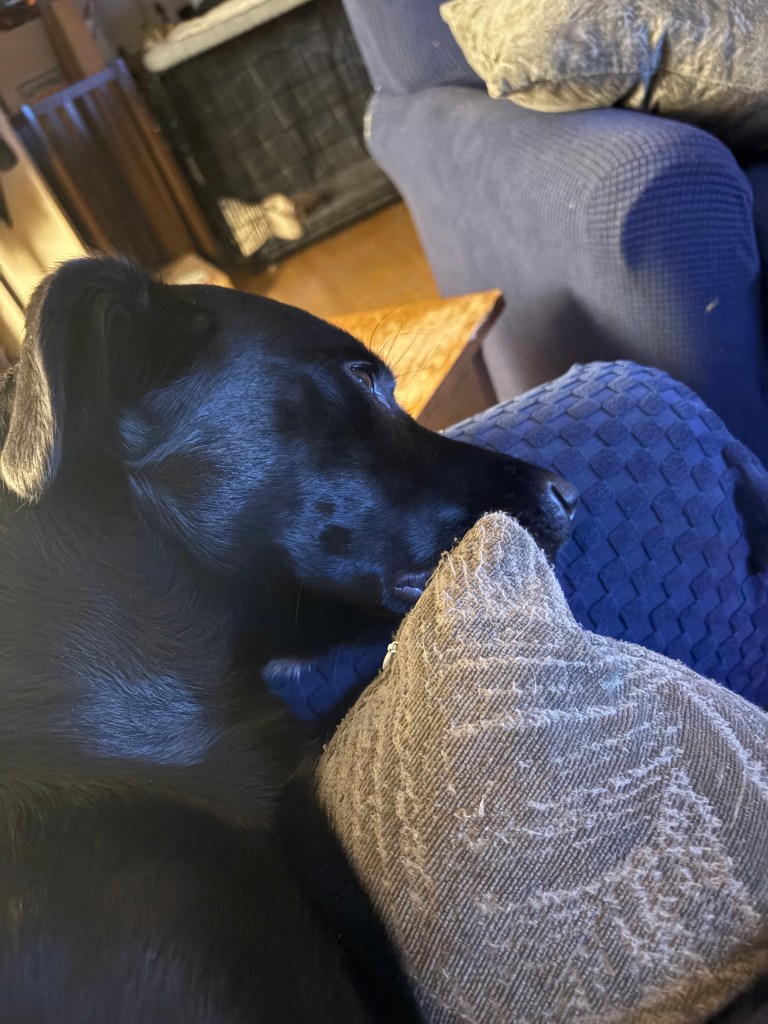
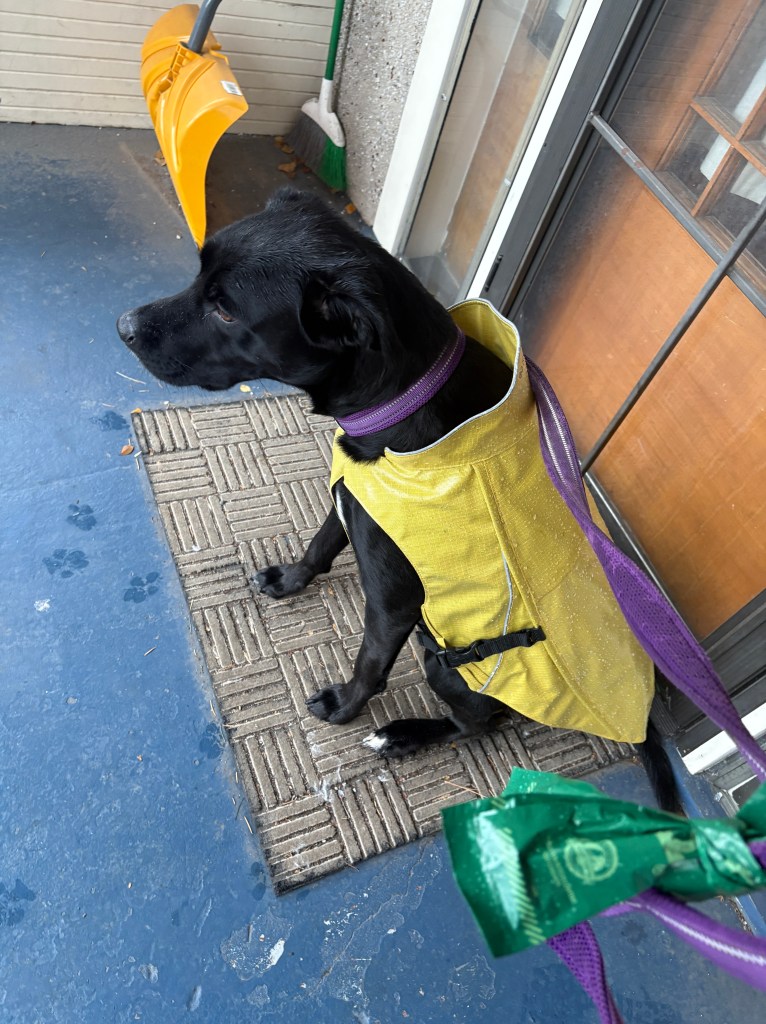
No, she does not like the raincoat, but she likes to walk (and it does help keep her body dry).

While I got a lot done, many things fell by the wayside: nature journaling, writing, my social life, cooking/baking, any kind of future career planning. These things are important, even if they (rightly) aren’t top priorities. I could say something about the difference between unscheduled time and availability, but the truth is that this year it would not have mattered; I didn’t have as much unscheduled time (that was my choice), and much of the rest of my time was used to attend to other pressing matters (that were out of my control).

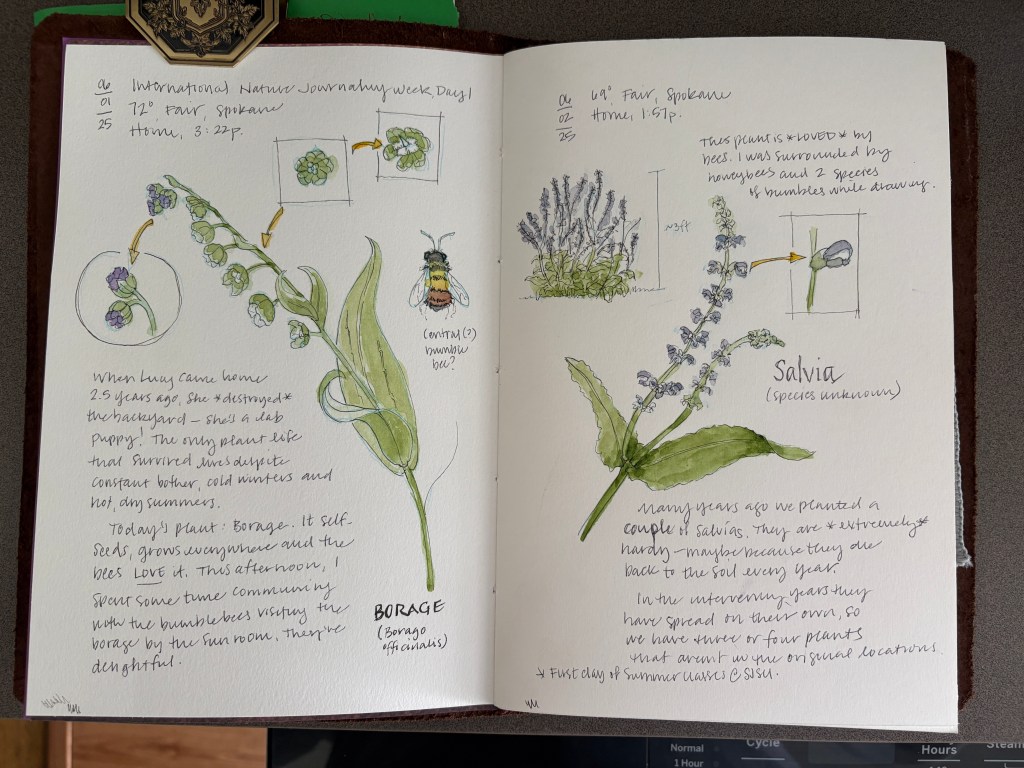
I only did a little bit of nature journaling this year. In the spring the bumblebees visit to forage native wildflowers, so I spent a couple of days sitting on a stool with the bumbles (and a mason bee!). Great times.
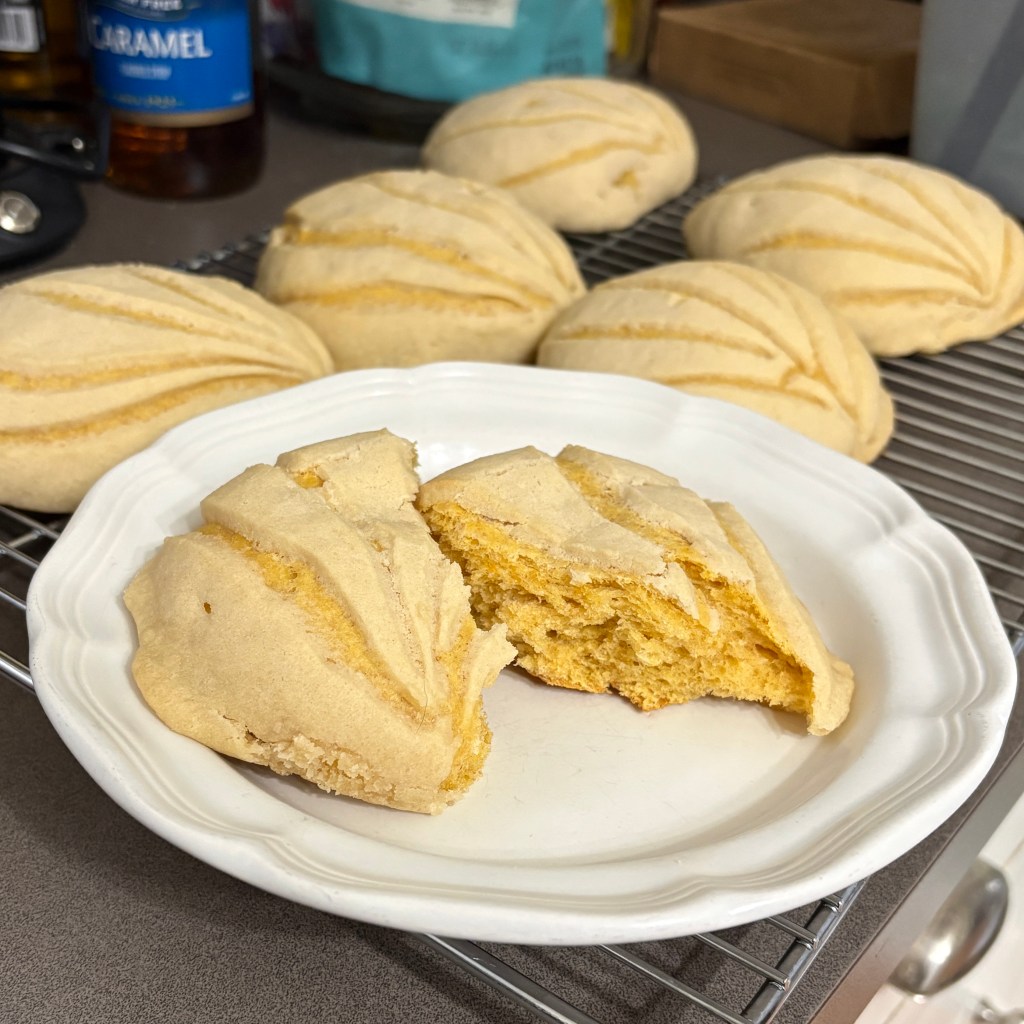
I made some conchas for Christmas, from a recipe by Dora Ramirez. The recipe I followed is from her cookbook, Comida Casera (highly recommend). (She published a similar one on her website: https://dorastable.com/vegan-concha-recipe/). These were delicious and fun to make; they use cooked sweet potato to replace egg in the enriched dough. 10/10, will make again.

2025 was challenging in some unpleasant ways, which makes the bar for improvement in 2026 pretty low. Backing off of my school schedule will hopefully help a little bit. And the missing things I can easily identify point to things I can hopefully find time to add more of… knock wood.

The Personal Project

Teaching with AI

I’m not a fan of using AI for day-to-day activities, or for art. It’s not that I think that nobody should use AI, or that AI isn’t useful in some circumstances. I just… don’t use it for the research and writing that I do (most of the peer-reviewed work I reference lives behind paywalls). And using it for literary writing or visual art is appropriating, at best, or even outright stealing. No, thank you.

(Also, I wish that browsers, word processors, Adobe products, and even WordPress would just knock it the f— off. Stop foisting it on me; I don’t want it and won’t use it… go away.)

I am interested in how instructors are teaching with (or trying to avoid) AI, because from what I’m seeing in the world, students using AI to generate some or all of their work has become a significant issue for teachers. It’s difficult to know how to address it, because AI is a thing that’s here. How do we interact with it, and teach others to interact with it, in ways that are responsible, ethical, fair, and useful?

In other words, it’s not just about using AI — it’s also about pedagogy. I don’t have answers, but I’ve seen what seem like some good ideas, including having students generate a piece of writing using AI and then asking them to fact-check it and revise it as necessary. I’m also seeing some instructors going back to requiring at least some handwritten work for drafting.

Another approach I’ve seen is one that one of my professors used this semester: requiring a lot of writing over the course of several weeks, much of it reflective writing based on personal experience (with citations based on course reading), along with written responses to classmates. AI wasn’t forbidden, per se (we could have used it if it was appropriately cited), but when you have to produce that much original writing, in that style, your distinctive “voice” becomes recognizable. That kind of writing isn’t appropriate for a lot of academic work, and we did have a couple of longer, less narrative, writing exercises, but it worked well for this class. (It was a lot of writing, though. I don’t envy our professor having to wade through all of it.)

The other class I took this semester was a coding class that focused on PHP and Javascript. It was a good class, challenging and structured well. Do I know how to use either PHP or Javascript as an expert? Lol, no. But I know more than I did at the beginning of the semester, so I guess that’s a win — good foundation and all that. What was particularly interesting to me, though, was the way the instructor asked us to use AI.

Photo by Peaky Frames on Unsplash

For the most part, we were required to demonstrate that we could use the concepts he introduced to us in the way they were introduced, without the use of AI. Most of our assignments consisted of small, simple (if you know what you’re doing, which I… did not) coding exercises that followed the logic of his demonstrations, but focused on a slightly different problem. (In my evaluation of the class, I said that this approach is an “infuriatingly effective” way for me to learn, because the problems he asked us to solve were just different enough from his demonstrations that I really had to think through how to use the concepts he was asking us to use.)

He asked us to use AI on three separate occasions over the 15 weeks, in three different ways:

  1. Early in the semester, we were asked to prompt an AI (of our choosing) to solve a simple coding problem, make sure the code executed the way we intended, and comment on whether we understood what the AI did and why. (The AI produced code that was far more complex than I could read, much less write, at that point in the semester. It worked, but I wasn’t sure how.)
  2. Several weeks later, we were asked to manually code the scaffolding for an assignment, and once the code worked the way it was assigned, prompt an AI to add additional functionality that we had not yet covered in the class. (I had to instruct the AI not to change the structure of my code, to make sure that I could still navigate it after the new code was added — I’m a beginner! We had to turn in/upload to a class server both instances of code.)
  3. For our final assignment, we were to use an AI to code a simple web app (with HTML, CSS, Javascript and PHP) that met his specifications — vibe coding! I used GitHub Copilot/GPT-5 mini in Visual Studio Code, so I was using AI within the context of an IDE (I found working within a specific environment very helpful). It required a fair amount of intervention to get where I wanted to go. (Granted, someone with better prompting skills would probably be much more efficient.) But by the end of the semester I could at least read the code and understand most of the logic — or ask the AI to explain what it was doing — so I could make the adjustments I needed or wanted to meet the expectations for the assignment.

As a person who does not use LLMs on the regular, I thought these exercises, in this progression, were an interesting and effective way to introduce AI. The exercises asked us to solve specific problems, and encouraged us to develop an understanding not just of the end product, but of the working parts. Exercises 2 and 3 also introduced us to different ways of using AI: to generate code that complemented manually written code, and to generate most of the code and adjust it as we tested it. Using AI to generate code to let a machine do the work of machines seems like a good use case to me. And because code needs to be checked and adjusted to make sure it’s doing what it’s supposed to do — no matter who (or what) generates it — that workflow seems like a defensible use of an AI.

Coding · Studenting · The Personal Project · Volunteering

This summer sucks.

Confession: a big part of that is on me.

[I am in a mood today, and I feel like screaming into the void. (Sorry, not sorry) This post is even more skippable than most.]

I mean, for a little bit of context, am I the one snatching legal residents from the streets of Spokane? No.

Am I causing uncertainty in the markets by threatening/misusing tariffs, defunding the Corporation for Public Broadcasting, “re-appropriating”(?) funds to spiff up a “free” jet, and building a $200M ballroom at the White House? Also no.

Am I sending congressional propaganda email polls to my constituents in WA-5 (do you think the US should bomb Iran, or should Iran be allowed to build nuclear weapons unchecked? Oh, I see, those are the only options in that situation…) and chirpy weekly newsletters about how I’ve met with three constituent groups and explained to them that the Big Beautiful Bill is the best thing that ever happened to America? LOL, most definitely not.

[Quick aside, though, to Congressman Baumgartner (Harvard, ’02*): given the demographics of our district, you’re going to be re-elected for as long as you want to hold the office. How are you going to manage your next term, after that bill starts limiting access to Medicaid in earnest, given that our district will be one the most impacted in the state? “Waste, fraud, and abuse” are rampant at the federal level (see “free” jets, ballrooms, firings/hirings, and paying people not to work), and your party has given over the power of the purse to the executive. You enabled (funded!) secret police to indiscriminately snatch people off the streets. And, um, you might want to steer clear of talk of high moral character. So, Mr. “fiscal conservative” who campaigned on economic responsibility, protecting the southern border, and family values… what’s your plan?]

Ok, off the soapbox, and back to business. Yes (waves arms), all the things are a monumental buzzkill. But here’s the thing: I don’t actually have any control over any of that. So when I say that this summer has been icky, I’m not talking about all the things. I’m taking about the fact that I made a couple of dicey choices:

  1. I took two graduate courses this summer (because I need to get through this degree before it either goes away or becomes too expensive to continue — another set of circumstances I preemptively blame Congressman Harvard* for). In my defense, one of them was a one-month, one-unit seminar on copyright law. It might have been manageable, if I hadn’t added the second course. Where I really messed up was taking a web development class — a 15-week spring/fall course that was compressed into a ten-week summer semester. BIG. MISTAKE. (It’s a good class, and I know way more about CSS inheritance and precedence, grids/flexboxes, and media queries than I did before, but I would have gotten more from it, had an easier time of it, and enjoyed it more, with a little bit more time.)
  2. And then, to add insult to injury, I took on an additional weekly volunteer shift. Ugh. By the time I realized how messed up that was, it was too late to back out of it without creating a lot of work for a few other people. (It would not have been advisable, or fair, for me to say “whoops, my bad” when I volunteer for a small, heavily volunteer-staffed, environmental education organization whose few employees take a much-needed quasi-break during the summer.)

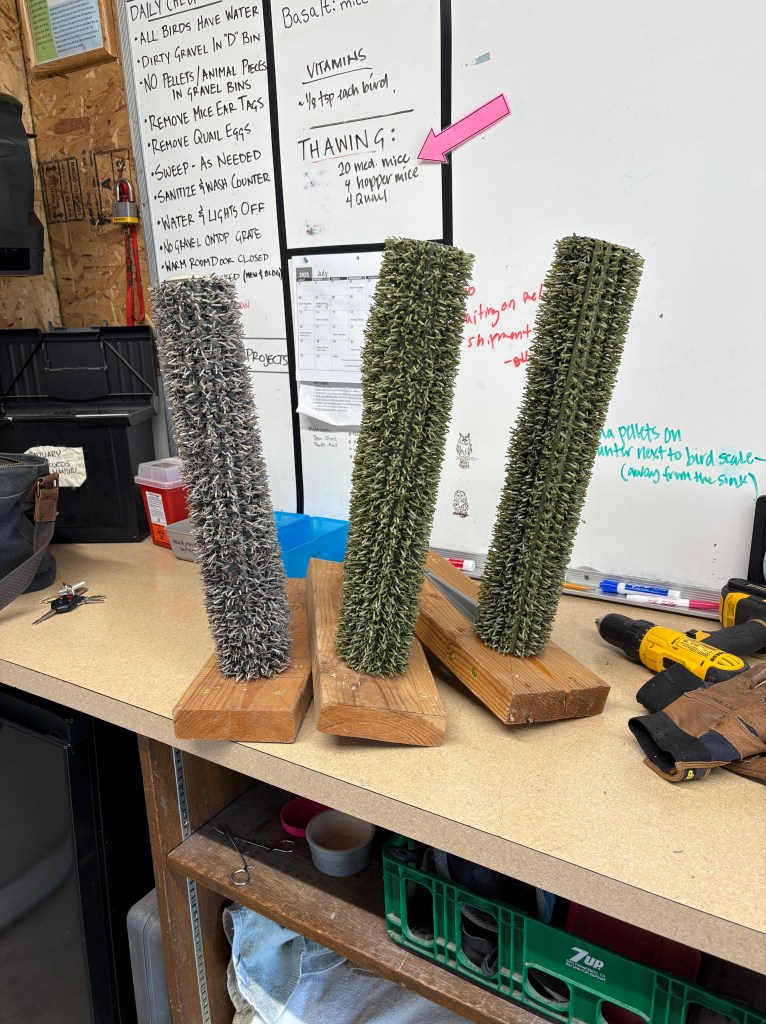
Any one of those choices would have been doable. But all of them together? Not great. Don’t get it twisted; even in the midst of (waves arms) all the things, I did it. I finished my final assignment last night at 9:30p; both of the classes were interesting and worth taking. I haven’t missed any of my volunteer commitments (I have 3 shifts next week); the OLC’s birds (and sometimes other critters, depending on the day and what the rabbit’s enclosure smells like) are fed and cared for, the raptor gravel piles have new markers, and the Harris’s hawk has three new perches (because power tools are a delight).

But it has not been easy, or pleasant. I’m in charge of the meal planning in my house, and that’s not going well (although it is also summer, when my coffee is cold brew, my morning toast is store bought, and we often have “snacks for dinner” so I can avoid using the range — no one is going hungry, but it is… inelegant). I have no hobbies at the moment, and very little social life. The only extracurricular reading I have brain space for is rom-coms, for 30 minutes before going to sleep — think spicier Hallmark stories (at least they’re from the library). My TV time has been largely limited to replays of WNBA games (League Pass, FTW).

But I also haven’t had a lot of time for social media, and maybe that’s a good thing.


* Congressman Baumgartner (Harvard, ’02) used a not insignificant amount of space in one of his weekly newsletters to parrot the administration’s anti-Harvard shenanigans. I gather, from the newsletter, that Harvard is elite, they’re not sending their best, and they need to be taken down a notch. I could have told you that, Congressman Harvard, but how are you the exception?

Lucy the Pup · Thoughts about Stuff

Leftovers

July 4th ended up being a very busy day. I had an early volunteer shift that had morphed into doing animal care for the whole place (instead of just the birds) — for me that adds more than an hour to my shift (I’m not terribly efficient with the other animals because I don’t work with them all that often). I had to finish a school assignment that — technically — was not due until today, but I’ve had a bunch of other, unrelated stuff on my plate and just didn’t have time to mess around with it. I have a standing date on Fridays to talk to my mom, and we had a lovely conversation.

And then Lu and I got to spend some time in the evening with friends. It was a comfortable day outside (thankfully), so getting her in the car and spending time in their backyard was lovely. This is her after spending a few hours playing with her special friends Jennifer and Kevin (special friends because she loves them unequivocally, and loves to play with them — she’s more wary around new-to-her people and men):

Lu needed a nap, but she wasn’t *sure* she needed a nap.

We got home kind of early to make sure we were tucked in before the fireworks got going. We’re lucky that (so far, knock wood) Lu hasn’t shown any reaction to boom booms, other than to make a note and go back to sleep, but I wanted to make sure that she was at home and could spend time in her crate if something had changed between last year and this year… thankfully, her experience of the fourth this year was similar to her first two years, in that she could not have cared less about what was going on outside. (I’m not sure how we have lucked out on this front, but I’m grateful we have… at least so far.)

Lu’s special friend Kevin is great on the grill, and I got sent home with a care package that included some bell pepper slices and grilled corn on the cob. Last night for dinner, I “repurposed” both and made a coconut curry with tofu and vegetables, which I topped with chili oil.

Yellow coconut curry with tofu and vegetables over rice.
YUM.

It. Was. DELICIOUS. And there are leftovers!

The world feels heavy right now; it was a nice reprieve from (waves arms) everything to spend some quality time in community with friends. The leftovers were a nice (and tasty) reminder of our time together.

Coding · Studenting

Summer School

I made a couple of miscalculations this summer.

Last year I took a MySQL course, which is only taught during the summer at SJSU. It’s designed to run as an intensive 10-week course. And yep, it was intense — the kind of situation where you end up knowing about 1000% more than you did before you started, but you recognize that you’re still just scratching the surface. It was a good class.

This summer, I’m taking a front-end web development survey course. Most of the material is a review (not all of it, but I’ve been at least exposed to most of the concepts and have a little bit of experience with the code), so I was not worried about tackling it over the summer. I was so unbothered by the prospect that I added a four-week seminar that examines copyright law through the lens of digitization of special collections (also only taught during the summer, by a professor I like).

Those were both miscalculations.

The seminar, because it’s designed as a short course covering a specific (very niche) topic, required a lot of reading, a fair amount of writing, and some engaging assignments. It was heady stuff — interesting and dense, and full of important information. It ended last week.

The WebDev course is primarily taught in the Spring and Fall semesters, as a 15-week course. For the summer, that course is compressed to 10 weeks. It’s also a graduate-level survey (similar content to an undergraduate course of this type, but you’re expected to do a deeper dive and produce a more “finished” product). And as it turns out, there is a significant difference between a 10-week intensive course and a compressed 15-week course. I wouldn’t change the course structure or content; I really enjoy this kind of work — any coding, or working with data, is absolutely my jam. My primary frustration with the situation is that there is not enough time to finesse or explore anything beyond what’s in the task list, because the timeline is so compressed.

The latest example: we had to produce a navBar and style it, which I did (with flexbox!), but it’s not responsive for mobile screens (yet) because a) it wasn’t explicitly part of the assignment, b) it would have required another big technical leap (for me), which I did not have time for, because c) there was another — totally unrelated — piece of the assignment to complete.

The navBar in question.

Sometimes you don’t finish projects… you just have to end them so you can move on.

There are other things going on that are making the summer more challenging, including a bigger volunteer load and some unforeseen family stuff. It’s tempting to be all dramatic, like, I’m in hell, but that would be inappropriately hyperbolic; it’s just a more than I expected… sometimes an uncomfortable amount of more.

[Side note: almost all of the projects I do for my MLIS program in some way involve the organization I volunteer for, because there’s a lot of information floating around an environmental education organization that is responsible for animal care. These projects aren’t affiliated with the OLC, but I discuss them with the director, and if anything I do is relevant to their interests, they’re free to use my work. I strongly suggest that if you decide to pursue graduate work, you have some experience (volunteer or paid) that you can draw on; I have found it extremely helpful for contextualizing what I’m learning in class.]

Studenting

Get the Useless Degree

Get in losers, we’re going for a trip down memory lane, via my current grad school classes. I’m feeling salty today, for reasons, so there might be some swears. (Here’s a photo tax.)

My homegrown drip coffee setup: a quart-sized mason jar, a quart-sized measuring cup with a strainer and coffee filter. In front is an iced caramel latte with cold foam.
Improvised cold brew system. The drink: caramel iced latte with cold foam.

I’m an MLIS student (Library and Information Science), and this summer I’m taking a one-month seminar on copyright for cultural institutions, and a 10-week front-end web development survey. (Turns out doing them at the same time is not something I would advise; I’m struggling at the moment.)

Before the MLIS program, I spent a hot minute as a graphic designer. Before that I spent a few years in school (New York City College of Technology — CUNY FTW) studying graphic design and print production. I took a lot of shit for it, because despite the program being vocational in nature (the print production part), it’s… ahem… not useful.

OK, but here’s the thing: I learned how to research and write during my “useless” undergraduate degree (Classics). What that means right now: I don’t use AI LLMs because I don’t find them useful — too much copyright infringement (cheating) and making stuff up, or “hallucinating” (lying), that I would have to account for, and I’m sorry, but ain’t nobody got time for that. Everything is already too complicated to have to spend extra time dealing with AI slop. (This is not to say that there is no use for AI; I’m saying that for what I’m doing right now, it’s more distracting than helpful, so I just don’t use it… and I would appreciate it if Microsoft would stop reactivating CoPilot every time office updates.)

As for studying graphic design, guess who has a pretty reasonable foundation in copyright law, particularly with regard to fair use? That would be me. When you’re in art school, you copy masters on purpose. And you might use photos that don’t belong to you to mock up design assignments… and you learn pretty quickly that you’re not allowed to sell or distribute those works. While you might have a defensible fair use argument for creating that work in the context of an education setting, the copyright holders of the original works may very well be able to claim infringement if you publish or otherwise distribute their work without permission or licensing.

Drawing from a photo reference? Did you take the photo? The drawing is yours to do whatever you want with. If you didn’t, and your drawing is a faithful reproduction (has not been substantially altered), it’s not yours to sell or distribute. And guess what, friends? Posting something to the internet is a potential method for distribution.

[Related: do not ask me to remove a watermark from a low-resolution digital mockup so you can use it as the finished piece. I made it a low resolution digital mockup with a big ol’ watermark on it for a reason.]

Also:

  • Darkroom photography –> photo editing in Photoshop or Affinity Photo
  • Typography –> relative measurement units in CSS
  • PPI vs DPI –> IYKYK
  • Color theory –> related to everything, everywhere… it’s astonishing, really.

Moral of the story: study what you want to study, and make sure to develop some critical thinking skills along the way. Everything is related, and even if you don’t end up using that exact discipline for your work for the rest of your life, there’s a better than even chance that at least some of it will be useful.

Black History Month · In the Kitchen

Black History Year

I did not get through my ambitious syllabus in February, so I guess 2025 is going to have to be Black History Year… I’m not mad about it.

One thing I did do: cook using recipes by Black recipe developers.

First up: Bryant Terry. He specializes in vegan food, which I enjoy, and the cookbook I used is one I already own (bookshop.org link): The Inspired Vegan. It’s a cookbook for entertaining, with recipes for whole meals, including drinks, books, and playlists. He handles tofu really well; I could eat buckets of the tofu from his tofu saag.

A couple of weeks ago, I made congee and tofu with peanuts and chili oil. I did not mix my rices, so I didn’t follow the recipe exactly, but it was still delicious… so delicious that I had leftovers for breakfast the next day.

This one will be in the rotation. It’s really good.

As I type this, I’m making Terry’s masala chai, which I have also been enjoying for the last few weeks. I’ve done some research online, and his technique isn’t entirely traditional, but it’s very tasty (and it makes the house smell so good while it’s in the works).

Since these recipes are for entertaining, I halve them so we don’t end up eating (or drinking) dishes (drinks) for weeks. What I should do is make the whole tofu recipe, and halve the meal it comes with, because the tofu is just that good.

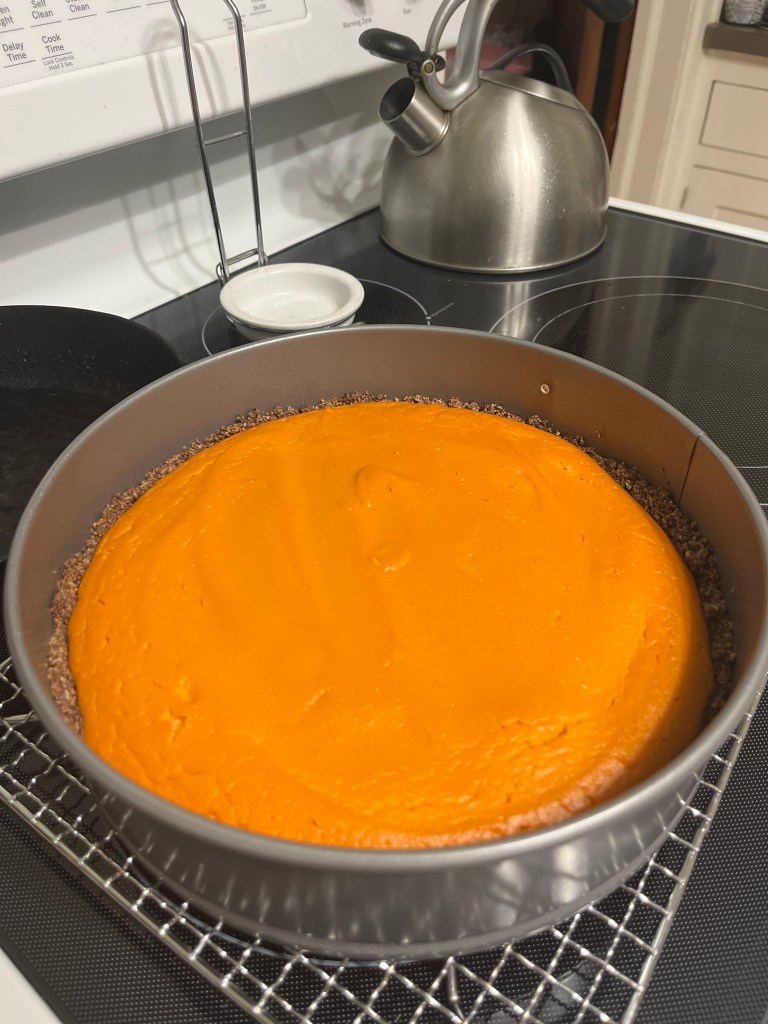
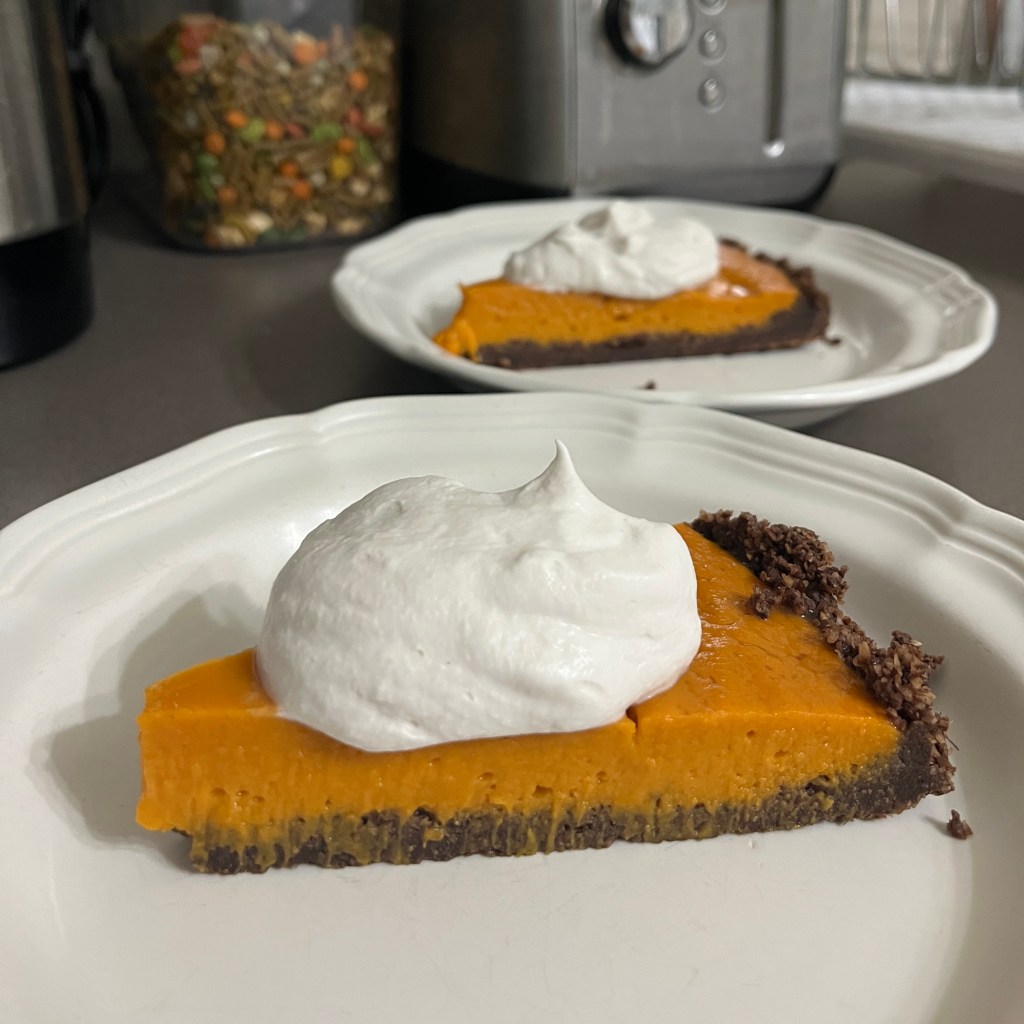
Next up: Jerrelle Guy’s sweet potato tart with chocolate hazelnut crust, from (bookshop.org link) Black Girl Baking. Look, I know I said I was going to do something new to me… but I can’t convey to you how delicious this tart is, and I really wanted to eat some of it (confession: I’m having a slice right now).

It’s really pretty, right? It has some citrus zest and juice in it, which gives the sweet potato filling a nice, bright flavor. I think this is going to replace the pumpkin pie at Thanksgiving (or at least be an addition).

The tart has eggs in it, but it doesn’t have any dairy, so it’s safe for fabulous and talented husband to eat (the whipped cream is also non-dairy).

So yes, it’s true that I did not do all of the reading I wanted to do, but it’s only March; there’s plenty of time left in Black History Year.

Black History Month

Black History Month: Kadir Nelson

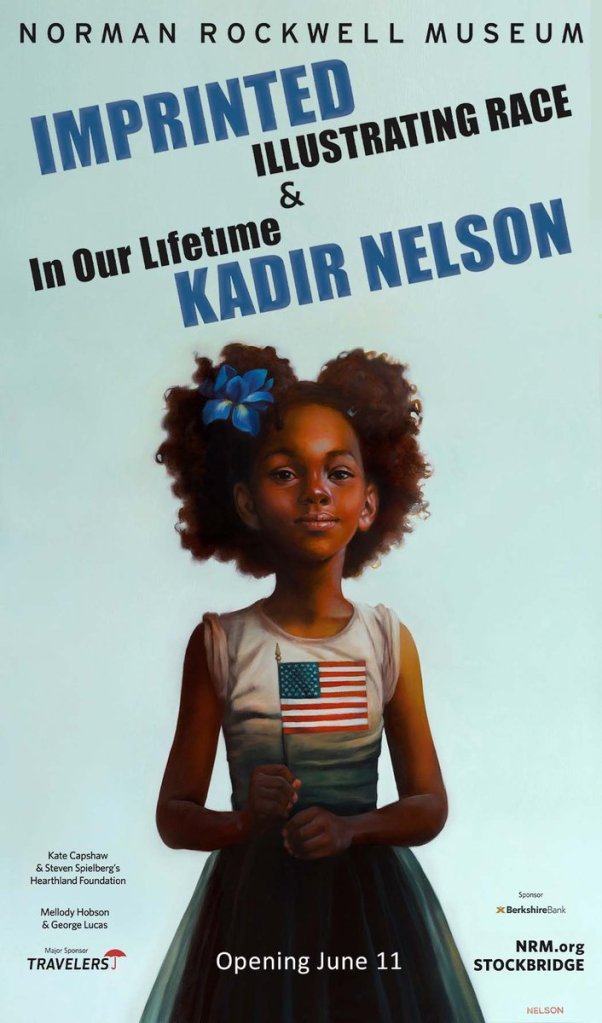
Kadir Nelson is a talented, prolific, accomplished artist. I became aware of his work because of his New Yorker and Rolling Stone covers, which are… just… breathtaking. In addition to his incredible skills as a painter, his narrative chops are second to none.

He has a website, with a gallery and store: https://www.kadirnelson.com/

In 2022, the Norman Rockwell Museum curated an exhibition titled “In Our Lifetime: Paintings from the Pandemic by Kadir Nelson.”

He has written and/or illustrated a number of children’s books (autographed copies available).

And he painted what is, quite possibly, the best bookstore poster of all time (in my humble opinion):

Norman Rockwell was able to create self-contained visual narratives, using incredible drawing and painting skills. I would argue that Norman Rockwell was good at showing us what we already knew, sometimes even when we didn’t want to know it. That is a very particular, very specific skill. It is rare, and it is special.

Kadir Nelson is wholly original, artistically — he is one of a kind — but I think he does a similar kind of narrative work, with a similar skillset, and that his work is incredibly important in our time.

Black History Month

Black History Month: Augusta Savage & Annie Easley

Gamin (1930), by Augusta Savage. Photo credited to the Cummer Museum of Art & Gardens, Jacksonville, Florida. Image featured in Sculptor Augusta Savage’s Towering Impact on the Harlem Renaissance, by Niama Safia Sandy, on artsy.com.

This morning I learned about two extraordinary Black American women: sculptor, poet, teacher and gallery owner Augusta Savage (1892-1962), and mathematician and computer scientist Annie Easley (1933-2011).

[The New York Public Library has a great libguide for Augusta Savage.]

Thank you to Mariame Kaba (@prisonculture.bsky.social) for posting a link to a PBS American Masters segment about Augusta Savage:

Annie Easley was a NASA “computer.” Hidden Figures (the book by Margot Lee Shetterly, and the film of the same name) featured profiles and stories of Black women hired by NASA for their skills and mathematics and engineering. Annie Easley wasn’t featured in that work, but she shared a similar skillset. Among her accomplishments, she created code for the Centaur rocket stage that allowed it to be used successfully (it was blowing up on launch). The code Easley created allowed the Centaur stage to be used in more than 220 launches; the technology was incorporated into other rockets used for missions to the moon, and for the space shuttles.

Annie Easley is one of the featured women in an article at biography.com: NASA’s Hidden Figures: The Unsung Women You Need to Know

Caitlin Aamodt, PhD (@caamodt.bsky.social) posted a gift article of an obituary for Annie Easley, published on February 1, 2025, by the New York Times in their “Overlooked No More” series: https://bsky.app/profile/caamodt.bsky.social/post/3lh7czy27ws2r

The Times summed up some of her skills this way: “She analyzed systems that handled energy conversion and aided in the design of alternative power technology, including the batteries used for early hybrid vehicles.” (For those of us who flirt with data transmission, the article also mentioned that she worked with SOAP.)

Easley spent her retirement mentoring others, and served with the EEOC.

From the Times piece, in a 2001 interview, Easley said this: “My thing is, if I can’t work with you, I will work around you.”

Wise words.