
A couple of days ago, The Raptor Center at the University of Minnesota announced that one of their bald eagles, Maxime, had passed away. She had been at The Raptor Center for more than 20 years. In her later years, she developed severe arthritis that interfered with her quality of life. On May 19, she was humanely euthanized.
In 2016, I had the opportunity to visit The Raptor Center to take a week-long workshop on the care and maintenance of captive raptors. Some of Minnesota’s birds are like ours at the Outdoor Learning Center. That is to say, at least a few of them came into care from the wild, and have ongoing concerns resulting from injuries sustained in the world.
I’ve only ever worked with one bald eagle, and only for a few minutes, and it was at The Raptor Center. It was Maxime.
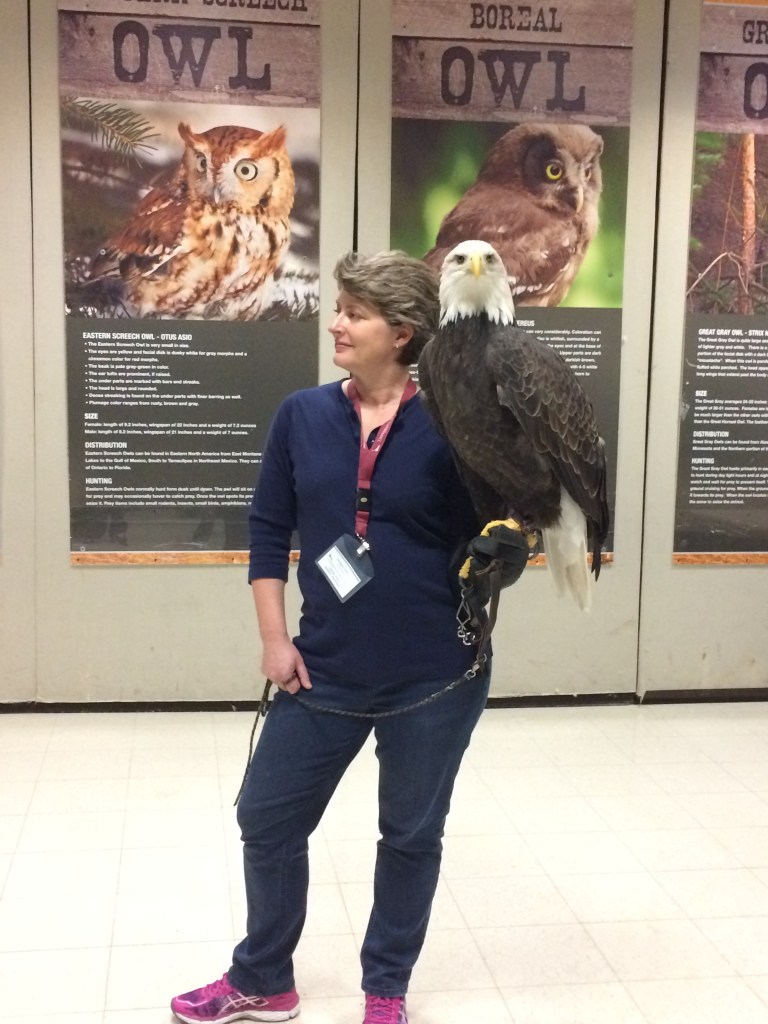
First thing, bald eagles get heavy in that position. I had her on my hip for stability for almost the entire time I worked with her. I was closely supervised by two of her handlers. They were very patient with me, and so was she.
By the time I went to that workshop, I had worked with the OLC’s birds for about 3.5 years, so I had experience working with great horned owls, a barn owl, a barred owl, a screech owl, and American kestrel, a Harris’s hawk, a rough-legged hawk, and a red-tailed hawk. I knew how to keep myself, and the birds, safe during our handling and husbandry sessions.
I knew that raptors aren’t props, pets, or toys. I knew that most raptors aren’t social (unless they’re migrating or nesting), and that “friendship” between our species just isn’t a thing. I knew how to tie a falconer’s knot. The OLC’s facilities are much smaller and less sophisticated than The Raptor Center’s, but we had checked in with other rehabbers and vets, and Fish & Wildlife, to make sure they’re good for the birds. I understood that our goals at the OLC were (and are) habituation, and tolerance.
The most profound thing I learned at The Raptor Center was how to incorporate cooperation into the relationship. The birds are sentient individuals who have preferences, and personalities, and it’s important for those of us who get to work with them to honor those preferences when we can. It’s not always possible, but to the extent that it is possible, it’s our responsibility to try.
These thoughts are still front-of-mind today:
Do not lie to the bird.
Do not try to conceal what’s going on, especially in situations where you know that bird isn’t going to enjoy it (like restraint for medical procedures).
Project what’s going to happen.
Be safe.
Be efficient.
Let the bird recover quietly, without interference from you.
If you’re going to be involved in activities the bird doesn’t enjoy, and you want to be a regular handler of the bird, you have to put in extra time, so time spent trimming beaks and talons isn’t the only time you’re handling the bird.
It’s 2023, and I’m still working on this stuff, with our birds (many of them new since 2016) and other volunteers. It’s aspirational, particularly if a bird came into care as an adult. But I think about it often, and I’m grateful to have had the opportunity to learn it from The Raptor Center, with Maxime.
At the workshop, we broke into groups for some games, and my group was named Maxime’s Minions.

 Carmen Yount