
This is an appreciation for a barred owl who hated us with almost comical intensity. There is sadness in it, but also gratitude.
This was Oroville:
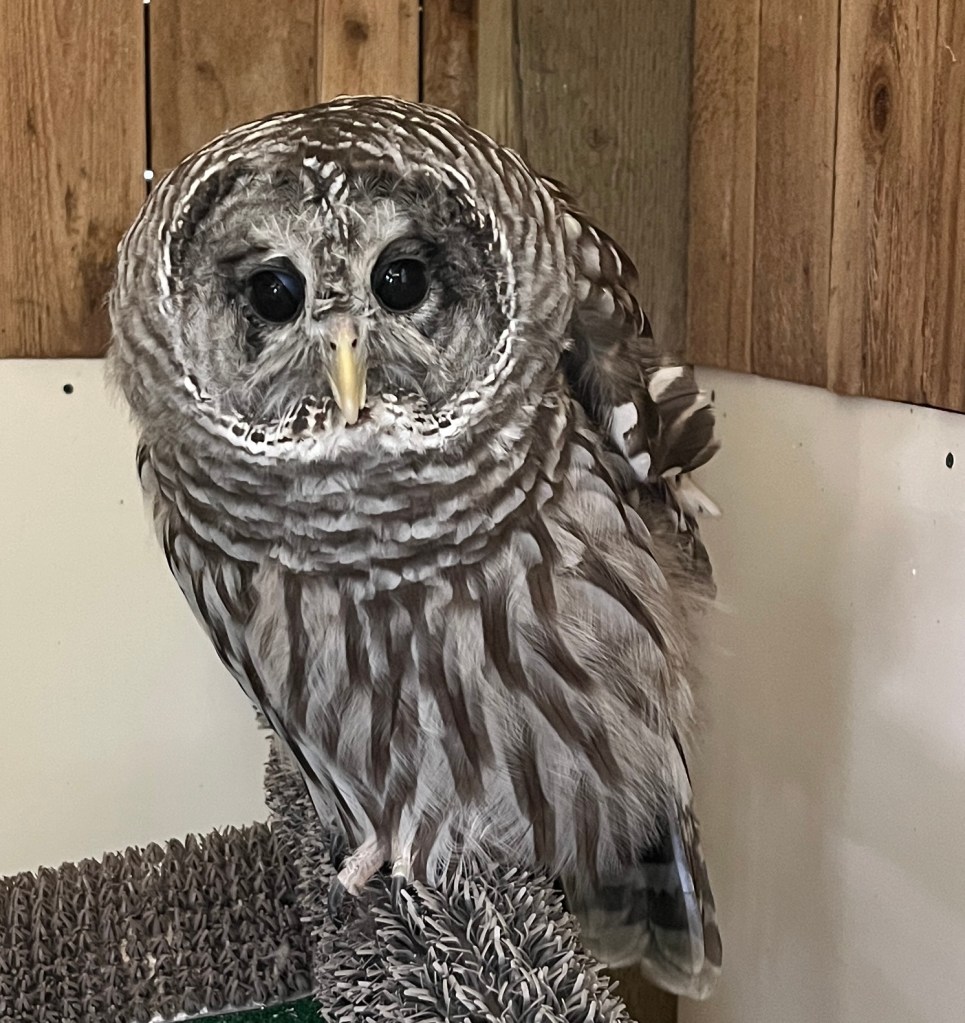
(He was going through kind of a rough molt when this photo was taken.)
Oroville suffered a severe patagial injury to his left wing when he got caught up in some barbed wire as a fledgling. It rendered the wing useless for anything but balance.
He came to the West Valley Outdoor Learning Center in, I think, 2011. (I started in early 2012, and he was in a starter mew then.) He could not fly, but by every other metric, he was a classic barred owl, which is to say, he was deceptively aggressive. Got too close to him? He’d jump at your head. Stand up too quickly near him while cleaning? Jump at your head. Try to retrieve cached mice in his mew? Lunge at your hand. Collect him on the glove? Gnaw aggressively at your hand. Trimming his beak? Snap at your fingers. (The only black eye I’ve ever had came from one of Oroville’s launches.)
These were not character flaws, or lapses in training. Oroville was a wild barred owl who was being asked to live in circumstances that were completely foreign — and unnatural — to him. It wasn’t bad, but it wasn’t normal for a barred owl. He was free-lofted (as in, not tethered) in a large mew with two windows and perches at different levels. He had daily access to fresh water and food, and was weathered regularly. He was protected from the elements, but we left one of his windows partially open all winter so he could feel the wind and snow on his face. He was heat intolerant; he didn’t do events during the summer, and spent most of his time sitting under a fan.
It’s important to note for people who don’t have a lot of experience with education raptors: the alternative to this life was not freedom. It was death — because he could not fly, he would not survive in the wild. He was not a pet; keeping him required both state and federal permits. The compromises we asked him to make were extensive, but he helped to educate thousands of people about how owls fit into our ecologies, and the challenges owls face in the wild, over the course of his life.
This week Oroville developed some weakness in his right leg. And then he stopped eating. (Both of these are big red flags in raptors, but combined, they can signal a very bad situation.) Yesterday I drove him to WSU to the veterinary hospital to see our (amazing) avian vet, Dr. Marcie Logsdon, for X-rays and bloodwork.
As it turns out, his heart was enlarged, and so was his spleen. It looked like the situation had been developing for a while, but owls are both 1) stoic, and 2) good at hiding signs of illness. Until this week, Oroville’s behavior had been his feisty normal, and he had been eating/maintaining his weight, so we had no idea about this underlying condition. By the time we got to WSU, he was very ill, and had the OLC chosen to pursue treatment, his final days would have been spent receiving treatment that was best case, intrusive (worst case, invasive), but not curative. After consulting with the OLC’s director, the decision was made to euthanize him.
In addition to being an avian vet, Dr. Logsdon is a falconer, and she works with the WSU raptor center’s education birds. Working with education raptors requires walking a narrow path, ethically, and she has some good experience with it, which is really helpful to us. (Some vets know how to treat birds, but don’t have a lot of experience actually working with them.) I loved that she consistently referred to Oroville as our “friend” (even though considering the concept of friendship with Oroville would make anyone who knew him giggle).
Another thing I appreciate about Dr. Logsdon is that she is not a vet who goes to euthanasia as an early option, but if it’s important to consider, she’ll put it on the table. She did not pressure us. She told us what our options for treatment were and that she would support our decision to continue treatment, but she did not shy away from the fact that Oroville’s prognosis was very poor, and his quality of life would not improve with time or treatment.
Sometimes the worst decision is not the hardest one to make.
It’s easy to say, but it does not diminish the sadness of packing an empty crate into the car. I am sad, and I will miss him.

 Carmen Yount