I *finally* saw Shang-Chi and the Legend of the Ten Rings last week. WOW. So good. I enjoyed every part of it, from soup to nuts. I’m not the best critic — I’ll see any superhero film, and I usually like to see them on the big screen (but not during a pandemic, when I live in place where vaccination rates are too low). Confession: I usually like them because they’re full of action, big music, and pretty people.
But that said, I really liked some of the choices the creators of Shang-Chi made — I liked that so much of the movie’s dialog was Chinese, that the fighting styles were varied and reflected the characters employing them, and that they had the good sense to cast Michelle Yeoh and Tony Leung. Simu Liu and Awkwafina were amazing as well.
But the line in the title, “If you aim at nothing, you hit nothing,” stopped me in my tracks. One of the characters in Ta-Lo said it to Katy (Awkwafina) in the context of archery (but, you know, WAY more than archery), and I was like, “mind blown, thank you very much.”
I grew up with a mother who said that she wasn’t into goal-setting, because life is too uncertain to make definite plans. (Technically, she’s not wrong, but that’s not the whole story.)
I have tried for so long to emulate my mother, who is brave, smart, hard-working, creative, compassionate, and did I mention smart?
That said, one of the hallmarks of the dysfunction in my family is gaslighting. It’s so common that they all did it without even knowing it.
Because here’s the thing: my mom decided she wanted to be a nurse in college, AND THEN SHE DID IT. She was an RN/BSN before the BSN part was cool. And then, right after I graduated college, she got her master’s degree. She was an operating room nurse, and then moved into staff training and management. She was a nurse for 40 years. She went on medical missions to Mexico and Mali. When she retired she gave flu shots for a couple of years.
She decided she wanted to apply her musical knowledge and experience to learn to play the Celtic Harp, AND THEN SHE DID IT. Over the last 20 years, she’s played as a student, and now she and her former teacher get together to play duets every once in a while.
After she retired, she decided she wanted to work with little kids, AND THEN SHE DID IT. She tutored some children in reading, and now she assists in a couple of the classrooms in the elementary school near her house.
So, yeah, my mom may not be keen on 5-year-plans, but she knows how to set and pursue goals.
Moral of the story, kids, is that you should watch what your parents DO, not what they SAY, because if they were gaslit their whole lives by their parents (who were likely gaslit by their parents, and so on), you won’t get the whole story from their words.
For no reason in particular. I’m healthy, for the most part — my back is actually feeling really good at the moment as I move *SLOWLY* back into my yoga routine. I’m really enjoying one of the two classes I’m on track to finish this term, and actually learning some important stuff in the second. (I had to drop the third. Even though I was learning some important and useful skills, it was just too much homework to integrate all three classes into my daily life.)
I will say this: I’m weary from the pandemic and being stuck in the house with a parrot. That’s a big part of it. Also, not being able to take a vacation from the day-to-day is taking a toll.
And I think taking a (temporary) larger training role at my beloved outdoor learning center is wearing thin. Don’t get me wrong, the people are wonderful (and it’s nice to interact with people again!). That said, I kind of miss my easy mornings with the birds. And I’m starting to feel a little… put upon. (See above about weariness and the lack of a vacation.) In any event, I think I’ll take a short break (for a vacation!) after the holidays when staffing levels are somewhat regular again.
Rather than fight the fatigue, I’m trying to build in more periods of rest, especially to journal… usually with my morning coffee. (It’s easier to sit down now that the weather is cooler and moodier.)
Right now I’m working in a Moleskine, but that’s about to change because I can’t find my favored journals anywhere. Maybe that’s a good thing… support a small business and break out of an existing habit, at least for a little while.
The pages are plain, because I don’t like lined paper… I tolerate dotted paper in my bullet journal, but I start to get titchy when darker marks start showing up on the page.
I haven’t always been this way. When I was in the fourth grade, my teacher made us starting working on paper without lines. I was scandalized at the time, and deeply uncomfortable with the rule change, but I was assured it was temporary so we could have a different experience on the page. I went back to lined paper as soon as I could, but over the years I’ve moved irretrievably into the plain paper camp. Thank you, Mr. Stevanus, I guess.
Anyway, my journals are not the kind that I (or anyone) should save for posterity. They’re mostly laundry lists and mini-rants about whatever is bothering me at the moment, usually something petty and irrelevant. I wish I were a person of substance in this way, but alas, I am not. I find the exercise helpful for getting stuff out of my head. I hope it prevents me from feeling the need to overshare on social media.
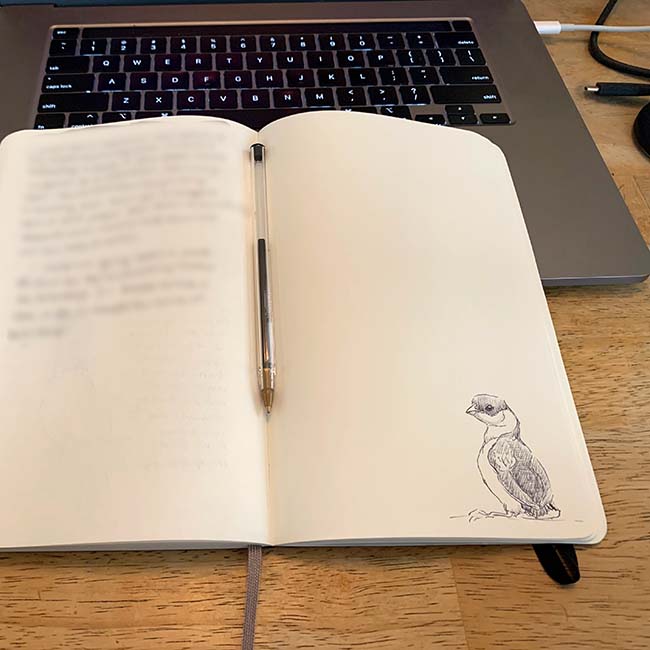
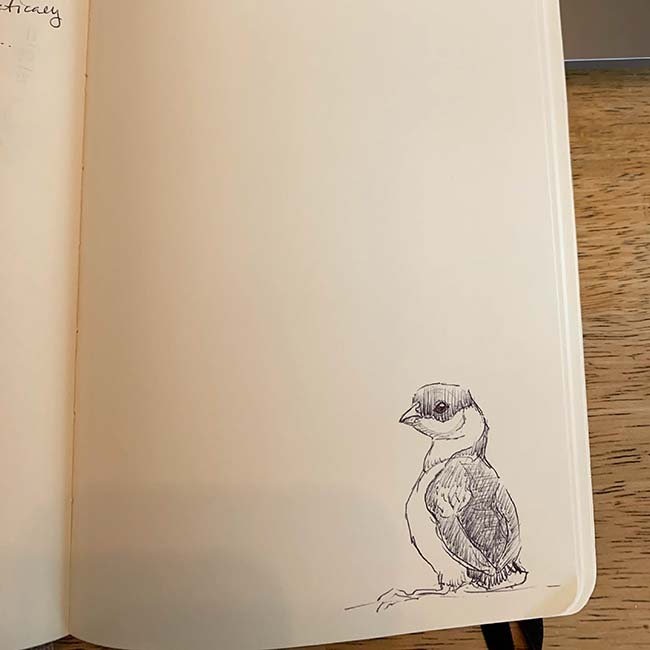
The one really constructive thing I do in my day-to-day journals is doodle, almost always in the lower left corner of the page. Always in pen, almost always really bad because they’re the first drawings of the day (at least that’s the reason I give… I suspect that, at least in part, it’s because my attention usually isn’t where it needs to be to do better). This dapper little dovekie turned out pretty well for what it is: a couple of minutes to warm up in the morning.
Yeah, so that’s an interesting observation… it is true that because these are generally throwaway drawings, I don’t spend very much time and attention on them — this one was no more than 5 minutes, and probably closer to 3 minutes. I wonder if one of the reasons I’m tired is that my first instinct is to go hard at everything. It’s an old habit from a long ago corporate experience, but it isn’t really needed (most of the time) in my present situation. Maybe I’m trying too hard to finish first/quickly, and it’s taking more energy than it needs to, and as a result, I’ve expended too much energy trying to be quick/perfect/right/first… exhausting.
OK, so maybe my goal for the next part of my life is to slow down enough to spend more time and attention on tasks that would benefit from a more intentional interaction… including my journal marginalia.
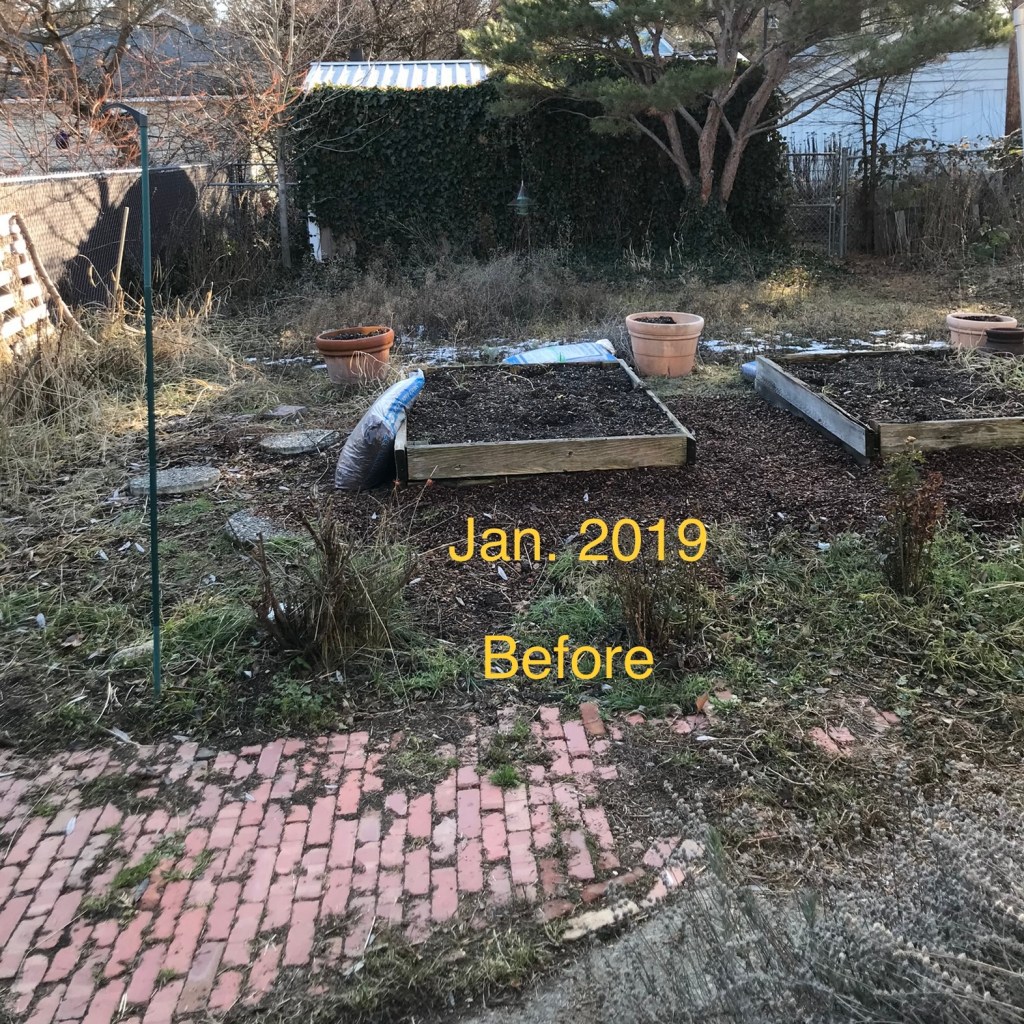
Actually, fabulous and talented husband Dana did it, with an assist from good friend Kevin. (I was in physical therapy for my injured back.)
As a reminder:
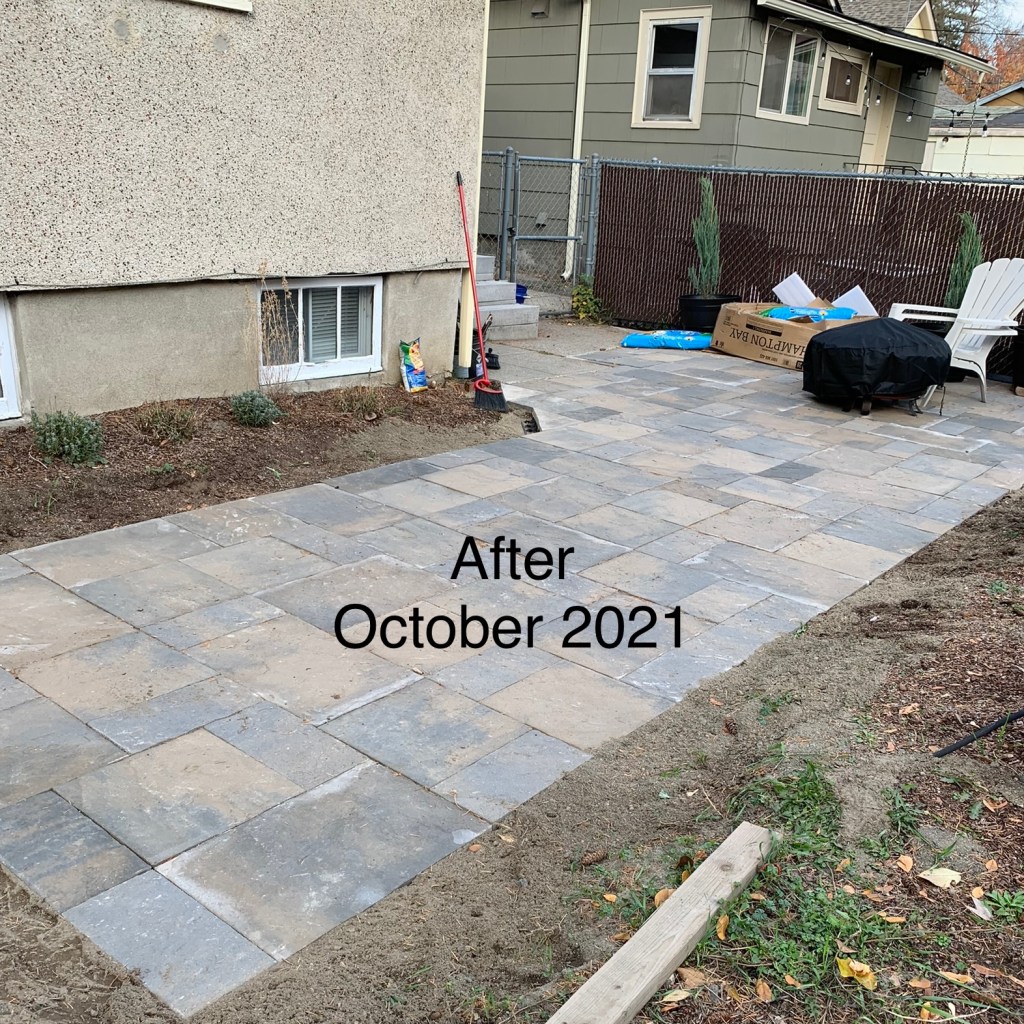
And now…. ta-dah!
Much better. Good landscaping will have to wait until next year, and part of the project next year will be to hire someone to “fix” the concrete pad near the fence… and by “fix,” I mean remove and replace. Then we’ll have to level and slope that part of the patio correctly. (The good news: everything drains away from the foundation. The bad news: that concrete is sloped in such a way that it was impossible to level and slope the patio appropriately in that spot. Our neighbor, a former contractor, said, “I’m not sure how they got that so wrong.”)
[A word to DIY homeowners: if you’re unsure about how to do stuff, HIRE SOMEONE. Even if you want to do the work yourself, get a consultation about how to do stuff the right way, particularly for issues having to do with water and electricity. We’ve spent a good chunk of money and time over the last decade repairing and replacing plumbing, roofing–and now the patio. We have more to do in the coming years. It sucks. OK, back to the patio.]
Did I mention the fire pit? Now that we have a nice, big enough, not weedy outdoor space to relax, we can have use a fire pit! A fire pit!
It’s so great to be done with this project (for this year, anyway). It’s a huge relief to have it finished.
Pop, a green (but actually brown) iguana. He’s working through a shed in this photo — you can see some on his leg, his shoulder, his tail and his head.
I like lizards. I do. But this one… (face palm).
Pop is gorgeous. Mesmerizing, really. He’s strong and muscular and has beautiful eyes. He’s smart. He’s big, at least six feet from nose tip to tail. He’s about 2x larger than he was when he came to the outdoor learning center, and because he’s grown so much his enclosure (4′ deep, 9′ long, 9′ tall) is likely verging on too small. He’s opinionated, and may or may not also be hormonal, territorial, hungry… unknown.
If I’m the first to arrive at the OLC for the day, I feed him right after I turn off the alarm so he doesn’t have to watch people moving around the classroom/not feeding him when he’s hungry. On this particular day, we were completely out of food when I got in, so I had to skip it and headed out to the sanctuary to work with the birds.
When I finished with the birds, I came back through the classroom and asked the inside animal volunteer if there was anything I could do to help her out… and that’s how Pop and I butted heads on that day. The food had been restocked by then, so it was *theoretically* possible to give Pop a big bowl of greens.
When Pop is upset about something (origin known or unknown), he hangs out on one of his shelves close to the enclosure door, does pushups, flashes his wattle, and threatens to jump at whomever opens the door. He was doing that last Thursday. It’s terrifying, and some volunteers aren’t comfortable dealing with it.
Completely understandable. I’m not comfortable with it, either. But we all want Pop to be able to eat and I had the time to work with him for a few minutes.
So I pulled out a couple of big collard green leaves, washed them, and then used them as a “target” to get Pop’s attention and direct him to his upper hammock. I was outside of his enclosure (one side is 2/3 windows, so he could see me just fine, but the target wasn’t “real” because he couldn’t get to it). When he decided that that’s NOT what he wanted to do, I put the leaves on a chair where he could see them and walked away for a few minutes — to feed the other iguana in a different enclosure.
We did this three of four times over the course of 30 minutes, me showing him the leaves and directing him to his hammock, and then walking away when he decided that it wasn’t going to happen at that moment.
Eventually Pop decided to head up to his upper hammock and I was able to put the big collard green leaves in the enclosure on his lower hammock (just under the highest one). Rather than step down to them (totally possible), he leapt on them… not at all intimidating (ugh)… which gave me enough time to pull his bowl out, fill it with greens and put it back.
I snapped the photo of him hanging out over his bowl.
The school district whose outdoor learning center I volunteer at starts their year this week.
I’m looking forward to seeing the staff folk I get to interact with again. Everybody was around over the summer, but our schedules didn’t match at all because there were no kids around.
I don’t usually interact much with the kiddos in the fall — I’m a volunteer, the schedule is a bit more manageable as the seasons change, and the fall curriculum doesn’t usually overlap with my area of expertise. But the energy changes quite a bit when kids are around, and that’s been missing for much of the last 18 months. That energy is electric, and it will be nice to be around it again.
I don’t usually say (or think) this, but I can’t wait for summer to end. I love long, warm days. I appreciate quiet, early mornings. But this summer… ugh.
There have definitely been some highlights: we got to see some family and travel a little bit. That was wonderful. I got to do a couple of in-person bookbinding workshops and a printmaking workshop, and it was a joy to work with other people in a creative environment. We got to spend time with some local friends (outside), and it was so nice to see people again.
But:
It was 90+ degrees F for something like 40 days, and 100+ degrees for four or five more (our highest high: 109°F), starting in late June. We’re used to a hot July/August, but we got an extra month of the heat, and it sucked. Oh, and there was no rain, so in addition to extreme heat, we didn’t get any break from cooling showers, which meant…
Another awful fire season. We’ve always had fires in the West, but because the atmosphere is so much drier than it used to be (thanks for nothing, climate change), and our poor forest management practices are catching up to us (too much fuel), the fires are bigger and burn hotter and longer. Those intense fires dump a lot of smoke into the air, and it travels.
I hurt my back in mid-June — it seized in early July — and I’ve been, for all intents and purposes, out of commission when it comes to fun summer activities like gardening and kayaking. I’m thankful I can do most of my day-to-day activities, and because my back has some hypermobility issues, I still have enough range of motion to live my life… it’s just not as much as I’m used to, or as much as I’d like. And the pins-and-needles sensation in my shin is super weird and sometimes painful. Fingers crossed that physical therapy will help… and maybe another round of anti-inflammatory drugs.
The parking lot at the outdoor learning center was under construction until last week. Parking ranged from inconvenient to unavailable for the duration. If we didn’t have animals to feed every day, it would have been tempting to blow it off. (For the record, I would never intentionally flake on the animals.)
So yeah, not a great summer. Here’s hoping for some improvement in the fall.
I spent a year at the University of Washington studying natural science illustration. It was one of the highlights of my life. Not only was it extraordinarily fun to be in Seattle for a while, I felt like I had met my people. We were a group that, more than anything, wanted to get together and geek out over animals and plants while drawing them.
One of the most impactful bits of advice I encountered was from a visiting instructor, who advised us to carry around a small plastic animal figurine of whatever live animal we were observing. The goal is (obviously) not to draw the plastic animal, but when you’re working with a subject that moves around, you can use the figurine to get some idea of how the animals parts relate to one another and (if it’s a good figurine) some clue about proportion.
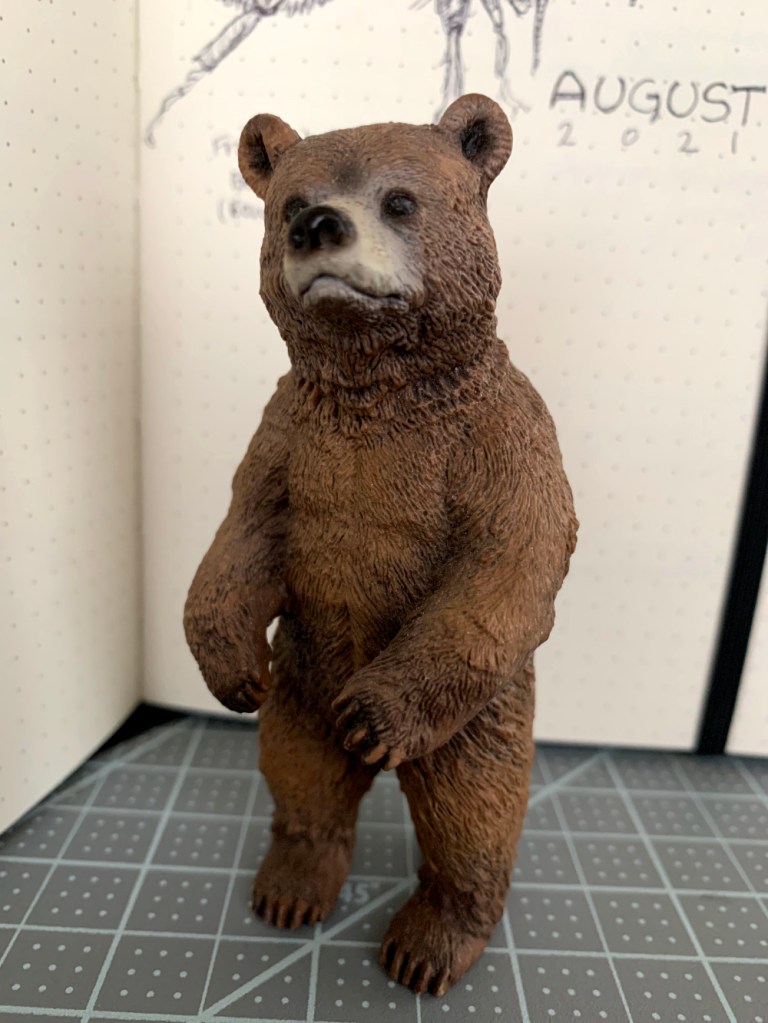
A Grizzly Bear… sort of.
Over the years I’ve become a bit of a collector of animal figurines; I have a plastic shoe box full of them. My favorites are from Schleich, but I’ve been known to pick up figures from other companies as well.
I’ve always wanted to do a small zine featuring watercolor paintings of some of the figurines. Maybe now is the time (sigh).
I’m sad (kids sick and dying from Covid). I’m mad (very high Covid rates: cases, hospitalizations and deaths). I’m annoyed (financial advisor says to me, “if Carmen ever decides to work for a living”… sigh. Once more for those in the back: just because I don’t get paid to take scrub walls, scoop poop and butcher small animals… and hang bee traps (that I paid for), trim beaks and talons, replace perches, jesses and platforms… doesn’t mean I’m not working.
And my hip hurts (see ill-advised patio installation gig, and subsequent physical therapy).
See also: too much doomscrolling. (Why does my spellcheck insist that this is not a word?)
My fall plans were never set in stone, but aside from switching to KN95 masks when the kiddos come back to the Outdoor Learning Center, whatever plans I had in mind are no longer viable. Depending on how the next month or so goes, our holiday plans might also be out the window, which… I’m having trouble contemplating that, so…
In other words, everything sucks. (Except the Paralympic Games. The Paralympics definitely don’t suck.)
So I’m going back to school… sort of. I’m taking three drawing classes, all online, two of them asynchronous, and one of them with an artist whose work I admire (I’ll be making the sketchbook(s) I use for that one). They’re socially distant by design. It will have the benefit of putting me on a schedule (a rather tight one, actually), keeping me busy, and allowing me to upgrade skills I already use. If this term goes well, I’ll do some more of that kind of thing so I can specialize a bit more.
So it’s not school, per se, since it’s not an accredited program with a terminal credential. It’s more like a couple of classes concentrating on subjects I enjoy and want to learn more about… just on a pretty good schedule, with feedback.
Here’s hoping I learn some things, improve on some skills, get to interact with fellow students, and cut down on the doomscrolling.
I struggled with a pretty extreme case of perfectionism from the time I was a young child until well into adulthood. Occasionally, I still have to talk myself down from the attitude that “everything you do has to be exceptional or you’re a failure.”
If you have children, please make sure they don’t have to deal with this. It stunts development. Seriously. If you have a child who is afraid to make mistakes, you (and they) run the risk that they will constantly feel like they’re failing and so will be afraid to try new things, and/or be afraid to explore whatever limitations they encounter.
We’re all going to find things that we’re just not that good at, particularly if we don’t have a lot of experience with them. If those things are things you don’t enjoy all that much, it’s fine to move on from them. But if you have enjoyed those experiences, and want to explore more about them, you should feel free to explore them, even if that exploration doesn’t look productive to others.
We all deserve the opportunity to mess up now and then. Mistakes can be a gateway for learning, particularly if you can look at your own work and figure out how you might approach the same task in the future.
I have been experimenting with printmaking and bookbinding over the last few months. My background is in lettering, illustration and graphic design, with a little bit of (darkroom!) photography thrown in for good measure. I’ve dabbled with both book making (mostly single signature, but some stab binding) and eraser carving, but this year I’ve been experimenting with techniques that are a squidge more technical — they are techniques I’ve never used and know nothing about.
There have been some disasters, and some near disasters. And my most successful books and prints are, well, the work of a beginner…
… And that’s OK.
A book using techniques that I’ve never tried before, made at a workshop. This book contains techniques that I’ve never even heard of, so it’s a wonder it got to this level of finish.
As I move into this next phase of my life, as I work to contextualize and let go of perfectionism, I’m learning that I am not good at setting goals. If you aren’t working on specific goals, you can’t fail, right?
But you can’t succeed, either.
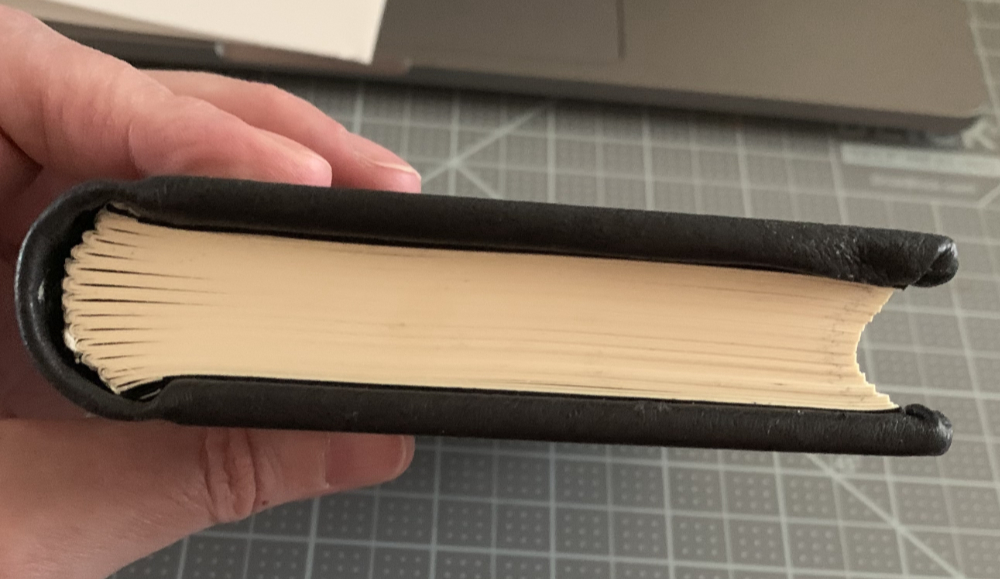
The spine of this book was sewn on tapes (new, to me, technique). The spine has been glued, and pounded to round it, then stabilized with tissue and super.
The bookbinding workshop I attended last weekend contained techniques that I was so unfamiliar with that all I could do was listen carefully to the instructions, do my best, and seek help often. (I’m really grateful for a compassionate and kind instructor!)
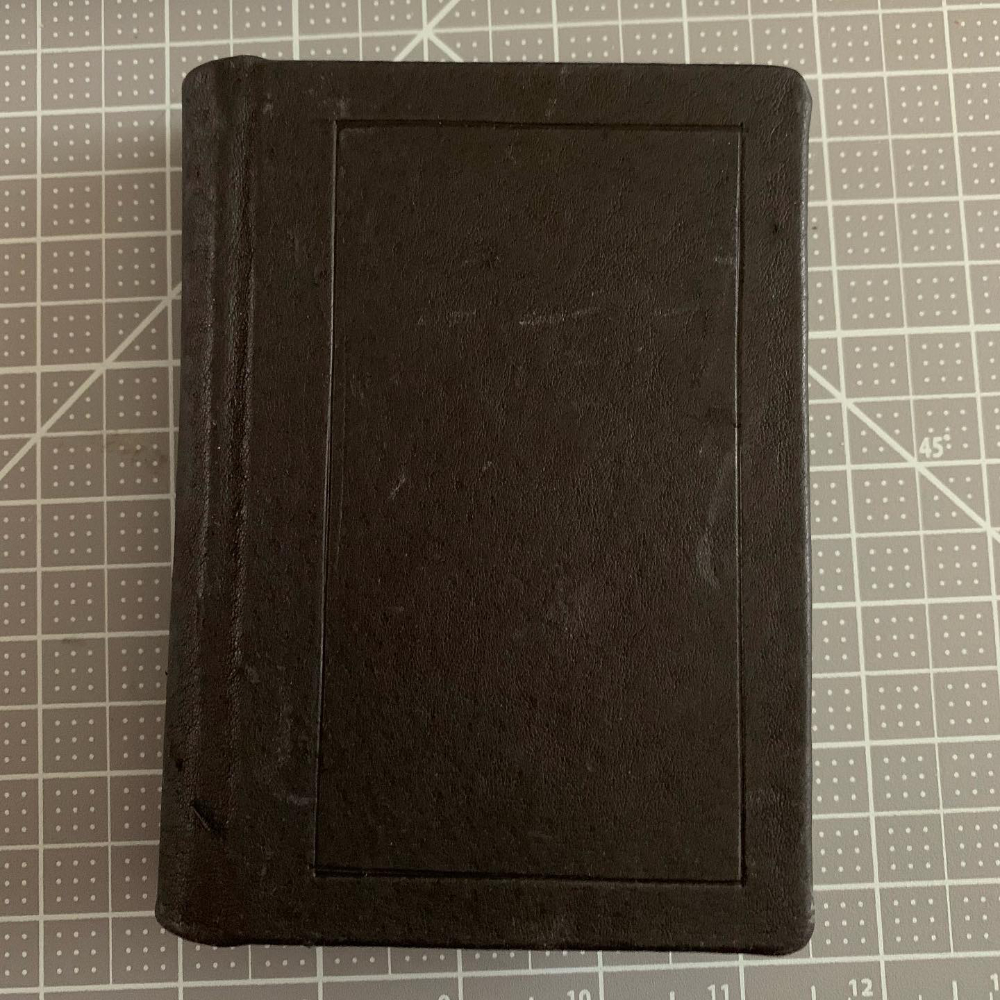
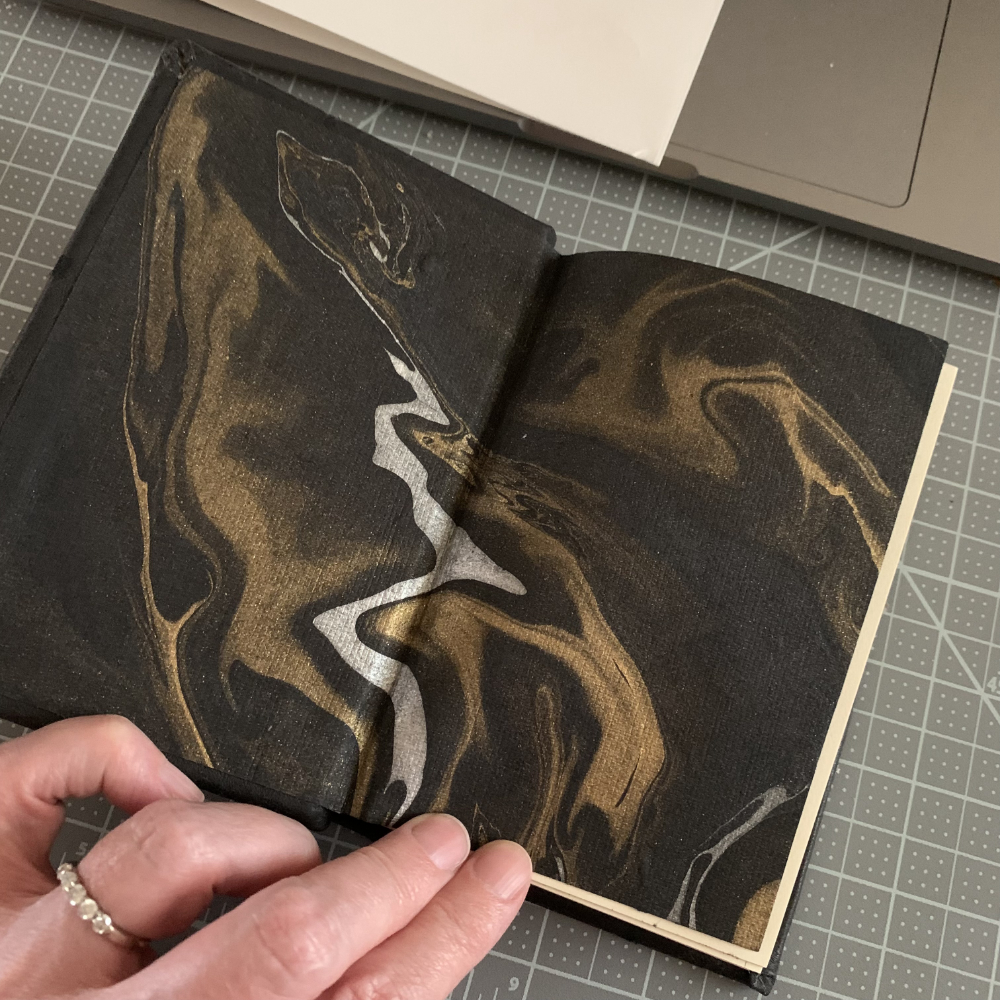
The book is bound in leather, with sandwiched boards and zigzag end papers (a technique I’d never even heard of until trying it).
My takeaways from this workshop: the skills I was introduced to last weekend will require a lot more practice before they become truly useful to me. I’m grateful to be able to learn.
Yeah, so I missed the crop marks with the guillotine, so… but it’s a finished book! (Just don’t look too closely at the corners… they’re really bad…. It’s fine.
Not a disaster, but it really could have gone either way at just about every point. Let’s just say it’s desperately imperfect and leave it at that. That’s OK. I’ve never used these skills, and there’s a first time for everything.
Ultimately, I want to be able to make my own journals. That’s my goal for right now.
This week, I tried it. My immediate goal is to work on my sewn bindings, because my books are a little more wobbly than they should be.
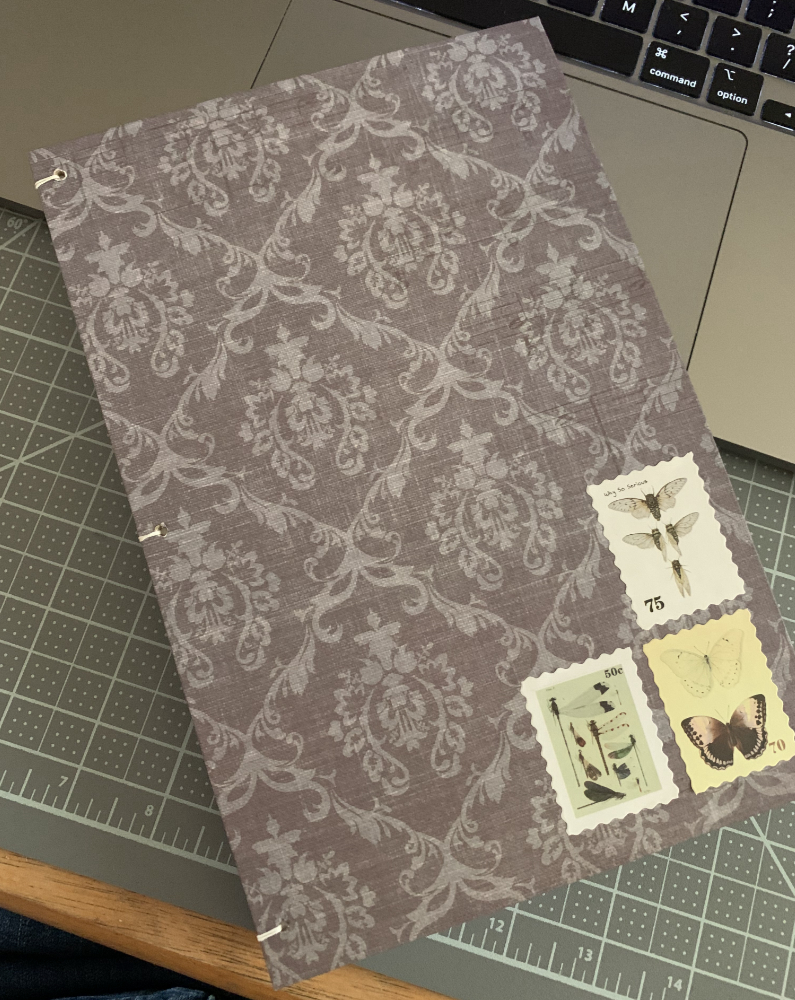
This book is 9″ x 6″ — paper is a very basic drawing paper, seven signatures. I didn’t notice the cover pattern was upside down until I took this photo (whoops)!
I folded the signatures one day and put them in the press for 24 hours. Then I made the sewing station pattern and created the sewing stations.
The covers are made from too thin chip board, covered with scrapbook paper I had in my stash using PVA. They spent 24 hours in the press to cure.
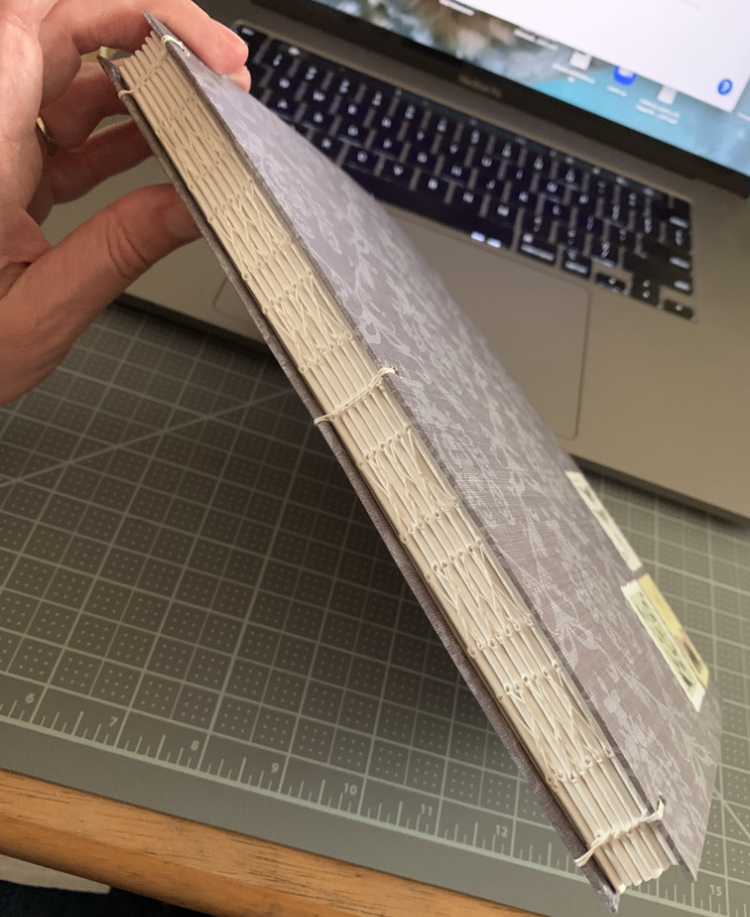
Binding sewn using Kettle stitch at the head and tail, French link across the spine, and a chain stitch at the center.
You can see that the covers are a little bit warped from too much tension at the head and tail. But the stitching at the spine is improved from some of my earlier efforts.
Despite its shortcomings, this will be a useable journal. On that front it’s a success!
Ta-dah! It will work!
Some things I learned from this project:
The chipboard I used for the covers is too thin, but if I want to try making actual end papers again (or even if I don’t and want to use the first sheet as an anchor, I can sandwich them.
Make some bookcloth (or buy some) for the covers. This paper cover won’t be as sturdy as I need it to be… by the time I get to the end of this journal, the corners will be a mess… and maybe the rest of the cover will be as well.
… and (maybe) watch to make sure the pattern is right side up! (face palm)
Watch my stitching tension, particularly at the head and tail.
The covers are not square. Not sure how to manage that… it might be a lack of experience/practice.
Explore the notion of making a leather (cloth?) reusable cover. (If I do that, I don’t necessarily need a nice or fancy cover — I can use plain board.)
The point of all of this is, it’s okay to not be an expert on your first (or second, or third) go. (Sometimes it’s actually fun because the expectations are a bit lower than shooting for perfect. Attention to detail is good — maybe double check to make sure your covers are right side up — but so is acceptance that it might not be as nice as you’d like.)
It’s good to have experiences. It’s great to be able to interrogate those experiences — and the products coming out of them — and to identify a) whether you want to keep going, and b) what you can do to challenge whatever limitations or shortcomings you encounter.
Let your first efforts (at whatever) be disasters… or desperately imperfect. Learn what you can from them and take that knowledge and experience with you as you move forward. It’s all good.
On Friday evening and Saturday morning, I got to take a bookbinding workshop. I’ve been wanting to learn to sew text blocks onto tapes, and that was the focus of the class, which was awesome, but there was so much more.
The text block, after it had been sewn, glued, trimmed, pounded (to round the spine), glued again and reinforced with tissue and super, then set under weight to cure. Elapsed time: 3 hours.
We were exposed to techniques that I’ve never even heard of or read about:
1) we made zigzagged end papers to help stabilize the attachment to the cover…
2) we pared leather… my attempt wasn’t all that successful, but it’s not something I’ve ever done, so the lack of success was both understandable and acceptable.
3) we sandwiched our covers. That text block is not going anywhere.
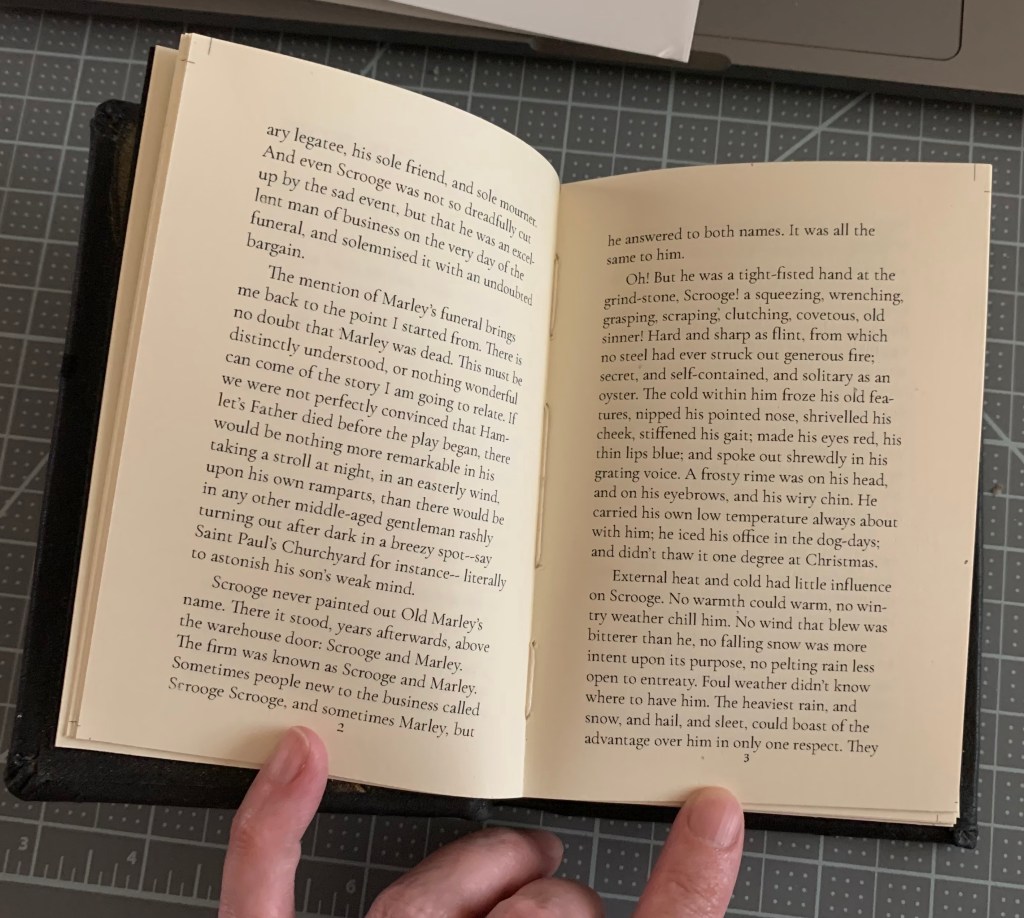
The book. The leather isn’t the greatest, and I didn’t help that with my lack of skill.The end papers are fun… little bit of flash! The corners are… um, not expertly done, but see above re: lack of experience.The instructor was kind enough to give us the text of A Christmas Carol so we could say that we had actually bound a book. (I kind of missed the upper crop marks on the guillotine… my bad.)
When I take these workshops, I’m more interested in being exposed to new techniques than I am in making a masterpiece. If it’s my first time trying something, I reserve the right to create a disaster. Anything other than a disaster is icing on the cake.
This was not a disaster. There’s a lot of room for improvement, though. It will require quite a bit of practice before any of these skills can actually become useful to me, and that’s fine.