A couple of nights ago, there was a mid-air collision between a military helicopter and a commercial flight on approach to Reagan National Airport. Sixty-seven people were killed, including the crew of the helicopter, and the crew and passengers on the jet.
Although we saw what happened, we will have to rely on the skill and experience of air crash investigators to sort it out. [In the meantime, apparently the FAA has restricted the helicopter route along the Potomac to police and medical helicopters.]
In my personal search for helpful information, my husband alerted me to this video, made by a former F-15 pilot. In my limited experience with pilots, this is how the really good ones talk about flying — as analytical, careful practitioners. This creator has a YouTube channel, and is at https://pilotdebrief.com/. (One of my first questions was about why TCAS didn’t seem to be in play in the jet, and he answered that question — because of the low altitude of both aircraft.)
I’m sure there are many other smart, experienced people, with relevant experience as pilots or controllers, who can help us make sense of the publicly available information we have so far. I watched another video where the creator (a pilot) talks about the tower and ground response being quick and professional, and another where the creator broke down (in more technical terms) the routes each aircraft were taking and the challenges presented by busy airspace in nighttime, urban, conditions. Although “visual separation” is a recurring theme in these videos, one of the most important features of them is that each of the creators says that they are working with publicly available data, and that there’s still a lot that we don’t know…
… which is an excellent reminder that air crashes tend to be complex, often cascading, events. A lot of the time, they can’t be explained easily, and sometimes, investigations raise more questions.
The NTSB investigated the air accident that killed my dad, many years ago. The report was comprehensive, and fair, and included not just information about the weather (nighttime, poor visibility due to fog, near-freezing conditions), and the equipment involved (which I can’t remember off the top of my head), but information about the pilot’s (my dad’s) qualifications, his decision making on the ground before the flight, and in the air. They also sought information about the conditions and operation of the airfield, and the quality of information from the tower just before the crash. In their final report, the NTSB pointed out decisions that probably should have been made differently (including by my dad), but stopped short of assigning blame for the accident. (This may be wrong, but I get the sense that they avoid assigning blame when they can, particularly if no one is behaving recklessly, or purposely acting against their training.)
Of course, in my dad’s accident, the investigator knew what had happened immediately (the pilot was dead, the plane was destroyed, the tower was damaged), but they took the time to examine multiple factors that may have contributed to the accident, to get a better sense of how it happened, why it happened, and how to prevent it from happening again. None of it could bring my dad back (closure is not a word I would reach for, here). There have been other small-craft air accidents in similar situations with similar outcomes, because when weather issues, human perception issues, and navigation issues converge, bad things can happen. But I hope that, with more information and understanding, these kinds of accidents are rarer than they might have been otherwise.
Point is, I think the NTSB does excellent, important, work. I expect they will do the same here. The rest of us should avoid coming to conclusions based on easy explanations and/or speculation, and let the NTSB and the FAA investigate the accident without pressure or interference.
But it’s also important to understand that even if the NTSB’s report is helpful, and this kind of accident never happens again, there is no making sense of this event for the families of those killed in it; it is a terrible tragedy.
–*–*–
Confession: I’m a fan of the TV show Air Disasters (Smithsonian Channel, and now Paramount+), not because of the flashy recreations, but because they highlight the work of air crash investigators (often the NTSB, but they have featured agencies from around the world). The work these folks do is creative, evidence-based, interesting, and important, and has improved safety for both aviators and passengers.
If you’re expected to be one of the smarter people in the room, I understand that it’s tempting to wade in to a topic you know nothing about and make stuff up, to sound smart.
Bit of unsolicited advice: don’t do that. Particularly if you don’t know what you don’t know. Fudging around the edges? Still not great, but if you really don’t know what you’re talking about, best to avoid the practice altogether.
On Friday, President Trump visited California to meet with leaders about the recent fires. During a press conference, he said this:
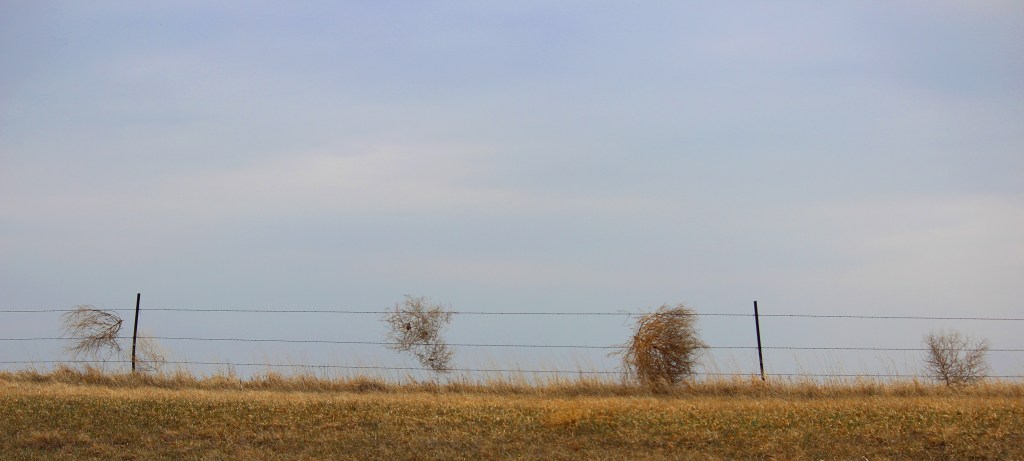
“We shouldn’t be in a position where you have tumbleweed that’s dry as a bone. Even tumbleweed can be nice and green and rich and it’s not gonna burn. You don’t even have to remove it. It’s not gonna burn. But it’s just dry. So I hope you can all get together and say I’m so happy with the water that’s gonna be flowing down.”
Here’s one reason the President’s statement is problematic: with *my meager credentials* (they are neither comprehensive, nor sterling), I can say — with some confidence — that there is no contextwhere that statement is correct.
I have no special knowledge about tumbleweeds. I’m actually allergic to them, which seems kind of weird, but whatever. In Spring 2020, I took a community-college-level botany class, because I think plants are pretty amazing and it seemed like a good opportunity to learn some new stuff (good class, highly recommend). Because of where I live (Eastern Washington), and other interests (I’m a master naturalist), I have a passing interest in (but not a lot of knowledge about) fire ecology.
At least one species of tumbleweed commonly found in the West is invasive: Russian Thistle (Salsola tragus). This plant is an annual. And yes, it is green for part of its life cycle, but it’s the early part, when the landscape still has access to some water ( –> lower fire risk). Near the end of its life cycle, as its above-ground structure starts to senesce (begins the process of dying), it dries out and breaks off at its stem. And then, like the name says, it tumbles. The agitation helps to disperse its seeds. The plant evolved to work this way.
By the time this structure breaks off as a tumbleweed, it’s combustible. I think everyone agrees that in fire conditions, a rolling mass of dried out plant plant matter is bad. But the solution here is not to water the tumbleweeds. Setting aside the botany, the economics of that strategy don’t check out; even if you could locate every stand of tumbleweeds in California, it would be a tremendous waste of water that could be used for agriculture (or, you know, whatever). It would be great to figure out how to mitigate (or eradicate) invasive weeds in the West (LA County is working on this!) — our native landscapes would likely be healthier (less competition for resources from invasive species)… and maybe even a bit more fire-resistant.
To take this a bit further, even if there were no tumbleweeds, at least some of our ecosystems rely on periodic fire to maintain growth and foster regeneration. When I mention fire here, I’m not referring to the conflagrations we’ve seen in recent years. Those are a combination of factors, including climate change, decades of fire suppression, and human activities. (Good, recent article about this at the United Nations Office for Disaster Risk Reduction (UNDRR) website, PreventionWeb.)
Fire is a complex challenge in North America, with no one-size-fits-all solutions. But there are experts who know a lot about this very complex issue, because they study it, have experience with it, work with others on it, and think about it… a lot. Some of these experts include, but are not limited to: local indigenous land managers, local ecologists and fire ecologists, emergency managers, and with their first-hand experience, wildland firefighters (who do incredible work, under very trying circumstances, every year). I’m spitballing here, but it’s probably a good idea to defer to these folks when trying to suss out solutions for this, particular, very complex challenge.
The broader point is this, and we should all take a note: none of us has to be the smartest person in the room. If you run into a topic you don’t know anything about, it’s a really good idea to stop talking (or better, start asking questions!). Bullshitting can create misinformation, and it undermines your credibility, particularly if you’re screwing up on the lowest of low-hanging fruit by workshopping a poorly-reasoned organismal solution to a community problem.
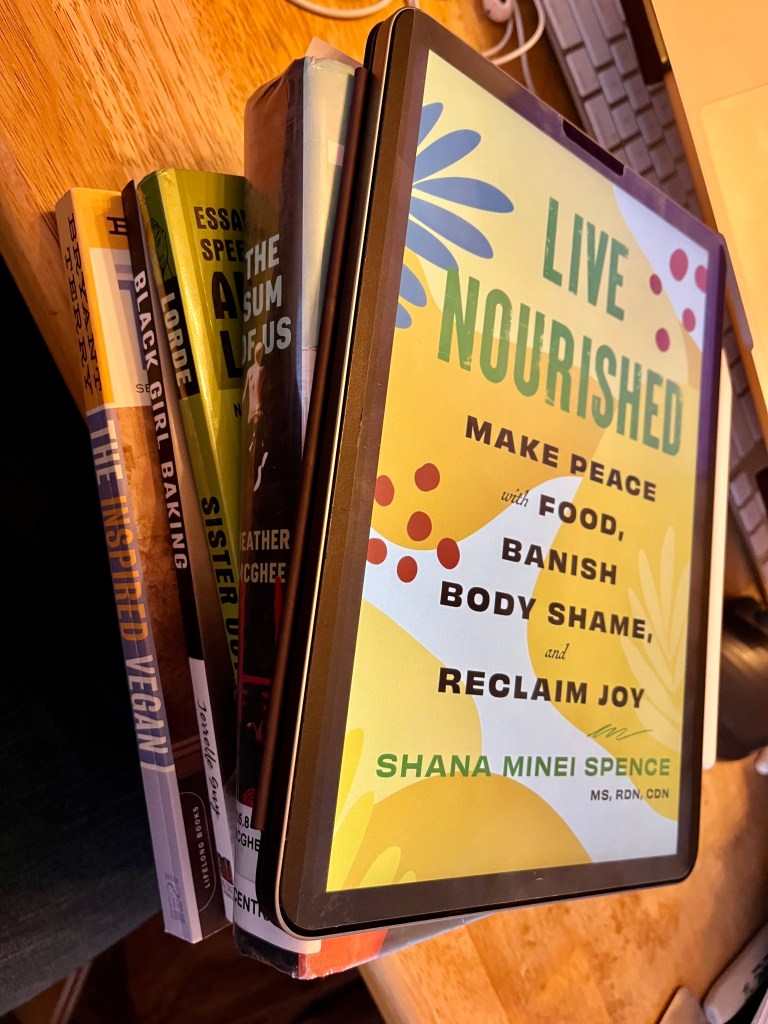
I’ve got a big semester coming up. Okay, so not any more intense than usual (I hope), but I think it will be both engaging and useful. Topics of courses this semester: data visualization, and instructional design. For the instructional design class, if the textbooks are any indication, we will be exploring information literacy, a topic most of us could learn a bit about and from.
The textbooks in question…
I volunteer in an organization where I do a bit of community outreach — mostly with adults and families, but sometimes I get pressed into service to work with kids on field trips. I do raptor talks, or insect talks, or (very occasionally) nature journaling, so I work very much in the realm of things that can be observed first hand. That said, I hear a lot of assumptions about wildlife, in both kids (which I expect, because most of them are young enough to lack a lot of context), and their adults (which can be indicative that there’s a concerning lack of education in very basic biology and ecology), that are… incorrect… and sometimes dangerous, for both the animals and the people.
In the realm I work in, these assumptions tend to be variations on themes of “tameness” and training (which, again, is somewhat understandable, given that most of us don’t — and shouldn’t — have actual relationships with raptors), or human supremacy/dominance (in other words, because we exist, we have something to offer animals that we think they need, or we need to bring them to heel).
PantsStanWhoolio
For most of us, our experience with animals is primarily with domesticated animals, like our pets. The understandable impulse is to apply our experience with our pets to other kinds of animals… which doesn’t work, and can be very dangerous, for everyone.
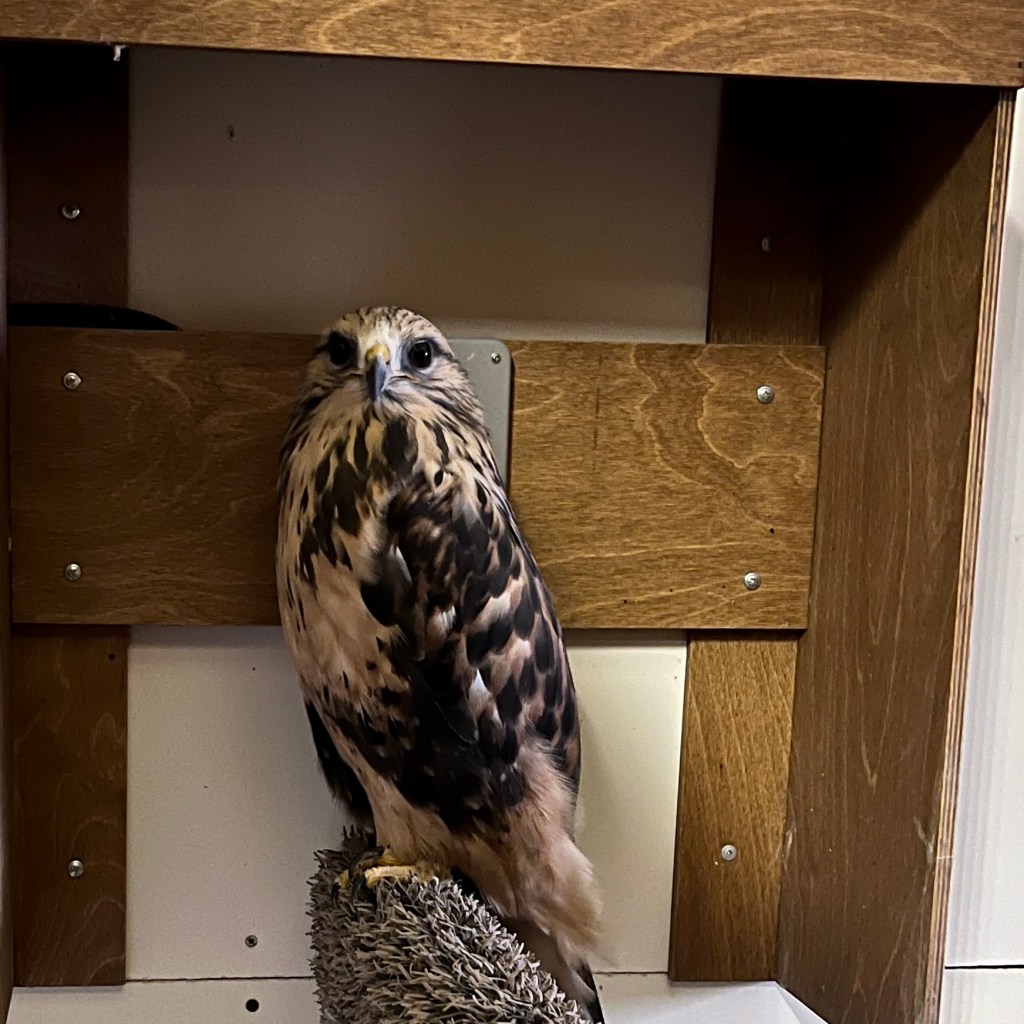
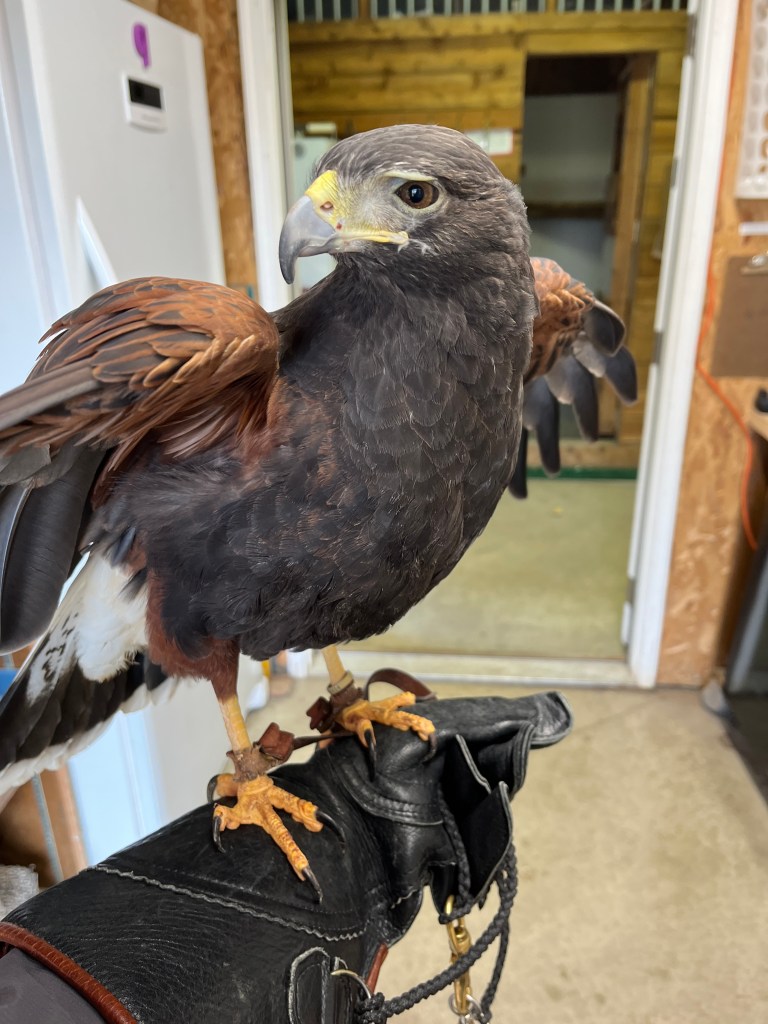
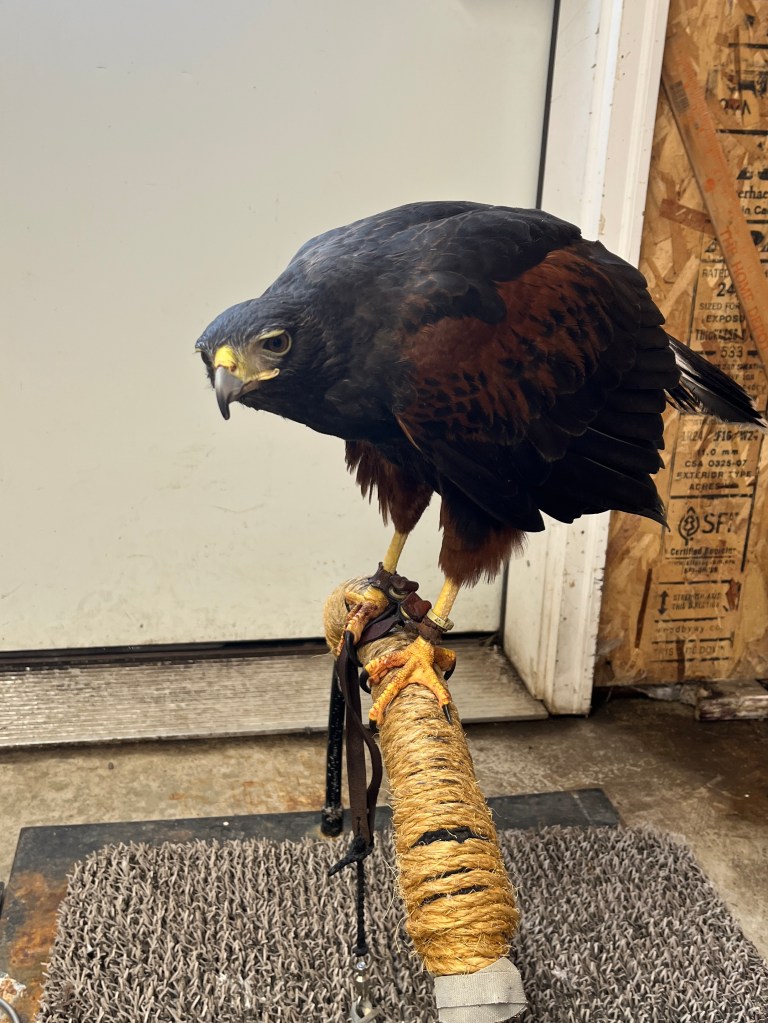
Take the ideas of tameness and training. These birds (who are unreleasable/cannot survive in the wild) are trainable, with consistency and a lot of practice, but they are not tame. They are not pets. Generally speaking, unless they are nesting or migrating, raptors are solitary. Stan is the possible exception, because Harris’s hawks live and hunt in small family groups in the wild. On the flip side of that, Stan, because he was raised primarily by people, turns into kind of a jerk when he’s looking for a girlfriend (he still has strong feet with sharp talons).
But Pants (rough-legged hawk) and Whoolio (Western screech owl)… definitely solitary — if they never saw any of us again, they would be fine. (I mean, they wouldn’t survive because their disabilities render them unable to hunt, but our absence wouldn’t leave them in any kind of emotional distress.) It’s difficult for us, as social animals, to understand that solitary animals do not need or want company; they are not lonely, and the presence of others often puts them at a competitive disadvantage.
And as for the other thing, the human supremacy… I’m not sure how to deal with that one, except to say that humans are bear-sized snacks, so if you are in bear habitat, you would do well to consider yourself a potential prey item and act accordingly. Interacting with moose, or bison, or Canada geese, is always a bad idea, because they don’t like us, and it would not matter if they did, because humans are predators and they do not want us in their spaces. A bison or moose that feels threatened could easily kill you and not think twice about it.
Even if we’re top of the food chain, the animals around us will do what they can to survive in our environment if we move into their habitat; coyote will do what they can to survive, including taking animals you may not want them to take. Same with owls. And raccoons (avoiding raccoons is tough; we live in a suburban area, and our dog treed two of them recently).
So yeah, having an opportunity to think about information literacy will be interesting. What is information literacy? How to we acquire it? How do we pass it on, in ways that people can ingest? If your thoughts about your interactions with animals are based primarily on vibes/your experiences with your pets, how can I introduce you to a way of thinking that’s more inclusive of wild animals and their habitats — in a way that is factual, and respectful/compassionate?
On another (very much related) front, I have to do some continuing education to maintain my Montana Master Naturalist certification. In past years, I’ve done nature journaling coursework, or seminars about ecology topics around the West. This year, I’m changing it up a little bit and working on introductions to topics that are more foundational, like ecology, climate change, and fire ecology (which, if — like me — you live in the Western US, is a topic you’re already probably more familiar with than you would like to be).
One of the reasons I love the internet is that you can learn just about anything. So, for ecology, I’m taking a Coursera Course: Introduction to Biology: Ecology (offered by Rice University).
I’m enjoying the content. It’s very basic, and the stakes are low. But it’s informative for a person like me, whose education has been mostly liberal-arts based, and who is interested in being exposed to a new and different topic.
I’m using this course to develop a little bit of foundational knowledge on the broad topic of ecology, and then using that foundation to inform some investigation into the topics of climate change, and fire ecology.
And hopefully, I’ll be able to bring some nature journaling into all of it.
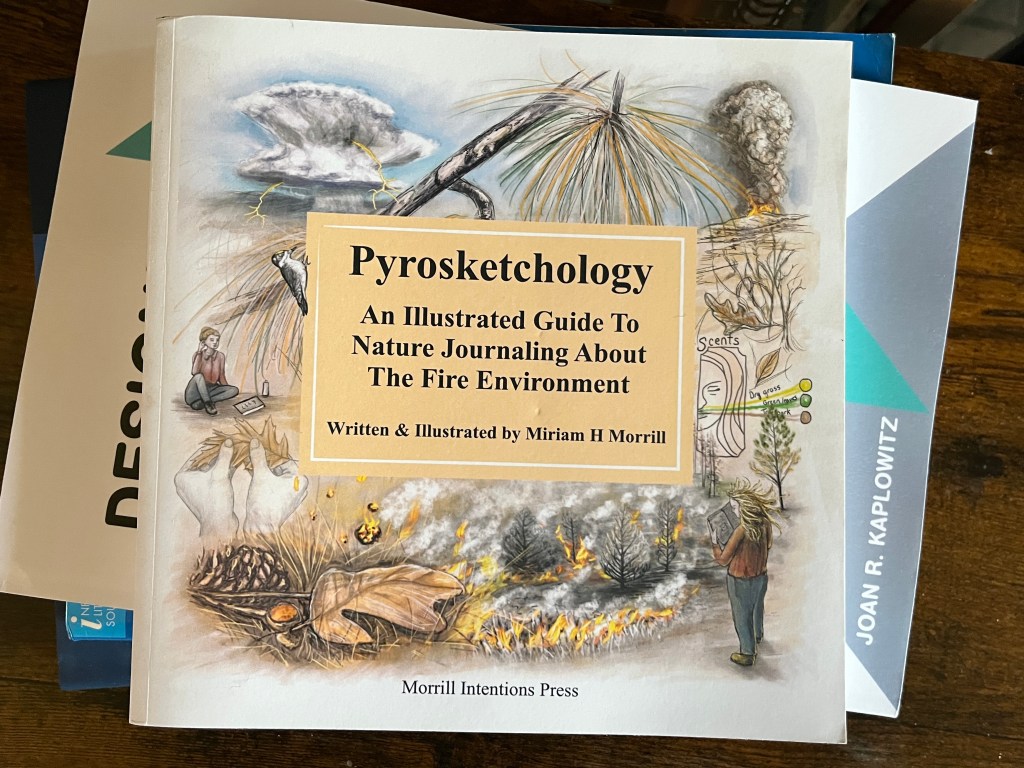
This looks to be an excellent book. I’m excited to delve into it while I learn more about fire ecology. (Bookshop.org link)
So, yeah, much to do this spring. I’m looking forward to it.
(Today will also include making a loaf of beer bread and some lentil soup for dinner.)
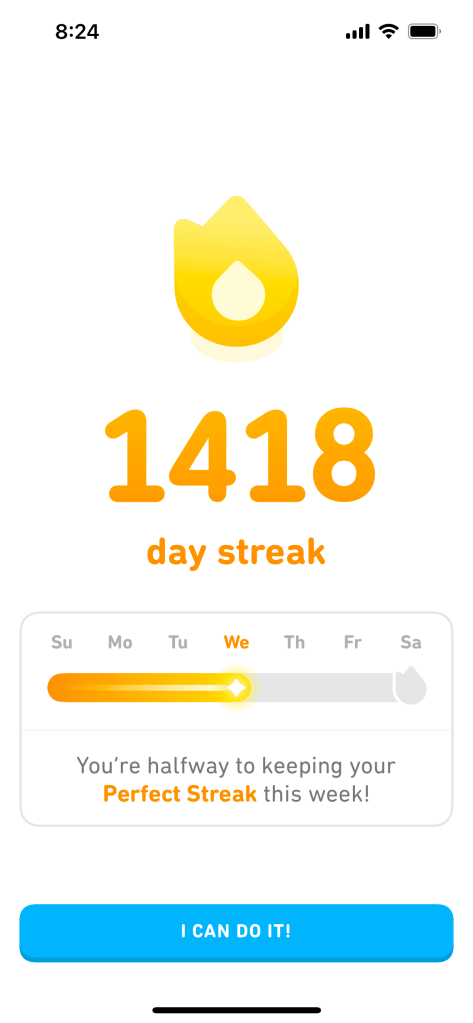
Confession: I was a Duolingo junkie. Until January 1, 2025 (January 2?)…
Screenshot from my 1,418-day Duolingo streak.
Yeah, so 1,418 days is… almost four years. We’re not talking hours a day or anything, but I’m not sure I’ve ever done anything (optional) on a daily basis for that long.
I’ve seen some criticism re: using Duolingo for language learning. I suppose at least some of it is valid. It’s a fun thing to do, but I think it would be a mistake to rely on it as a sole source for language learning. Am I fluent in Italian? Of course not. That said, I know a lot more Italian than I would if I hadn’t used Duolingo.
My issue(s) with Duolingo involve individual traits that made using it challenging. For example, I do not want to be in competition with anyone else when I’m trying to learn something new; for me that’s a recipe for spiraling into perfectionism. It’s not a good place to be mentally, and frankly, it’s not a good look. (I turned off the competitive aspect of it last year, and my experience improved.)
Being aggressively prompted makes me anxious, so that part of it wasn’t great either. As I was disentangling from the app, I saw that I could have turned that stuff off, so… lesson learned.
Last, when I have any kind of streak going, it can (and did) become more of an obsession than was helpful, particularly when the streak itself becomes the goal. I suspect that if I had had some solid language-learning goals in mind (including conversation and reading comprehension), it would have been a reasonable way to support those goals. But I didn’t, and it was starting to feel… not great.
So, at the beginning of this year, I decided to end it. I cancelled my subscription, turned everything off, and just… stopped.
I’d love to say that it was liberating, but that’s not it. Nobody cared about this streak but me, and I didn’t even care about it all that much. But it had become more of a distraction than I was comfortable with, so it did feel good to end that distraction.
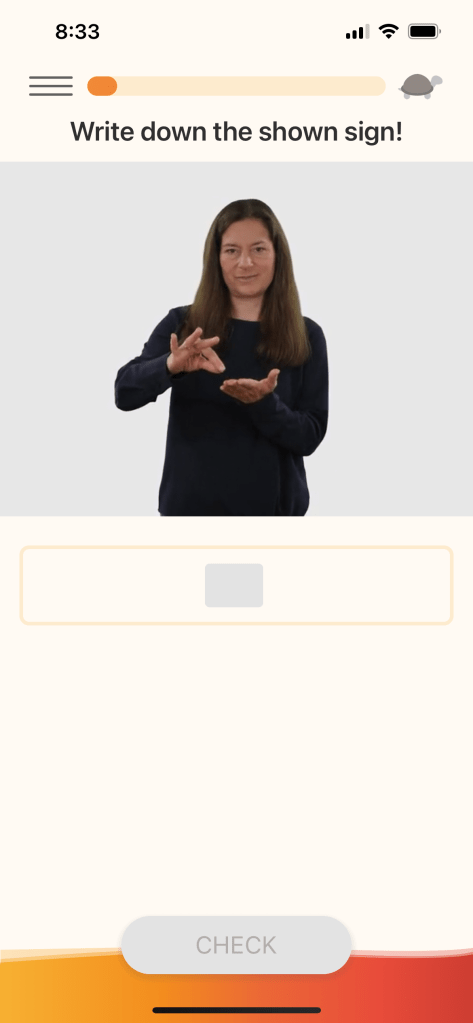
One of the main reasons I stopped using Duolingo was that I want to work on learning American Sign Language (ASL). It’s been on my list of things I want to do for the last couple of years, and last year, I found an app that would allow me to learn some of the basics (fingerspelling, some vocabulary, a bit of receptivity practice), in preparation for finding a class taught by a deaf teacher.
Why ASL? Yes, it’s amazing (watch The Barbie Movie with ASL!), of course, but I have a personal reason: I have no evidence that my hearing will remain intact as I age. Both of my maternal grandparents were profoundly deaf when they died in their late 90s, and I suspect that their hearing loss made their later years more difficult. Granted, it was a very different time — there was a great deal of stigma attached to aging, and the hearing loss that comes with it, so denial was significant for both of them. (One of the harder things about denial is that you have to consistently remind everyone that they’re not speaking clearly, or that they’re speaking too softly.) Hearing aid technology wasn’t great, and hearing aids were both very expensive and very technical. (It’s my understanding that hearing aid technology has gotten a lot better over the last couple of decades, but they’re still both expensive and very technical.) I suspect that neither of them started using assistive technology until their hearing loss was severe, and for a lot of reasons, they were both reluctant users.
I think my hearing is probably fine for a person my age, though I have developed tinnitus in both of my ears (chalk that up to aging, and living with a parrot doesn’t help), and I have a difficult time filtering conversation in crowded spaces. I want to stay on top of those changes, to use assistive technology as I need it, and to become conversant in ASL, so that as I continue to age, I don’t lose access to language and communication. (It’s a generational shift, I think, to consider the loss of language/communication a bigger issue than hearing loss.)
As for the apps, am I replacing one compulsion (Duolingo) with another (Lingvano)? Maybe. (I wouldn’t argue with you if you accused me of it.) Will Lingvano make me fluent in ASL (or even conversant)? No, but that’s not my expectation. My goal is to get through the Lingvano “course” to build a very basic foundation — to be able to introduce myself, to fingerspell with some competency, and to be able to ask (politely!) if the person signing to me can slow down a little bit — and then start looking for an ASL class, so I can work with other learners and qualified teachers.
In other words, I’m using Lingvano in support of broader language acquisition goals.
So far, 400+ days in, it seems like a good investment of time (and money). We’ll see how it goes.
For the first time since before the pandemic, we packed up and flew out of the country (US) for a little while. We obviously didn’t move around much at the height of the pandemic, and then we had a very old dog to take care of… and then a very new dog to train. And a year of school year-round, and work… and it has just been too long. I do not enjoy being in airports and on planes, but I don’t want to be a person who doesn’t travel, so it was long past time to pull some resources together and get out of dodge for a minute.
It ended up being a lovely, lovely break.
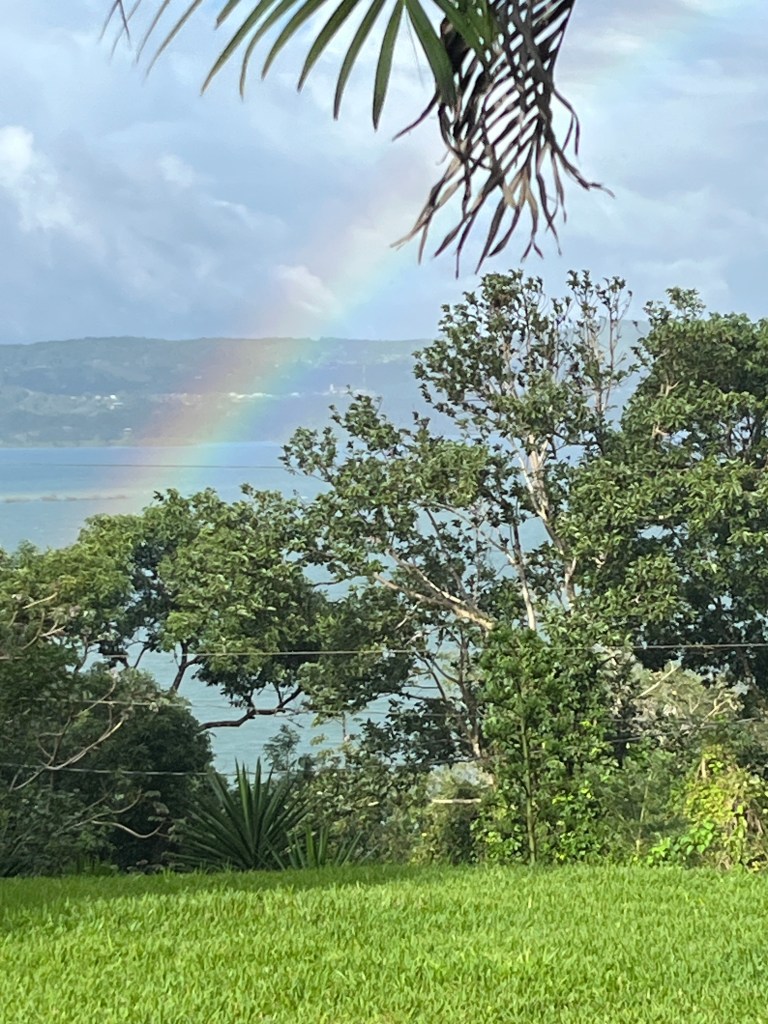
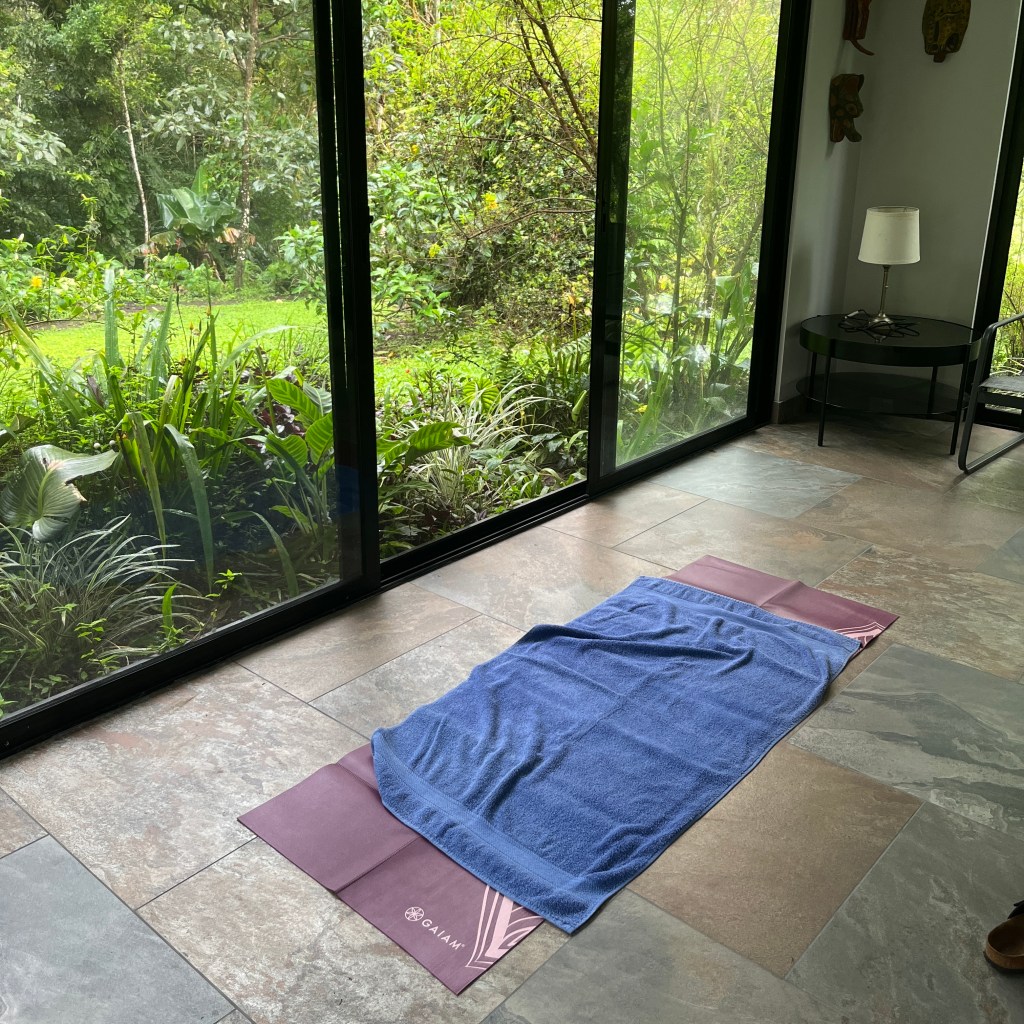
Fabulous-and-talented husband’s mother owns a house in Costa Rica, near Lake Arenal, and she invited us to stay with her for the week. We flew into Liberia and rented a car to get around. My MIL’s house is somewhat secluded, but not remote. It’s a lovely, comfortable house, with lots of windows. One of my favorite things about it was the covered patio, where I could do yoga in the mornings; it was warm and sheltered from the rain. So perfect.
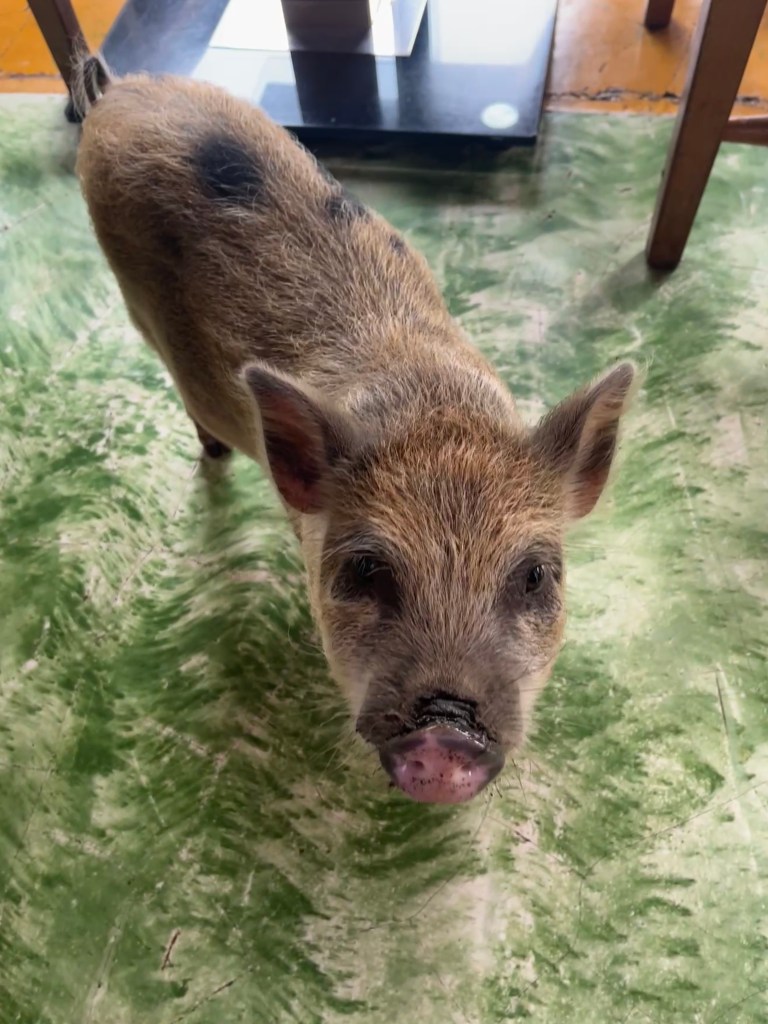
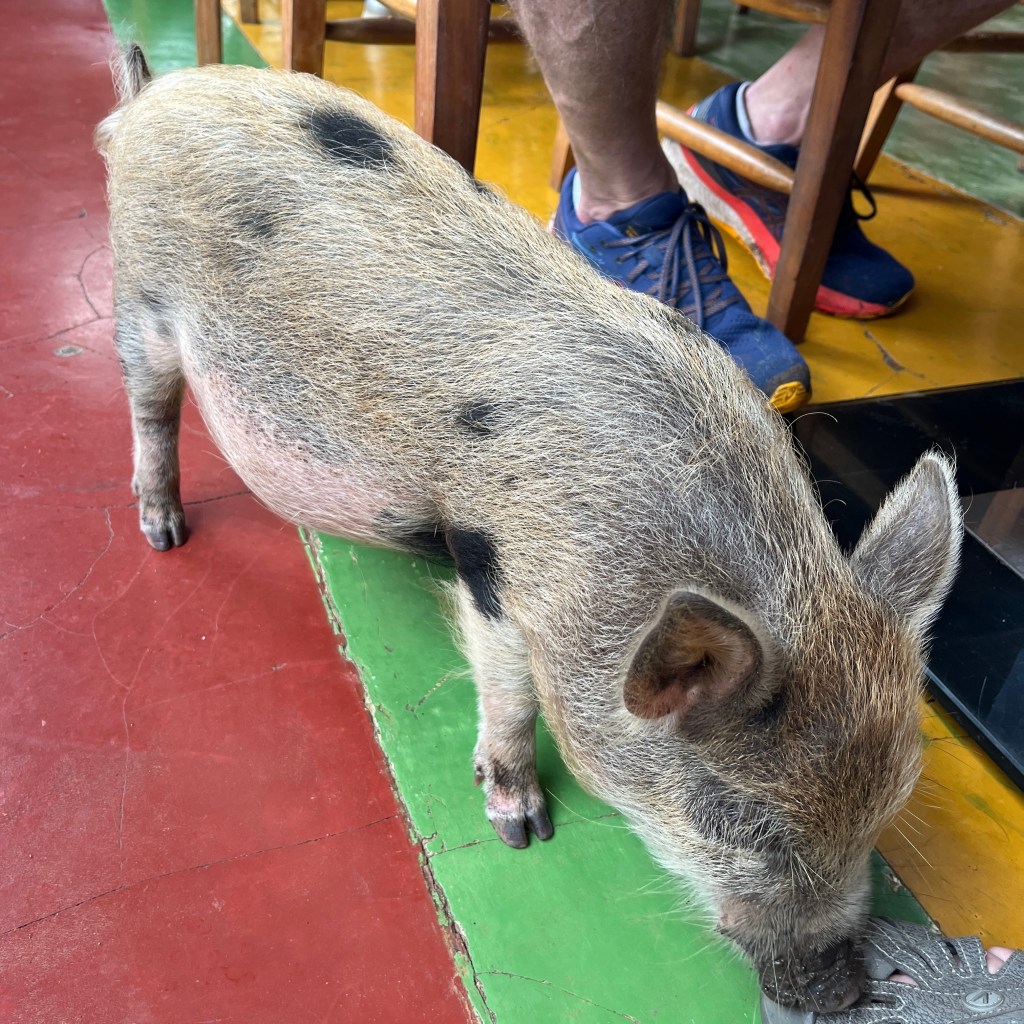
We met at piglet named Abejorro (bumblebee) at a local brewpub. And we saw all manner of wildlife, including howler monkeys, a two-toed sloth, a few common house geckos, leaf-cutter ants, one bat, and lots of birds, including woodcreepers (sp?), keel-billed toucans, Hoffmann’s Woodpecker, euphonia (sp?), great kiskadees and social flycatchers, cattle egret, great egret, black-headed and turkey vultures, summer tanagers. I saw a currasow-shaped bird, and I think I may have seen a scarlet-rumped tanager and a groove-billed ani, but those were on car rides, so … ? We popped in at Playas del Coco on the way back from Tilarán and saw magnificent frigatebirds, brown pelicans, and an elegant tern in the ocean/surf. (Neither my fabulous-and-talented husband, nor my MIL, are birders, so birds were not the focus of this trip.)
AbejorroAbejorro, nibbling on my shoethat round ball is a two-toed sloth
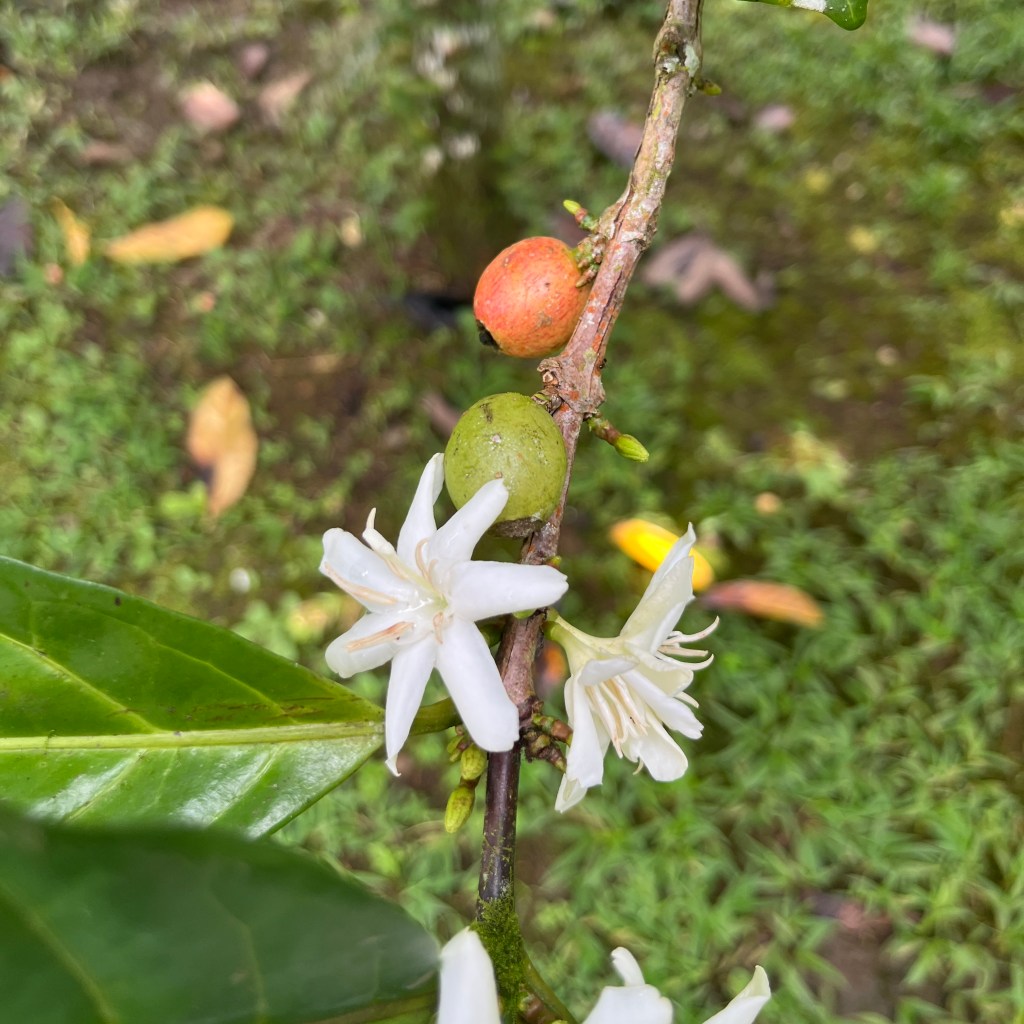
The plant life in Costa Rica is, of course, incredible. I am in love with the epiphytic plants (air plants!) and the varieties of monstera growing on the trees.
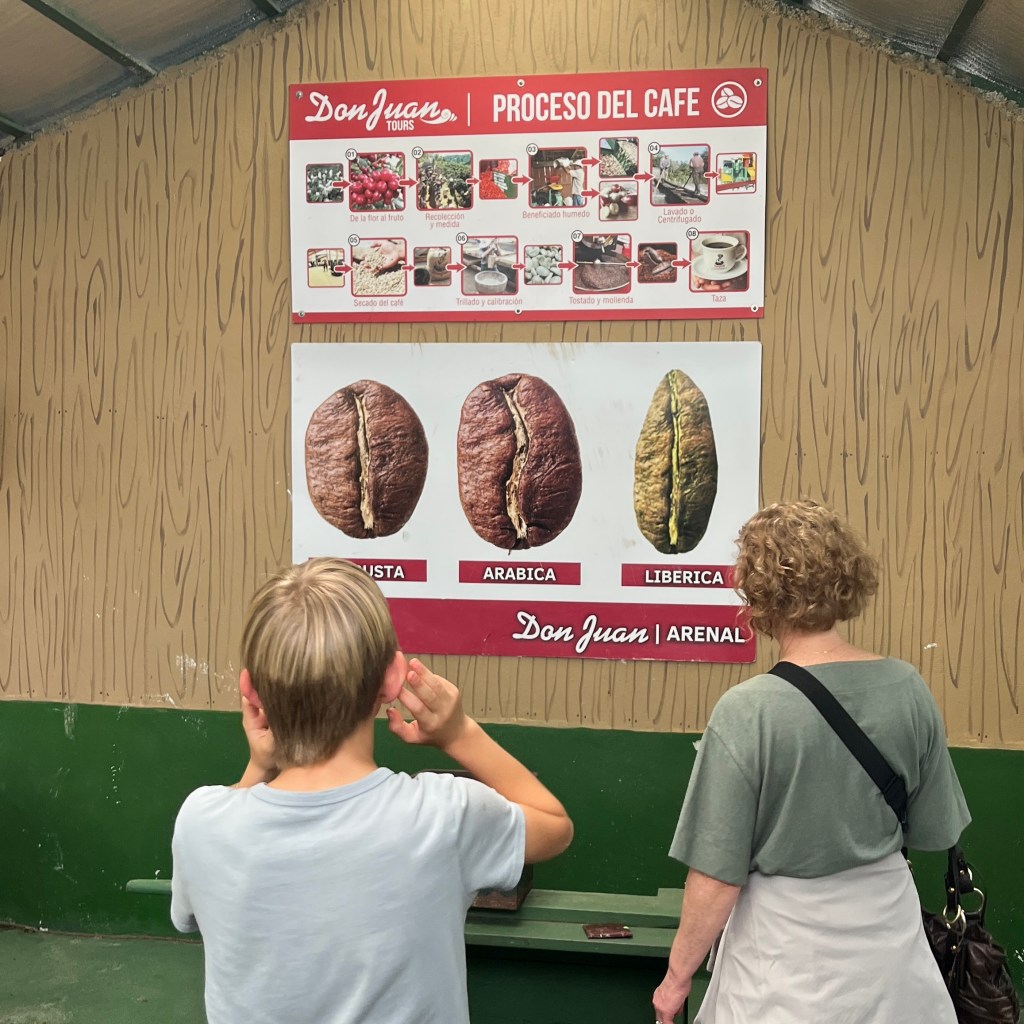
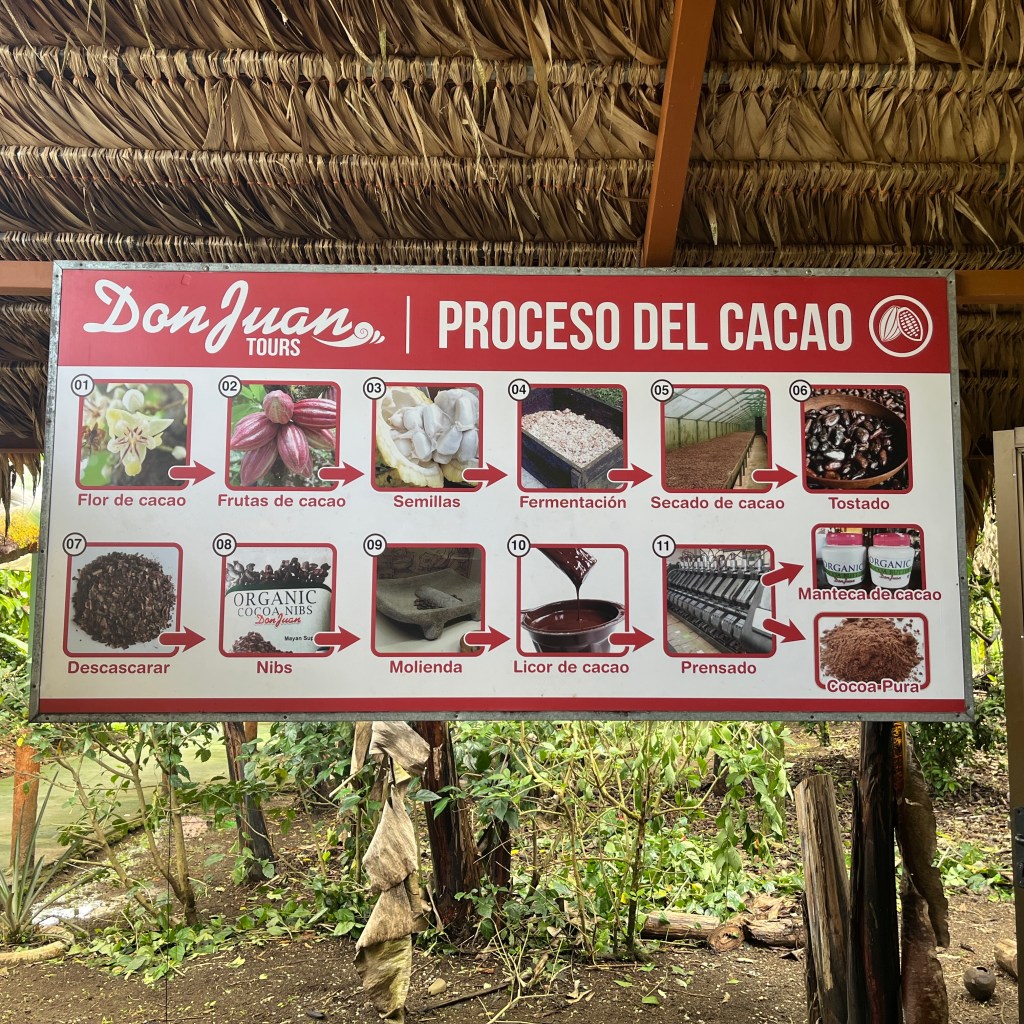
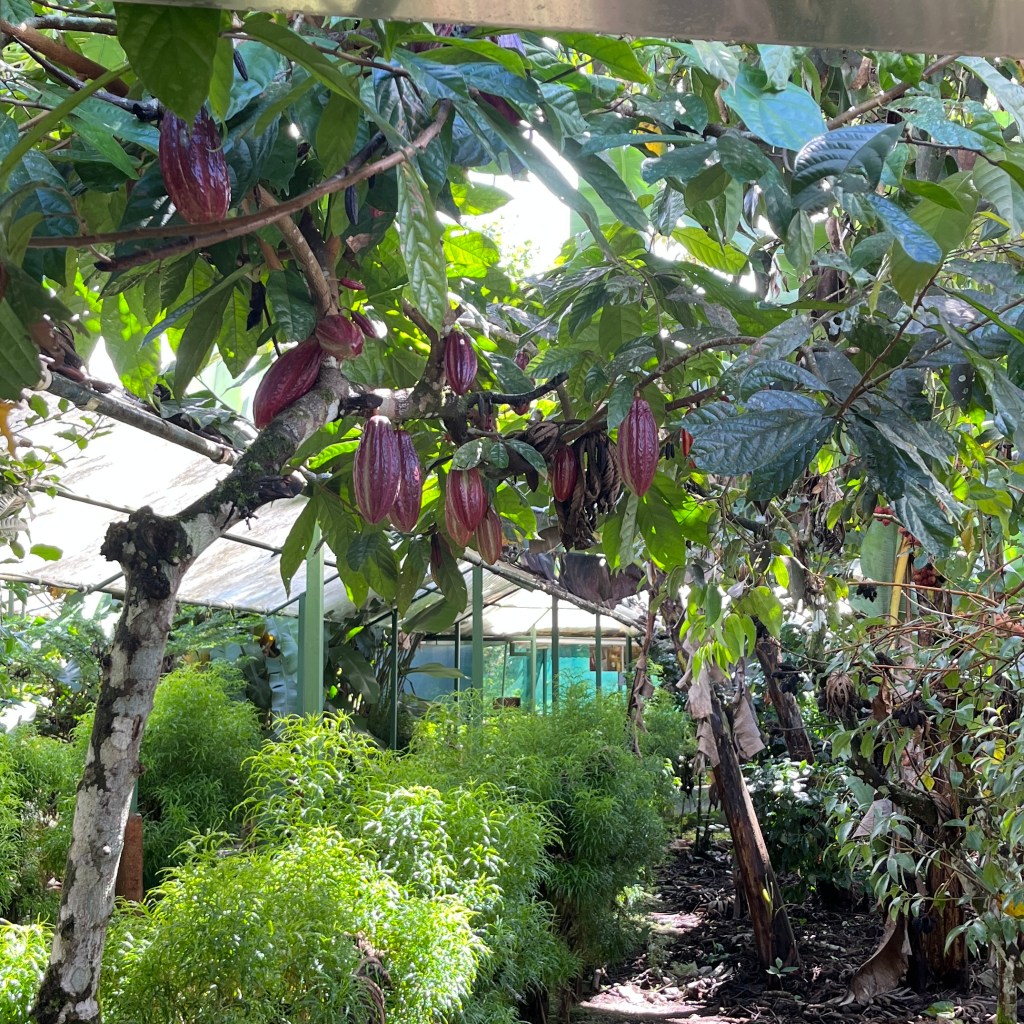
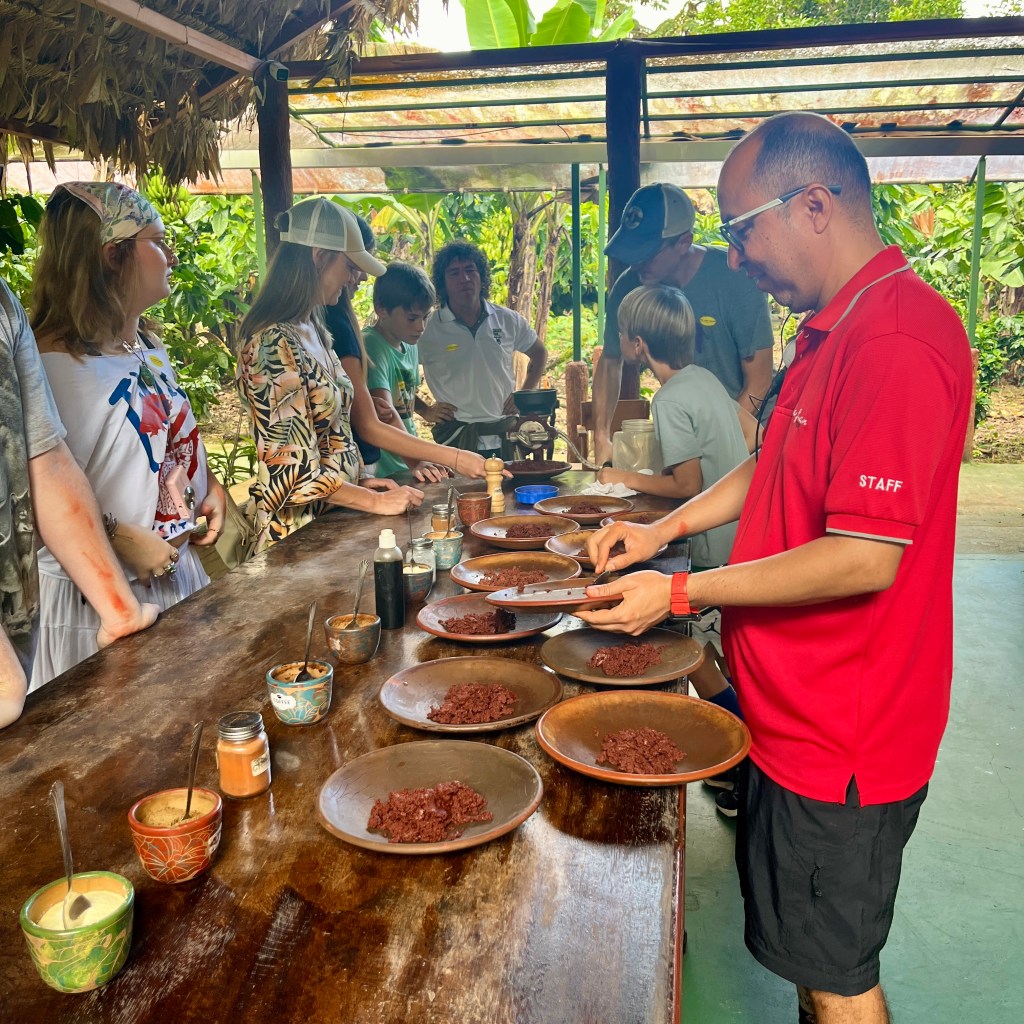
Our most ambitious outing was to La Fortuna, where we went on a chocolate/coffee tour (we got to make our own chocolate bars!), and went on one of the zip lines. Very touristy, but you know what? I was a tourist, so it worked out very well for me.
Zip line enthusiastscoffee infohow to make chocolatecoffee!cacao!Prepping ground chocolateI made a chocolate bar. (Processing by hand does not produce a terribly smooth bar… it was a good first effort.)
This was a good, but very long, day. Driving to La Fortuna took almost 2 hours — Costa Rican roads are paved and in good condition, but they’re winding roads, so travel isn’t quick. We were lucky to catch a break in the rain from about 10:30a to 4p, which is when we were most active. The drive back was in driving rain, in the dark.
Despite it being the dry season, it rained… a lot: at least 1/2″ every day, with a couple of inches of rain on some days. It rained so much that it was starting to cause slides, and Lake Arenal was having to drain surface water. We talked to the owner of Raja’s Curry Point (IG: @rajascurrypoint, linktree: https://linktr.ee/rajascurrycr), a wonderful Indian restaurant in Nuevo Arenal, and he told us that he learned in a conversation with a lifelong resident that there are 7- or 15-year cycles where the mountains get a lot of rain during the dry season. (I wonder if these rains are exacerbated by climate change? As I am not an expert on Costa Rican climate, I can’t make any kind of assumptions about this — but we have enough unusual and unexpected events where we are that when the impact of a weather event is exaggerated or not quite right, it’s a question I ask.)
BTW, Raja’s Curry Point has amazing masala chai. The chana masala was delightful, and so were the samosas. Really good. I had the leftover chana masala for breakfast the next morning — heated it on the stove in a skillet and then cracked an egg into it, shakshuka style — so good. 10/10 highly recommend. (I didn’t take photos of the food because I was so busy enjoying it.)
It was a delightful trip. It was good to see and visit with my MIL. Costa Rica is beautiful. Costa Ricans in general are very patient with tourists whose Spanish is muy malo. (Points at self — my second language is halting Italian. A few rungs below that: ASL. And then French… and then Spanish. Lo siento, pero mi español es muy malo… muy, muy malo. ¿Cómo se dice in español… everything?)
Here were the challenges:
There was so much rain that we didn’t get out as much as we would have liked. That situation, however, meant that we were able to spend a good bit of time relaxing and visiting, which is something we both needed.
Nothing in Costa Rica is close by. From where we were, it was at least 90 minutes of driving to other things we wanted to see. Next time: plan to spend a few days being a tourist and birding before heading to see my MIL, and use the time spent with her in her house as a retreat.
It was a very good idea for us to drive back to Liberia the day before our flight. It made returning the car and getting to the airport much less fraught.
I am so grateful for the much needed break, and for safe travels. And now, as they say, back to our show.
From Stan, the I’m-so-horny-I-need-to-land-on-your-head Harris’s hawk. I love you buddy, but no. Have some perching time in the warm room.
Do I have resolutions? No, no I do not.
Do I have things I want to accomplish this year?
Yes, yes I do.
More of this:
More intentional yoga. This is an extension of last year, which has gone pretty well; I do 25-30 minutes of yoga, 5 days a week. This year I would like to continue with that, but create a practice more focused on strength and flexibility.
Walking. I walk 1.5 – 2 miles a day, four or five days a week. I’d like to continue that, maybe commit to five days a week.
Reading. I’m using the library (both for books and Libby) more now, which I’d like to continue, because… the library!
Journaling and illustration. Another one of those things that I already do — but on a way-to-limited basis — I’d like to introduce more intentionality, and more sharing. I want to upgrade my rendering skills, and engage with more storytelling. Also, nature journaling.
Work with birds. I’m in a weird situation with my volunteer gig right now, where I really only have one volunteer shift every other week. It involves feeding and watering all of the OLC’s animals (reptiles, mammals, insects, fish, amphibians, and raptors), so there’s no dedicated time to work with the birds (unless I turn it into a 4-5 hour shift). But, I would like to do more training with some of the birds (looking at Stan the Harris’s hawk, Arden the red-tail, and Basalt the saw-whet owl), so I’ll have to make time to pop in once a week. I have a membership to Avian Behavior International’s online programs, so that’s going to be my classroom.
News from media not owned by billionaires. Right now I subscribe to The Guardian, The Philadelphia Inquirer, and a couple of newsletters. The Atlantic is my last wealth-owned holdout, and frankly, it’s on the bubble. I may resubscribe to my local newspaper, or a local independent media outlet, for news about my congressman.
School. I want to do 12 units this year, and no summer classes.
Less of this:
Cooking. Hear me out. I have been making full-onevening meals, 5 nights a week. It’s time-consuming to plan, shop for, and cook that much, that often. I’m not going to stop making food at home, or make food at home less often, but I’d like to create a rotation of about, say 10 dinners, that are simple and quick to make, and save more composed meals for special occasions, or for times when I’m itching to try something new.
Social media. Egads. I post very little, but I spend too much time doomscrolling, and it’s not a healthy situation for me. Frankly, I’m not sure that most of us need to be that dialed in.
Perfectionism. Do not let the perfect be the enemy of the good, and all that.
I’ve been thinking quite a bit recently about values, particularly since the U.S. election. I worked in media for more than a decade, and in that role, I was not allowed to become involved in partisan politics. It actually suited me just fine — I’m objectively bad at all kinds of politics (organizational, legislative, election, etc.), and I straight up do not enjoy participating in that discourse.
But I have values and opinions, and particularly right now, I think it’s important to be clear about them, so that everyone can make their own decisions. Some of them include, in no particular order:
Body autonomy. Even in situations where I would make a different decision, or I do not understand or agree with the decision being made… especially if that’s the case. I do not have to understand you (or agree with you) to believe that you have a right to thrive as yourself. Reproductive issues? Assisted suicide? Gender-affirming care? If it involves your body, it’s not appropriate for me to insert myself into the decisions you’re making.
Hold up a second, because there’s a caveat here: if you choose not to vaccinate yourself or your kids against the advice of your doctor, you’re creating the potential to harm others.
If you are a person who thinks it’s okay to hurt puppies, you are not welcome here.
Equity. Our society would be better served if, as a matter of policy, everyone had access to education and services, even if creating that level of access requires different funding, or additional work, from the rest of us. I want to live in a society that values and honors Black/Asian/Indigenous/Latino(a), disabled, LGBTQ+, Jewish/Muslim/Buddhist, and female perspectives, as much as White, male, cis-het, Christian perspectives.
I cannot help but suspect that humanity would be much further along if we didn’t spend so much time and energy othering people… like, maybe we would have already found cures for a bunch of cancers, and at least some degenerative diseases. Maybe we could have mitigated some of the more awful impacts of climate change. Heck, for those into the idea of going to Mars, we might have been able to get there — and back.
Caring for others. As a policy discussion, this is closely related to the idea of equity. For example, there’s talk of eliminating the VA, which should be a nonstarter. I’m not saying the VA couldn’t be improved; in my region, the fact that so many veterans have had to rely on help from our congressperson to make things happen is not good. But if you eliminate the VA, what is the alternative, and how long is it going to take to implement it? How many veterans will experience additional suffering in the interim? What is the goal of “efficiency” in this context — because it looks like a plan to cause harm to people who need/have earned/deserve help.
Also, children, need to have reliable access to food and to health care, and if the only place they can get it is when they’re at school, then that’s where they should have access to food and to health care. (And so we’re absolutely clear: there’s no such thing as gender reassignment surgery in schools. Just stop it.)
Preserving — and creating — access to information. Even if it’s information I don’t like or vehemently disagree with. And yes, I’m uncomfortable with that point of view sometimes; I occasionally run across book displays that I wouldn’t mind throwing paint on. But here’s the thing: I don’t have to consume information I’m not interested in, or don’t want. Neither do you. If you’re a parent, you’re entitled to make decisions for your family… but you should not be making those decisions for other families. You have a right to hold your beliefs/values/morals; it’s true that I should not be able to prescribe morality to you… but that goes both ways.
Going outside. Walking, hiking, skiing, kayaking… taking a few minutes to sit under a tree while you get the lay of the land. Watching birds and other wildlife, and learning who lives with us. Protecting public lands. Building out both our public and private outdoor spaces to accommodate both beauty and utility. Addressing climate change in ways that mitigate harm and find new ways forward. Helping people establish relationships with the “outside” they have access to is one of my greatest interests.
Not arguing with strangers on the internet. Social media is great for a lot of things; I follow artists, writers, registered dietitians, religious leaders and scholars, politicians, activists, and scientists, and I have learned a lot from them. But some conversations require nuance that’s difficult to convey in short form interactions between people who don’t know each other very well. Bad faith actors seem drawn to the format, and so does the “I’m just asking questions”/”do your own research” crowd. Frankly, there’s a lot of work to do out here, and nobody’s got time for that.
TL;DR: Pluralism, good. Taking care of each other, and the world, good. Working to level the playing field, good. Choosing not to engage with bad-faith actors, good. Doing my best to not be a dick, very good.
I hope I have been clear.
Postscript:
Looking for a smart person who is amazingly good at explaining where we are, and how we got here? (Dr.) Tressie McMillan Cottom, a sociologist and professor at UNC’s iSchool, is worth seeking out. (She’s also a columnist for The New York Times.) I see her on Instagram every now and again (username: tressiemcphd — not going to tag her because she doesn’t know me from a hole in the wall). She’s been on The Daily Show a number of times, and is an occasional guest on Trevor Noah’s podcast (which is also worth a listen).
This morning I read something that I found helpful, by Joan Westenberg: Rebel Optimism: How We Thrive in a Broken World. This part, in particular, perfectly described a mindset I’ve been trying (unsuccessfully) to formulate (and cultivate) for myself over the last few weeks:
“Lately, I’ve been digging deeper into the case for radical, stubborn, rebel optimism—a philosophy that doesn’t sugarcoat reality but stares straight into the void and says, “Not today, you fucker.” It’s not naive cheerleading; it’s weaponizing hope as a refusal to bow to the inertia of despair. The data backs it, history proves it, and action demands it.”
Fearless Girl is the energy I’m trying to cultivate right now:
Fearless Girl sculpture by Kristen Visbal. Photo by Volkan Furuncu/Anadalu Agency/Getty Images, featured in an article on TeenVogue.com: ‘Charging Bull’ Artist Calls for Removal of ‘Fearless Girl’ Statue. (Fearless Girl and its placement was part of a financial firm’s marketing strategy for International Women’s Day in 2017. Pretty good marketing, I think.)
I love nature journaling. I don’t get to do it as often as I’d like, particularly these days. My school load, volunteer work, and home life mean my schedule doesn’t have a huge amount of flex time for finding a “sit spot” and… you know, sitting.
Some animal skulls from 2022.
When I was asked to lead a nature journaling workshop at the outdoor learning center where I volunteer, I was excited, because I think it’s a perfect crossover.
Nobody signed up. (Might have been the topic — or the teacher — there also may have been some marketing issues.)
Still, I thought the idea had merit, so I suggested we do something shorter (1.5 hours instead of 3), less formal (drop-in without a prior sign up), tie it to an open house (both the timing and the theme), and see what happens. October’s open house was a Halloween theme, featuring animals that are perceived as being “creepy.” (For the OLC, that’s the resident rats and insects.)
The challenge: insect activity is low in our area right now, because it has gotten cold at night. We had a bunch of bumble- and honeybees until about 3 weeks ago, and water striders in the ponds, but everything has gone quiet. The spiders have gone into hiding (though we’re starting to see some webs in the raptor sanctuary, so maybe they’re finding food in there). We probably could have found some pill bugs, with some effort, but yesterday morning was going to be more comfortable inside. (I don’t know about anyone else, but my brain stops working when my feet get wet, and I lose too much coordination in my hands when I’m wearing gloves.)
With all that in mind, I gathered supplies:
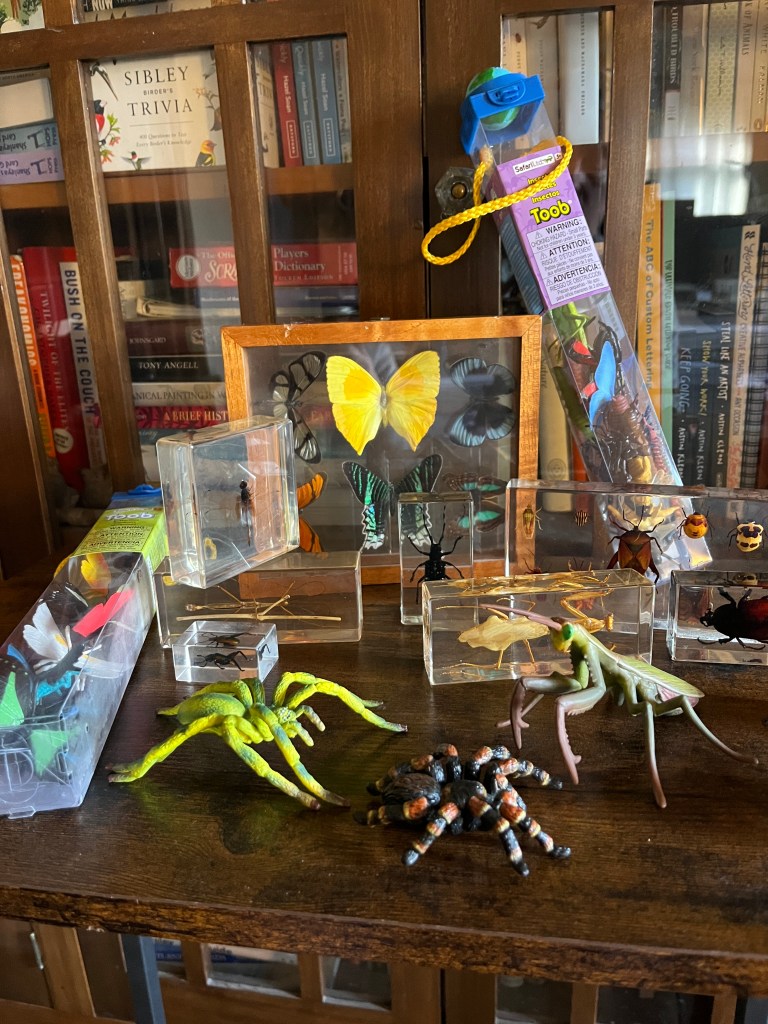
insects preserved in resin (difficult to draw, and not like living animals, but a good way to see some of the finer details of limb and wing structure, eye placement, and overall shape and size.)
plastic models (also not great representations of live insects, but a) they don’t move around, and b) it’s a good way to see the body plan, and how the masses of the body relate to each other)
I “borrowed” some of the live insects from the classroom: a roach, a couple of beetles, a couple of small stick bugs, and some mealworms.
sheets of 90lb watercolor paper (not precious, but sturdier than printer paper), and clipboards for stability
colored pencils, number 2 pencils, and some watercolors
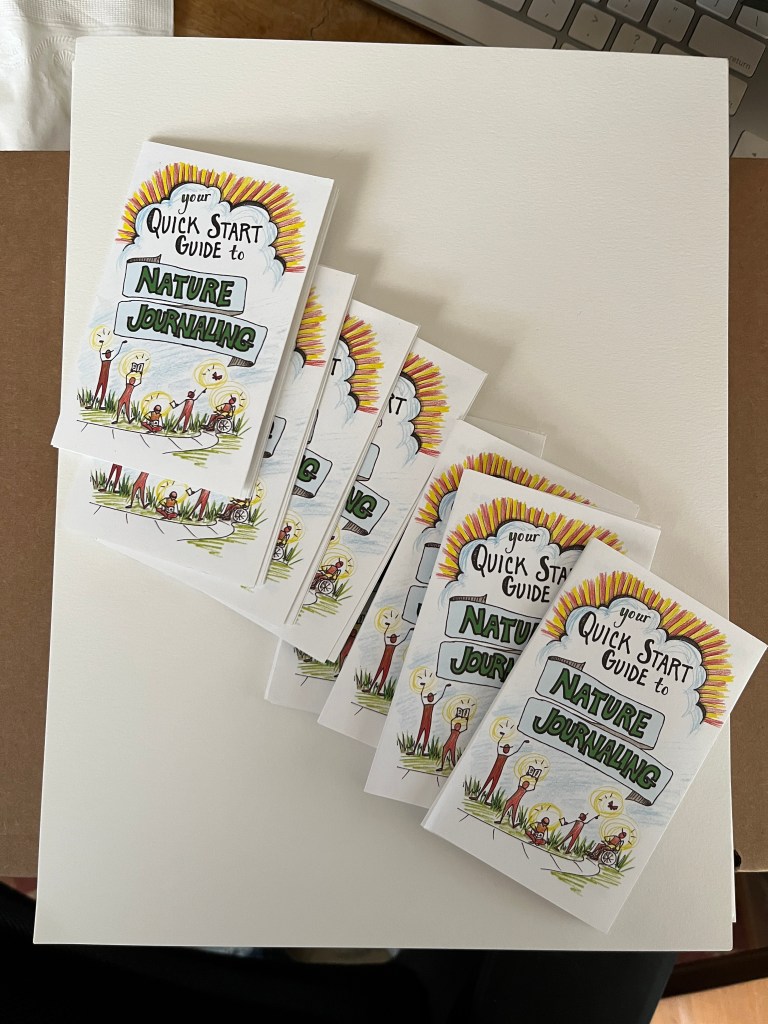
I spent some time this week making a “focus flyer” — a one-page intro with tips about how to approach nature journaling insects. (I made it with Procreate on the iPad — simple black and white so it could be photocopied.)
Everything got used, for sure, but I ended up spending most of the time chatting with small children and their parents about bugs (yes, for the record, I know that all bugs are insects, but not all insects are bugs — it’s the sucking mouth parts in bugs that make the difference — and that arachnids are their own thing, and so are the myriapods).
And hey, there is nothing better in the world than when a second grader sidles up to the table and says (something to the effect of), “let me tell you something I know.” To which I love to reply, “I’m all ears, friend.” If we’re dealing with insects or dinosaurs, it will probably be new-to-me information. In this particular case, after my education, we got to puzzle out whether a praying mantis’s forelimbs are legs, or something else (they’re counted in the leg count, even though they can be functionally different).
So yeah, it ended up being a lot of fun, even though it wasn’t nature journaling. There was no writing, very little counting, and no drawing (I think I got so far as to lay in the very first initial pencil-in of a long-horned beetle). I had planned on working with 5 – 8 (maybe?) people, ages 12 – adult, for 30 – 45 minutes. At one point, in the 90 minutes I was active, I think there were 25 people in the room (both kids and parents), and it got very loud.
I still think that nature journaling can be a great activity for kids, but unless they’re ready for it and intrigued by it, it’s going to feel more like a chore for most of them… and most kids already have plenty of obligations. The OLC’s open house wasn’t a great fit for a strictly defined nature journaling activity.
But it was still a good learning experience, and, as I am not a big bug person, a brain-stretching exercise. In the future, if the OLC is interested in a quasi-educational, quasi-artsy experience available at open houses, I think we should go a different way… perhaps a “coloring corner,” with nature-journaling-style worksheets. (I’ve been sitting with this idea overnight, and the longer I sit with it, the more I like it. Also, how fun would it be to design those worksheets?!)
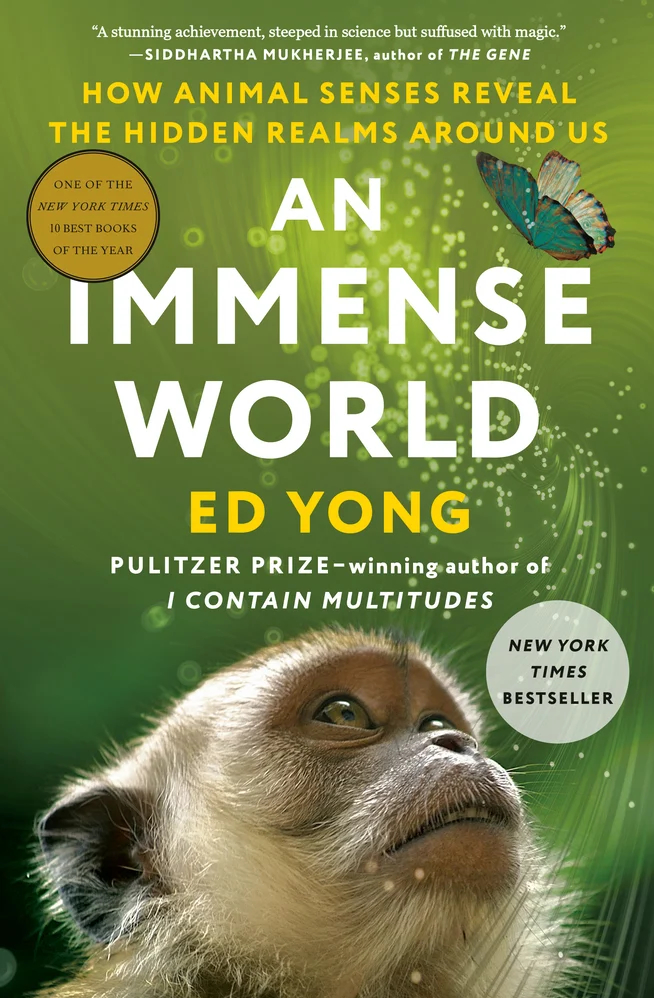
I think the quality of Ed Yong’s work is next level, so when he says something like this, I pay special attention:
“My position is pretty straightforward: There is no ethical way to use generative AI, and I avoid doing so both professionally and personally.”
To be absolutely clear: I am not an expert on generative AI. I am not a user of generative AI. I’m still trying to wrap my head around the idea of generative AI.
These are some of my concerns:
Do users know what content was used to train the LLM? To be more blunt, was the content stolen?
Generative AI tends to insert artifacts (again, to be blunt, LLMs can lie — remember this story?). Are users savvy enough to figure out whether or not that is happening, and where?
At what stage of a project is generative AI considered helpful? Do the expectations of users reflect the intent of developers?
For me, I think that generative AI would not be helpful for doing the bulk of my research; I need my brain to grapple with ideas, in clumsy ways, to find a way through. I feel like trying to use generative AI might add too much noise to an already messy process. I mean, maybe at the very beginning of a project, when I’m trying to wrap my head around something new, prompting an LLM to see if I can identify avenues of research I hadn’t originally thought about?
My husband uses an LLM to generate code snippets when he gets stuck, and that seems like it might be a useful application, because generating useful code requires that you understand what it is you want it to do (but you’re missing some syntactic nuance), and whatever the LLM generates has to be tested and integrated into a larger whole.
Whoa. If NARA (National Archives and Records Administration) is working with an AI, that might be a thing, right? It’s not too surprising to discover, as the article points out, that at least some archivists are… wary… of AI, in general, particularly after the organization told them not to use ChatGPT. Some of the cited concerns: accuracy, and environmental impact.
I can’t (and shouldn’t) be trusted to make decisions for anyone else regarding use of generative AI. I, frankly, don’t have enough relevant experience with it to speak with any authority about it. That said, at this stage, if I were going to use an LLM on a regular basis, it would occupy the role of a natural language search engine, one that I don’t entirely trust.










 Carmen Yount