The Personal Project · Thoughts about Stuff

Writing Practice & Fun Pasta

Lately, I have noticed that my writing does not read as smoothly as I would like, and since I don’t have regular access to an editor, it means I need more practice… and less social media (which has become my preferred time suck).

I prefer not to opine about the work of other people. Don’t get me wrong, there’s a lot going on, and opinions are things I have in seemingly unlimited supply. It goes back to being disappointed that most of the writing I did as an undergraduate was criticism. It’s a valuable skill, but it didn’t feel like I was making anything.

Also, I have no patience for the you’re-a-liar/debate-me/do-your-own-research crowd. I’m the first to admit that I make mistakes (often, sometimes big ones), and I try to be gracious about accepting both correction and criticism. But life is too complicated enough already, and too short, to respond to trolls.

So I guess I’ll stick more to slice-of-life, and pointing out the cool stuff I come across (because there’s plenty of that, too). And hoping that more noticing, and more writing about noticing, will bring with it some improvement.

And so we begin…

Warm food season is coming (for me, that’s the season when you can cook without feeling like you’re being cooked while you’re cooking), and I found a delightful recipe on Instagram — it’s easy, comes together fairly quickly, and uses mostly pantry ingredients (including beans, so it also has some fiber in it). We enjoyed it last night.

Pasta with a Chickpea Cream Sauce
from IG: cocolarkincooks

1/2 onion, roughly chopped
2 cloves smashed garlic (I used 5, because garlic)
small sprig of rosemary
piece of arbol chili

15 oz can of chickpeas
broth

vinegar or lemon juice
parmesan

Heat some olive oil. Sauté onions, garlic, and rosemary, on medium/medium low heat, with a pinch of salt, for 15 minutes (until vegetables are very soft).

Add one can of drained and rinsed chickpeas to the pot. Add enough broth to cover. Let simmer for another 15 minutes.

Remove rosemary sprig. Add a few drops of vinegar or lemon juice, and some parmesan* (measure with your heart). Add chickpea mixture to a blender and blend until smooth. Pour sauce back into the pan.

Prepare some small pasta. (She used quadratti, but I had ditalini so that’s what I used.) Reserve about 1/2c of pasta water. Drain pasta and add it to sauce. Add pasta water as needed to loosen the sauce.

Serve with chopped chives or parsley, and a drizzle of olive oil. Add parmesan* to taste.

* We can’t do dairy in our household, so I used a handful of nutritional yeast in the blending step, and a very small amount of non-dairy parmesan at the end.

Outdoor Learning Center · Studenting

Jack of All Trades

First, have a bird:

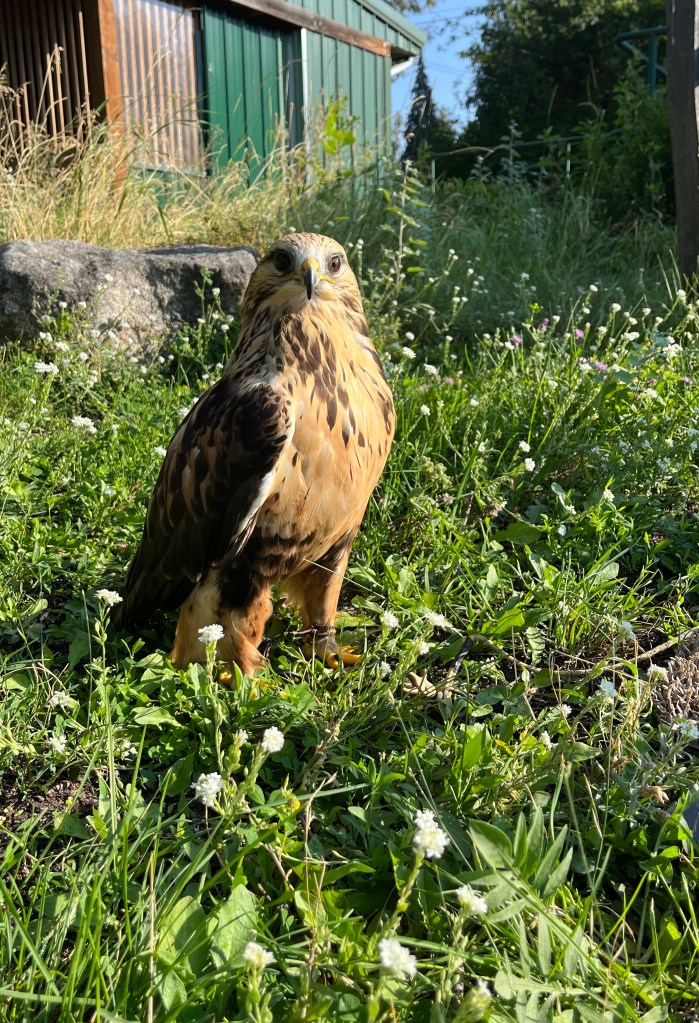
Pantalones (aka Pants), a mostly caramel-colored rough-legged hawk, standing amongst the wildflowers (aka weeds). She is a beautiful bird.
Pantalones, aka Pants, a rough-legged hawk at the
West Valley Outdoor Learning Center, enjoying some outside time.
Summer 2024

Pants has a partial wing amputation with significant tissue damage on her right wing, which, on top of the amputation, is missing both primary and secondary flight feathers. She is quite elderly, at 24+ years, and has arthritis. She has personality to spare, and in addition to being really pretty, she is quite sassy.

She had a near miss with Nelson, the OLC’s 80lb tortoise, the other day, and afterwards she seemed remarkably unbothered. She’s a champ.

Okay, down to business. I’m doing a skills inventory right now, and here are some of the skills I have listed: project management, database management, GIS, natural science illustration, graphic design, basic carpentry (power tools: *chef’s kiss*), raptor daily care and maintenance, research and writing, working at a coffee bar, community outreach.

Point is, you would not be wrong if “Jack of all trades, master of none” came to mind.

It is some comfort that one version of the “jack of all trades” quote goes something like this:

“Jack of all trades, master of none,
is oftentimes better than a master of one.”

(A Wikipedia article on the topic says that the couplet isn’t actually the original version, as many online like to claim, but I like it because it feels a bit less… awful? I’m not going to be able to solve the crises of the world, but I can make you a coffee?)

Believe it or not, even though my skills inventory looks like it’s all over the place, there are some through-lines:

  • I’ve worked on a few different newsletters, working on both writing and production — digital and print.
  • I enjoy engaging with technology: for database work, graphic design, and front-end web coding.
  • I’ve never been a teacher, but I have done a fair amount of training, teaching, and community outreach.
  • I gravitate toward environmental education and conservation.

It’s turning out to be an illuminating exercise. It will be interesting to see where it goes.

Outdoor Learning Center · Raptors

Sweet Boy: Oroville (2011 – 2024)

This is an appreciation for a barred owl who hated us with almost comical intensity. There is sadness in it, but also gratitude.

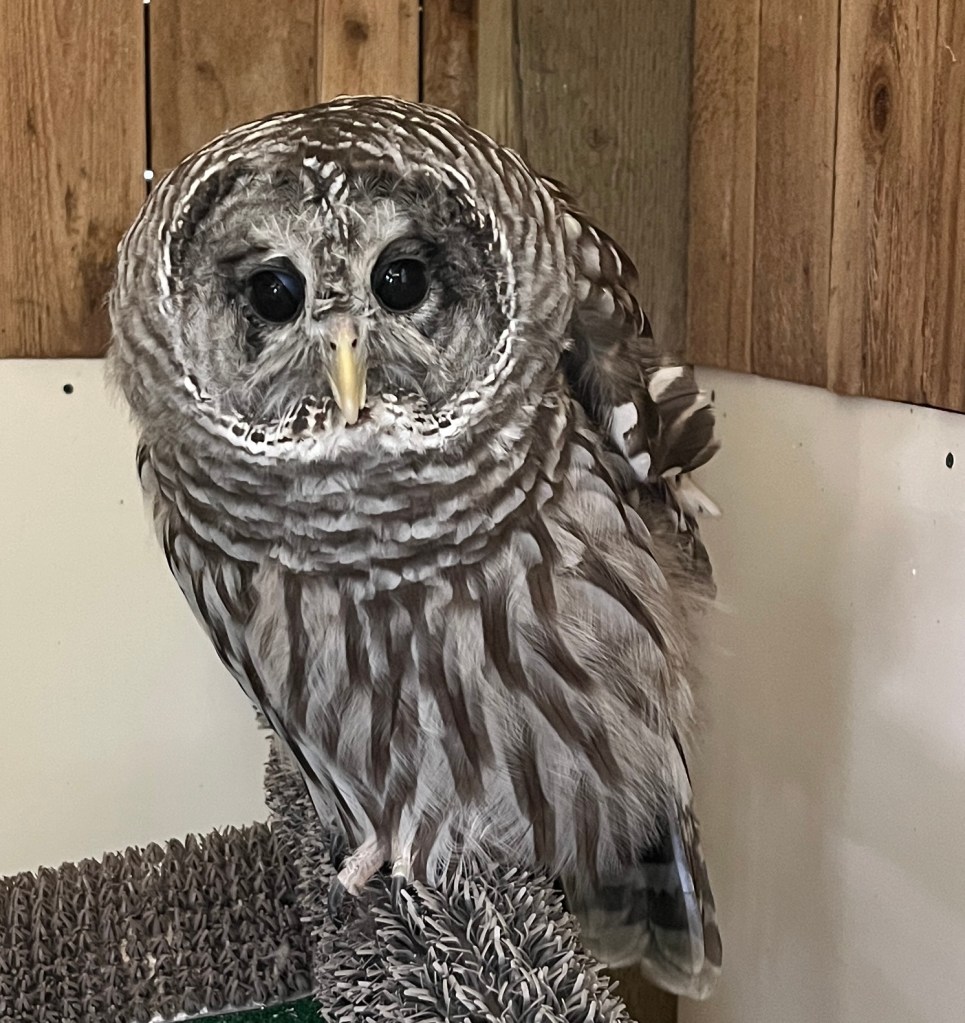
This was Oroville:

Murder muppet and professional crankypants Oroville.
(He was going through kind of a rough molt when this photo was taken.)

Oroville suffered a severe patagial injury to his left wing when he got caught up in some barbed wire as a fledgling. It rendered the wing useless for anything but balance.

He came to the West Valley Outdoor Learning Center in, I think, 2011. (I started in early 2012, and he was in a starter mew then.) He could not fly, but by every other metric, he was a classic barred owl, which is to say, he was deceptively aggressive. Got too close to him? He’d jump at your head. Stand up too quickly near him while cleaning? Jump at your head. Try to retrieve cached mice in his mew? Lunge at your hand. Collect him on the glove? Gnaw aggressively at your hand. Trimming his beak? Snap at your fingers. (The only black eye I’ve ever had came from one of Oroville’s launches.)

These were not character flaws, or lapses in training. Oroville was a wild barred owl who was being asked to live in circumstances that were completely foreign — and unnatural — to him. It wasn’t bad, but it wasn’t normal for a barred owl. He was free-lofted (as in, not tethered) in a large mew with two windows and perches at different levels. He had daily access to fresh water and food, and was weathered regularly. He was protected from the elements, but we left one of his windows partially open all winter so he could feel the wind and snow on his face. He was heat intolerant; he didn’t do events during the summer, and spent most of his time sitting under a fan.

It’s important to note for people who don’t have a lot of experience with education raptors: the alternative to this life was not freedom. It was death — because he could not fly, he would not survive in the wild. He was not a pet; keeping him required both state and federal permits. The compromises we asked him to make were extensive, but he helped to educate thousands of people about how owls fit into our ecologies, and the challenges owls face in the wild, over the course of his life.

This week Oroville developed some weakness in his right leg. And then he stopped eating. (Both of these are big red flags in raptors, but combined, they can signal a very bad situation.) Yesterday I drove him to WSU to the veterinary hospital to see our (amazing) avian vet, Dr. Marcie Logsdon, for X-rays and bloodwork.

As it turns out, his heart was enlarged, and so was his spleen. It looked like the situation had been developing for a while, but owls are both 1) stoic, and 2) good at hiding signs of illness. Until this week, Oroville’s behavior had been his feisty normal, and he had been eating/maintaining his weight, so we had no idea about this underlying condition. By the time we got to WSU, he was very ill, and had the OLC chosen to pursue treatment, his final days would have been spent receiving treatment that was best case, intrusive (worst case, invasive), but not curative. After consulting with the OLC’s director, the decision was made to euthanize him.

In addition to being an avian vet, Dr. Logsdon is a falconer, and she works with the WSU raptor center’s education birds. Working with education raptors requires walking a narrow path, ethically, and she has some good experience with it, which is really helpful to us. (Some vets know how to treat birds, but don’t have a lot of experience actually working with them.) I loved that she consistently referred to Oroville as our “friend” (even though considering the concept of friendship with Oroville would make anyone who knew him giggle).

Another thing I appreciate about Dr. Logsdon is that she is not a vet who goes to euthanasia as an early option, but if it’s important to consider, she’ll put it on the table. She did not pressure us. She told us what our options for treatment were and that she would support our decision to continue treatment, but she did not shy away from the fact that Oroville’s prognosis was very poor, and his quality of life would not improve with time or treatment.

Sometimes the worst decision is not the hardest one to make.

It’s easy to say, but it does not diminish the sadness of packing an empty crate into the car. I am sad, and I will miss him.

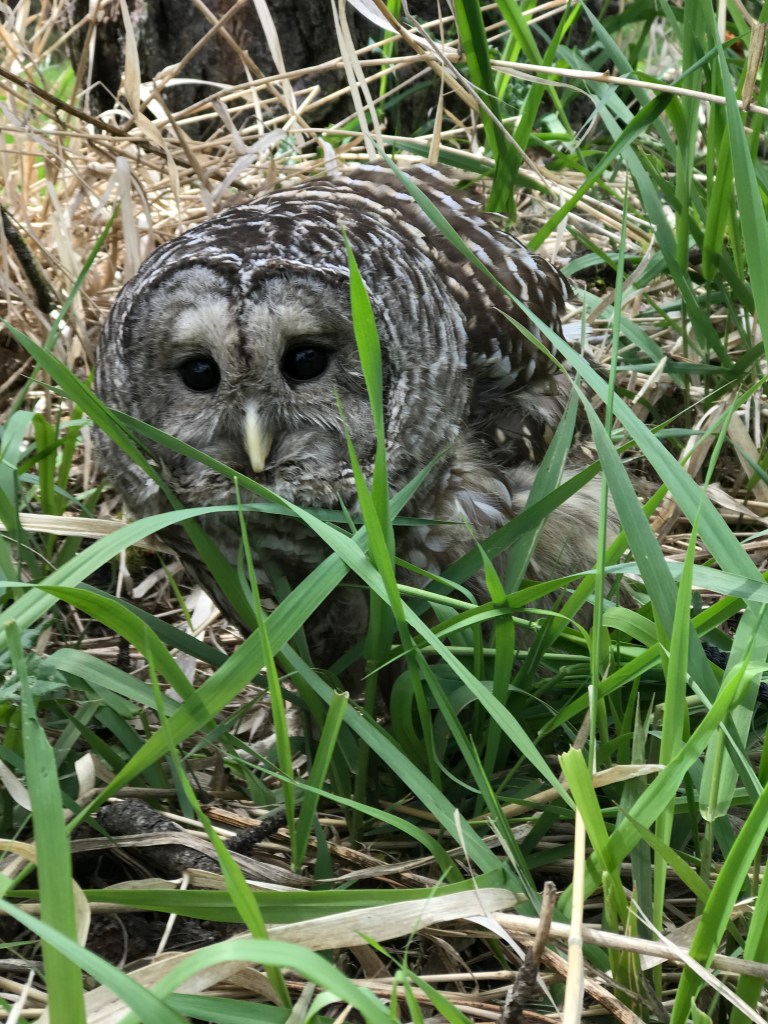
Oroville at an event at Turnbull National Wildlife Refuge.
Lucy the Pup · Studenting · The Personal Project

New Class: INFO 282

INFO 282: Seminar in Library Management: Marketing Yourself in a Networked World

OK, so, here’s the thing.

I absolutely suck at this… “marketing yourself” business. This is entirely by design. If you grew up in a particular kind of patriarchal (more than a little bit misogynistic), conservative, Christian household, you may have a similar mental block.

Some of the statements I internalized:

“Work hard, and let the work speak for itself.”

“Don’t call attention to yourself. Be humble.”

“Always obey your elders/those in authority. They are where they are for a reason. Learn from them.”

When I tried to explain this class to my mother (who is one of the most intelligent, thoughtful, competent people I know), this was her response: “I don’t understand. Why would you need that?”

(Because cultural/familial/religious standards generally don’t emerge spontaneously in one generation.)

I mean, sure, there is some truth in all of these statements. it is important to produce work that is useful in some way, and that you’re proud of. Humility is an important attribute to cultivate, no matter who you are. And yes, we should all be willing to learn from those who have more (or more relevant) experience.

But… statements like these can be used to groom people, particularly young women, to believe that they don’t have any agency, that their value is determined by others, and because of those two conditions, their ability of survive in the world is determined by someone else. If, say, a young woman finds herself working for a verbally abusive person with more relevant experience, and end up working for that person for more than a decade… well, let’s just say it leaves a mark.

So in addition to a course about XML (well-formed vs. valid, namespaces, schema… anyone?), I’ll be working on this for the next several weeks. I suspect the XML will be more technical, but the self-marketing will be more… complicated.

To do the work of INFO 282, this blog may be undergoing a radical shift over the next several weeks. So before we get to that, here’s a photo of beautiful and talented Lucy:

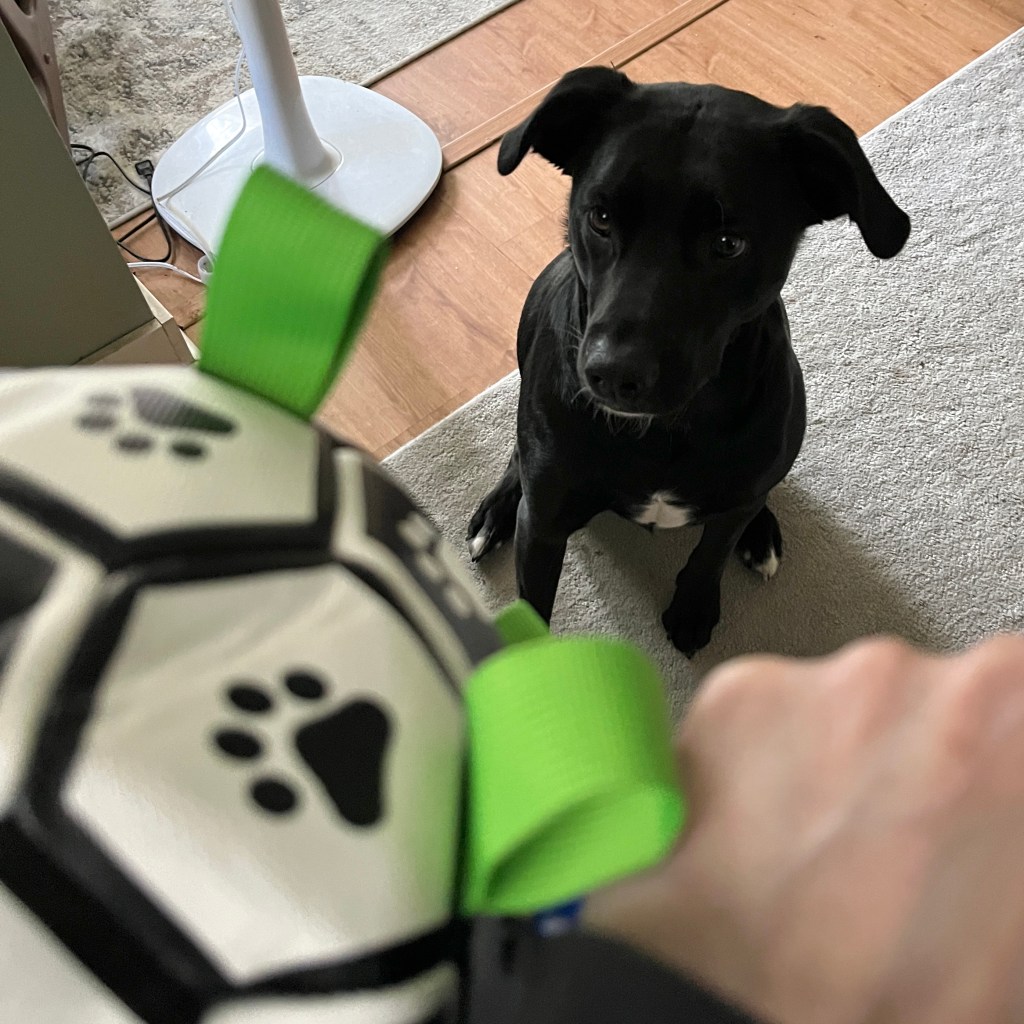
Photo of a black-and-white dog waiting (im)patiently for a new sportsball (small soccer ball with fabric tabs).
When you’re waiting (im)patiently for a new sportsball and your person is TOO SLOW.
Healthcare · The Personal Project · Thoughts about Stuff

Coffee & Learnings

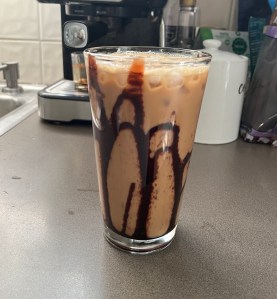
Have a coffee… (sugar-free) vanilla latte with soy milk and a chocolate drizzle (it was too sweet, TBH, but it was a nice treat on a Sunday morning). Before Covid, I was one of those people who would leave the house every day in search of a coffee drink, and a place to sit and write. Fast forward to now, I prefer the coffee I make at home to the > $7 latte in an overcrowded coffee shop. It’s not like there’s anything special about the drink(s) — I brew my coffee in a moka pot on the stove, use soy milk from the grocery store, and have a couple of syrups to change things up once in a while. While the coffee drinks aren’t anything special, the beans are extraordinary: High Drive roast from Indaba Coffee, here in Spokane (10/10, highly recommend).

Even though there’s nothing terribly special about my coffee drinks, being able to make coffee I like takes some of the stress and busy-ness out of my daily routine, and I like that a lot.

In August, I finished another successful semester at school. MySQL is neat, and I would like to delve into it more deeply, but now I’m on to XML (starting week 4 this week), and I’m enjoying learning about it. We spent last week working on XPath, and it’s yet another thing I’d like more experience with, because it’s very useful for selecting data within XML documents. Of course, the way I’m using it right now is clumsy, inefficient, and not very effective, but it’s new to me, so that’s to be expected. (Newsflash: sometimes it’s actually fun to be really bad at something… I think that acknowledging limitations can actually make a subject more expansive and interesting — “ok, so I can’t do this thing (at least not yet), but is there something I can do in this subject area?” Also, perfectionism is exhausting, and I don’t have the brainspace for it.)

I’ve written about how I’m trying to think about AI and how to use it, and I still don’t have an answer that I’m comfortable with. I’ll be exploring the ethics of AI in a course a little later on, but I’m not finding everyday use for it yet. Convenience seems to be the selling point right now, but frankly, if I’m going to be spending a bunch of time confirming information, I’d rather double-check information from “primary” sources (even if they’re not technically the primary source, maybe they cited the primary source or have some other relationship to it) than information from an LLM (where the primary sources aren’t necessarily revealed or cited).

So I haven’t figured out how to effectively use AI for what I’m doing now, but there is a technology that I’m re-considering: social media. I love it (Threads, X, Instagram) for learning about people and/or events — I learned a lot from paralympians and members of the media who took the time to post about their experiences on Threads. It was amazing, because I don’t feel like I’ve ever had access to much information about the Paralympics. Also, I enjoy following artists and scientists and content creators, and it’s great to be able to curate your feed to see (mostly) what you’ve decided you want to see. It’s also not terribly difficult to just skip over content that I don’t find interesting or useful. There’s some amazing value there… if you (mostly) stay out of the comments.

I made the mistake of posting something about a frustrating experience I had with my primary care doctor. It was not a constructive thing to do. There was no simple remedy, and because it was a personal experience, there’s not much constructive for others to comment on.

There were many “you need to get a new doctor” comments, a couple of helpful comments illuminating the ins and outs of insurance, and some trolls accusing me of taking advantage of the system (“How dare you ask your doctor about a health concern that she’s treated you for in the past 10 months. What is wrong with you?!”). Of the trolling comments, my favorite was, “You’re a liar.” OK, commenter who doesn’t know me, has never met me, and wasn’t there… sure. Anyway, lesson learned. I walked into the rake, and have no one to blame but myself.

For the record, I respect and appreciate my primary care provider, but I suspect she’s really overworked. For the last few years, I have had concerns about the way that particular medical system is managed, and also the way my insurance works within that particular ecosystem. Bottom line: it’s probably time to figure out a different primary care situation. But that’s a daunting option, because there’s a distinct possibility that it may not be better anywhere else. American healthcare… sigh. (Don’t get me wrong, I’m grateful to have access to medical care, and it’s a privilege to have insurance. Understanding that doesn’t take away from the fact that it’s a frustrating system to navigate, and I suspect at least some of the confusion is by design.) So anyway, it’s difficult to adequately convey all of that — in a nuanced way — via a social media post; my attempt was an epic failure.

My *new* social media strategy is to use it only to post (or re-post) positive or interesting information, or to hype up other people who are doing great things (there are so many!). The rest of it has too much potential to be both unhelpful and toxic.

On that note, have a delightful day, and another fancy drink: strawberry matcha latte with homemade strawberry purée, soy milk, and ceremonial grade matcha.

The Personal Project

Where does the time go?

Hey. How’s it going? How have you been?

Well, it’s been a while. I feel like I’ve been very, very busy, but it’s more likely that I’ve spent too much time on social media, bathing in the controversy(-ies) du jour. That’s probably the best explanation for how and why time is flying in ways I’m not entirely comfortable with…

That said, it hasn’t all been bad.

I’m enjoying the Olympics, a lot, and learning a little bit about sports I know nothing about. That’s really fun, and cool.

Like surfing. Surfing is not something I’m interested in doing. I grew up on the west coast of the United States. The only beach I know reasonably well is the northern part of Oregon, which is very pretty, but between the cold water temperatures and dangerous rip tides, I’ve always been certain the ocean is actively looking for ways to kill me.

Photo of Haystack Rock, Cannon Beach, OR, by DiscoverWithDima, CC BY-SA 4.0 https://creativecommons.org/licenses/by-sa/4.0 via Wikimedia Commons

So, yeah, not my cuppa. But Tahiti is so beautiful, and it is fun to watch the surfers navigate the ocean. Much respect.

Equestrian… also wonderful, and also not a thing I would be good at or interested in pursuing. I love horses in the abstract — they’re beautiful, empathetic animals. Also expensive, time-consuming, and to treat them the way they deserve to be treated, requires a lot of training on the part of the horse and the rider. I’m just happy when I have the opportunity to slip one of them a snack… After watching some eventing, dressage, and jumping, featuring beautiful horses and amazingly skilled riders, I’ve learned about fly veils, hackamore bridles, jumping “barefoot”, and, thanks to The New York Times, that the horses have their own cooled stables with locally produced hay on the grounds of Versailles, where they are competing.

USA rider Laura Kraut, on Baloutine, in the Jumping Team Final. August 2, 2024. Photo by Mike Hewitt/Getty Images. (US equestrian jumping team made last-minute lineup change… by Chris Bambuca, USAToday)

Gymnastics! Rugby! Soccer! Basketball! I’m telling you, I will root for any athlete, in any sport, from any nation. To be good enough — at anything — to get to the Olympics, and then to have the courage to step onto the world stage and compete with other people who are also the best of the best. It’s amazing.

Also, I’m enjoying the footage from Paris. In honor of the Olympics, I’m spending some of my Duolingo training time (usually spent on Italian) learning French. And at some point (when it’s not 100ºF here), I’ll bake off one of the croissants I have stashed in the freezer and enjoy it with some jam.

And also… school. Lot’s of school. Summer courses are condensed to 10 weeks (from the usual 15), and I’m in the thick of learning something new to me: MySQL. I’m enjoying it, even though after nine weeks, it is becoming more and more clear that, even though I know a lot more than I did nine weeks ago, it’s really… not much. Solid foundation, but I’ll need a lot more work and practice if I’m going to be able to use build databases and interact with them effectively.

Fall semester (starting August 22?) is going to be a banger, but after that, I’ll be about halfway through the program, and I’ll get about six weeks off from school, so that will be nice. We’re going to need to travel again soon — Covid kept us tethered for a couple of years (along with a sick dog for part of it), and then my school, and Dana’s work… I think we’re both kind of itching to go somewhere else for a minute, and that break will be a good opportunity.

Coding · Studenting · Thoughts about Stuff

Unlocking the Mysteries of the World

Last week I finished my last assignment for my last prerequisite course (we have four courses that have to make up 10 of our first 16 units). I enjoyed working with my classmates, appreciated the course content and feedback from my professor, and I got to do some interesting research.

Still, it was not my “cuppa,” and I’m glad to be done with it. (Of those first four classes, only one of them focused on what I would consider “my lane.” The rest were interesting and important, but kind of a slog.)

My next couple of semesters will be heavy on technology (yay!), light on group work (also yay!), and will include some marketing (we’ll see how that goes). I’m really looking forward to the next seven months.

This summer: MySQL. I worked with (Sybase) databases for many years as a user, and while I got very good at working within the confines of the existing interface, I never learned enough SQL to actually be able to work with the data outside of those proscribed activities. (These were amazing relational databases — elegant and thoughtfully designed — a testament to the positive impact of effective design thinking. In later years, they got kind of kludgy, but so did the organization’s thinking about the service, so … 🤷🏻‍♀️) I missed out by not learning SQL and diving into the guts of it. I could have learned a lot from that database and its developers.

It kind of reminds me of 4-year-old me. I don’t have many memories from early childhood, but I distinctly remember feeling like reading and writing was an adult conspiracy. I was just sure that meaningful information was being actively withheld from me, and if I could learn to read and write, I could unlock the mysteries of the world. Or at least my 4-year-old conception of the world.

SQL has become a later life version of that adult conspiracy for me. So this summer, I’m going to start figuring it out (for credit… it’s homework).

Let’s go!

mental health · Studenting · Thoughts about Stuff

That Time Calligraphy Saved Me

Photo from https://traderjoessignart.blogspot.com/ (lots of amazing signwork here!)

When I was an undergraduate getting ready to embark on a year-long writing project about an aspect of Ciceronian legal rhetoric, my advisor suggested somewhat strongly, but very politely, that I get a hobby.

Because it was September, and I was a mess of stress and anxiety.

So I signed up for a calligraphy class at one of the local community colleges. Every Friday morning, I gathered my large paper pad, pens and nibs, pencils, erasers and inks, and left my apartment early in the morning to catch the first of three buses to get to class. Three hours of class and lunch in the cafeteria later, I caught the first of three buses back to school.

I loved it. I loved everything about it, even the bus rides that took me away from campus for a little bit each week. I loved inky fingers and messy lettering practice. I loved the materials and equipment. I loved the history (I went to school at Reed College, in Portland, Oregon, home to a pretty well known calligrapher: Lloyd Reynolds. My teachers were a couple of his students, and they were — and continue to be! — very accomplished in their own right).

In some ways, it wasn’t the healthiest activity. I struggled with perfectionism… practicing calligraphy did not help with that. And I was looking for an escape, rather than a way to manage my anxiety, so in addition to fueling perfectionism, I was giving the experience way more weight than it deserved.

And then, when I was telling my mom how much I enjoyed the experience and wanted to learn more and maybe try to figure out how to do some of it professionally, she said, “ok, but how are you going to make a living with it?

I hadn’t thought that far ahead, and at that point I wasn’t considering it as a career — I was young, it was still an emerging hobby, and I was a long way from being able to earn bus fare doing it, let alone make an actual living. My assumption that you have to have everything planned out before you start, my lack of confidence in my ability to create something that worked, and that conversation killed it for me.

I continued practicing calligraphy for a few years after that (even served on the board of the calligraphy guild in NYC for a couple of years, and did some place cards). Then I got to do two years’ worth of typography when I studied graphic design (one of my instructors had us draw a different typeface every week: upper case, lower case, numbers, and basic punctuation. It was a lot of work, and I loved it).

That was a long time ago. These days I’m enjoying some Trader Joe’s sign writers on Instagram — they’re doing wonderful work, and it’s so fun to watch them create playful, colorful compositions that are supposed to be ephemeral. On the opposite end of that spectrum is John Stevens’s beautiful carved inscriptions.

Here’s the thing. There’s a place for beloved hobbies, even if they never become careers. I see so many talented actors, singers, knitters, bakers, horse folk, gardeners, and artists, who make their livings as teachers, admins, librarians, postal carriers. (One of the Trader Joe’s sign artists I follow is an abstract artist, and the sign work is steadier income.) Point is, everybody has to juggle something, and if you’re lucky, you get to choose what you juggle.

Also, I miss that part of my existence — not the perfectionism, but letterforms and the close observation of them. Maybe it’s time to start drawing letters again.

Studenting · Thoughts about Stuff

On a Random Monday

During our “spring break,” I wrote up the results of a group discussion topic, did a budget revision, prepped two case studies for discussion, and finished up scripts for 3 presentations (2 short presentations + a short subtopic) for another group project. (I recorded the presentations the following week so that our “production” person could stitch all of our efforts together to make a ~45-minute group presentation.) I also finished our taxes and got my hair cut. It was a very productive week; it was *not* a spring break.

And I did a bunch of it while camping out at my local branch library. It’s a recent thing for me… not every day, but it’s happening more and more. If you had told me even five years ago that the library would supplant a coffee shop as my go-to spot for getting work done, I would have laughed at you. But the pandemic broke me of my coffee shop obsession; I learned to make good coffee at home, and the library is usually a more pleasant alternative than most of my local coffee shops — it’s quieter, less chaotic, more spacious, and more comfortable.

The branch I have been visiting most frequently has robust programming for young children and their adults, so it’s usually not quiet (I’m not sure the recent renovation included much sound mitigation), but it’s lively. I settle at a table away from the joie de vivre, put in my ear buds and listen to some music or a podcast, pull out my laptop (or notebook and a pen), and get to work.

Some other highlights of a recent visit:

Anyone with a uterus can relate to the first; I can think of a few times when I would have benefited greatly from having access to free menstrual products, and I would have been profoundly grateful for them. The yarn and fabric exchange is just a great idea. I think I have some fabric (and probably yarn) I can donate…

These, of course, have nothing to do with traditional libraries, but they’re really, really cool, and indicative of this library’s desire to serve its community in nontraditional ways. The class I’m starting to finish up this semester required some thought about how libraries are evolving to become more than repositories for books, and I see some of the initiatives I have been learning about in Spokane’s South Hill Library.

I am here for it.

[This is a branch library that serves one of Spokane’s older, fairly wealthy, neighborhoods. Spokane had a Carnegie library (that now houses an architecture firm), and the original Spokane City Library was on the land now occupied by the Central Library. The South Hill branch is one of five neighborhood branches. Spokane Public Library also supports two book kiosks, and a maker space.]

Thoughts about Stuff

A Word about Holidays

All families have baggage. Each family’s circumstances are unique; even with shared DNA, each individual brings their own experiences, and perceptions of those experiences, into the mix. My family’s baggage centers around repression, judgement, and shame. It evolved over generations, and like a lot of generational trauma, it had its roots in cultural and religious biases, and abuse. We looked like a reasonably functional group to outsiders, and we loved each other as best we could.

But it was hard.

And it made holidays hard. I’m sure I’m not alone in this. Most of our families do not conform to marketing schemes, or religious ideals, or expectations surrounding food. We want to, and we try, and the trying is exhausting, and frustrating, and fraught.

And we cling to whatever traditions we have created, as tightly as possible. And that is exhausting. It makes these occasions, that are supposed to be about family, and food, and tradition, practically unbearable: occasions that are to be endured rather than enjoyed.

My experience with the particulars of my family shifted dramatically after I got married and we started splitting holidays. That had its own challenges, but I got to see how another family — one with different expectations for holiday get togethers — managed the situation.

And then, after my grandparents died, almost a decade ago, the experience of our big holidays changed considerably. It took my immediate family a few years to figure out what works for us: fewer expectations, more outdoor walks (weather permitting), watching football games, still lots of food (but simpler and easier to prepare).

There are as many ways to celebrate a holiday as there are people who celebrate it. I feel like there’s really no way to know this until you’re nearly grown, but it’s incumbent on each of us to decide what holidays we’re going to observe, how, and with whom.

Family traditions can be great, unless they’re not. Go all in with them, or engage with them as you can.

Maybe sleep in and have a lazy breakfast (if there are no small children to celebrate with), or get up early to run and play a pick-up game of basketball. Spend some time with family (the one you’re born into or the one you choose)… or don’t. Cook a big meal, if that’s your jam, or get takeout. (And don’t sleep on Chinese food for Christmas dinner.)

Or, if you need to, ditch the occasion altogether.

I feel like an outsider looking in when it comes to holidays (I don’t like that feeling), in part because for me, holidays have always been about fitting into someone else’s expectations. After basically ignoring last Christmas and Easter (forgotten? blocked it out?), I would like to be more intentional about holiday celebrations, because I like the idea of the winter holidays, at least. I want to spend Thanksgiving with my mom and brother (like we usually do). For Christmas this year, I’d like to send some cards, and have a tree, and maybe plan a tasty, but simple, celebratory meal with friends and/or family. Maybe celebrate with a few meals with friends as they have time. (We used to travel at Christmas, but after a few Covid years, and experiences with the airlines at the holidays, I am, as they say, over it.)

How do I reset my expectations for holiday celebrations and not impose my expectations on others? That will be part of my process, I think… What will the holidays look like? I don’t know. We’ll see. I’m shooting for eating well, drinking enough water, getting enough sleep, and figuring out how to find comfort and joy in holiday celebrations.