At the Museum

The Wyeths, and Maker Spaces

Dana went to the College World Series in Omaha over the weekend (bucket list for him, and a good time to go because his team was playing!). My mom came to Spokane for a visit. It was Hoopfest weekend. We live with an 8-month-old puppy.

There was a lot going on.

One of the highlights of my mom’s visit was a trip to The Northwest Museum of Arts and Culture (the MAC).

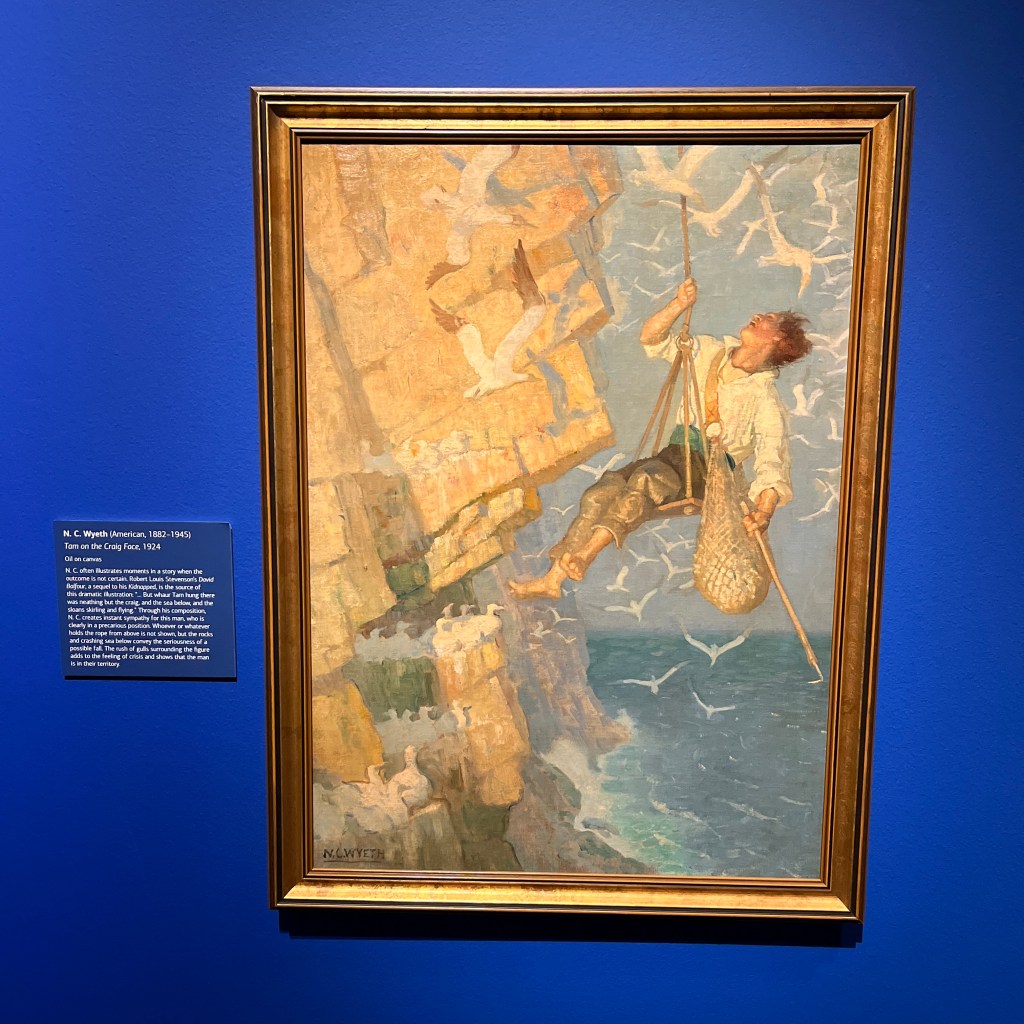
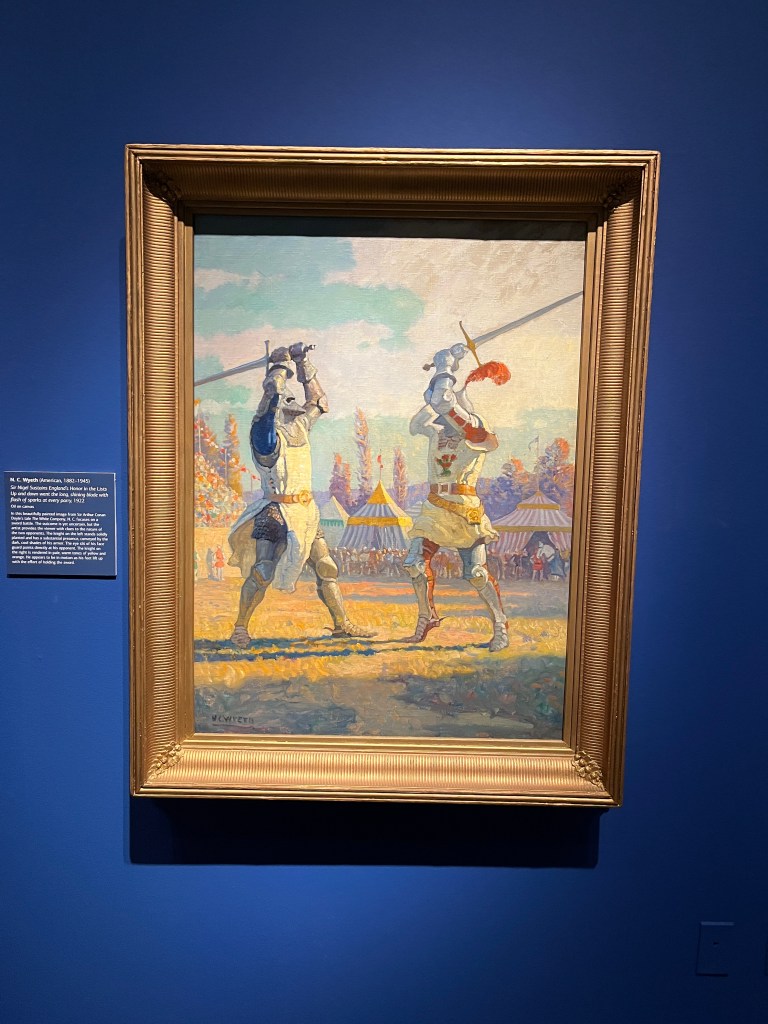
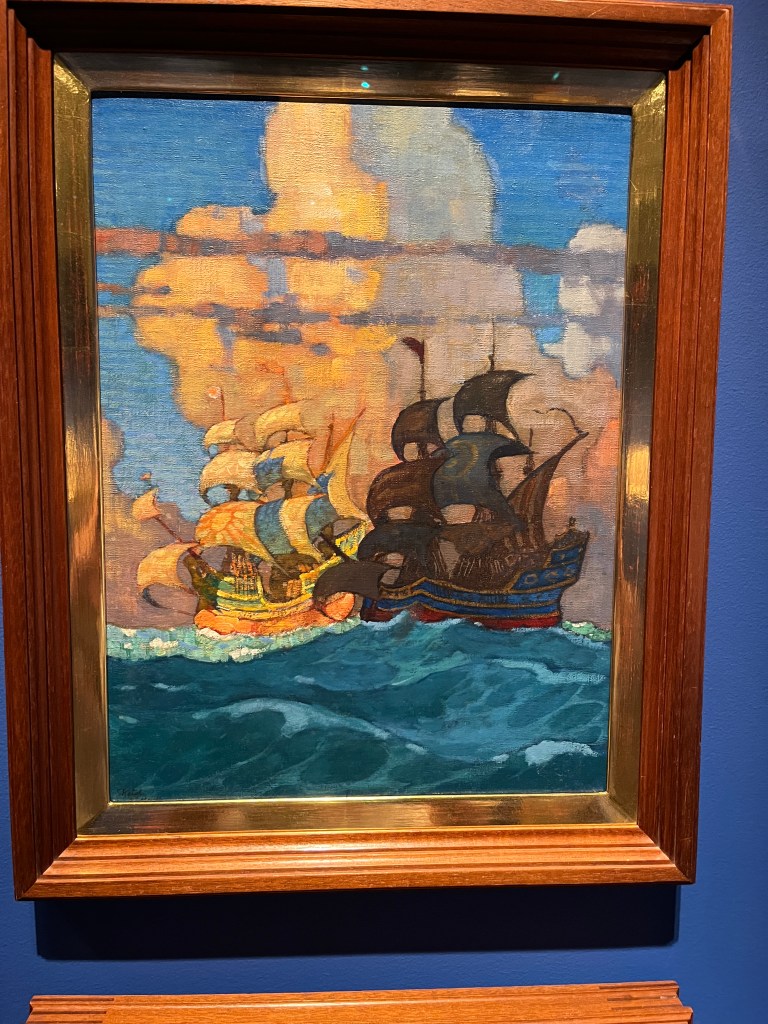
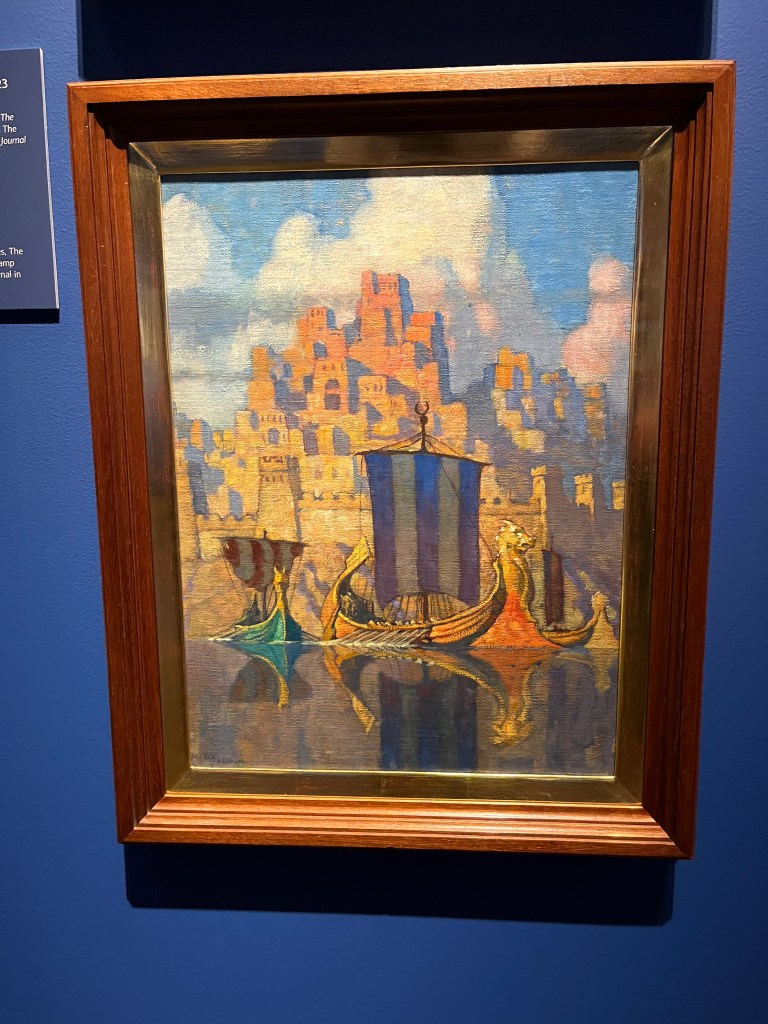
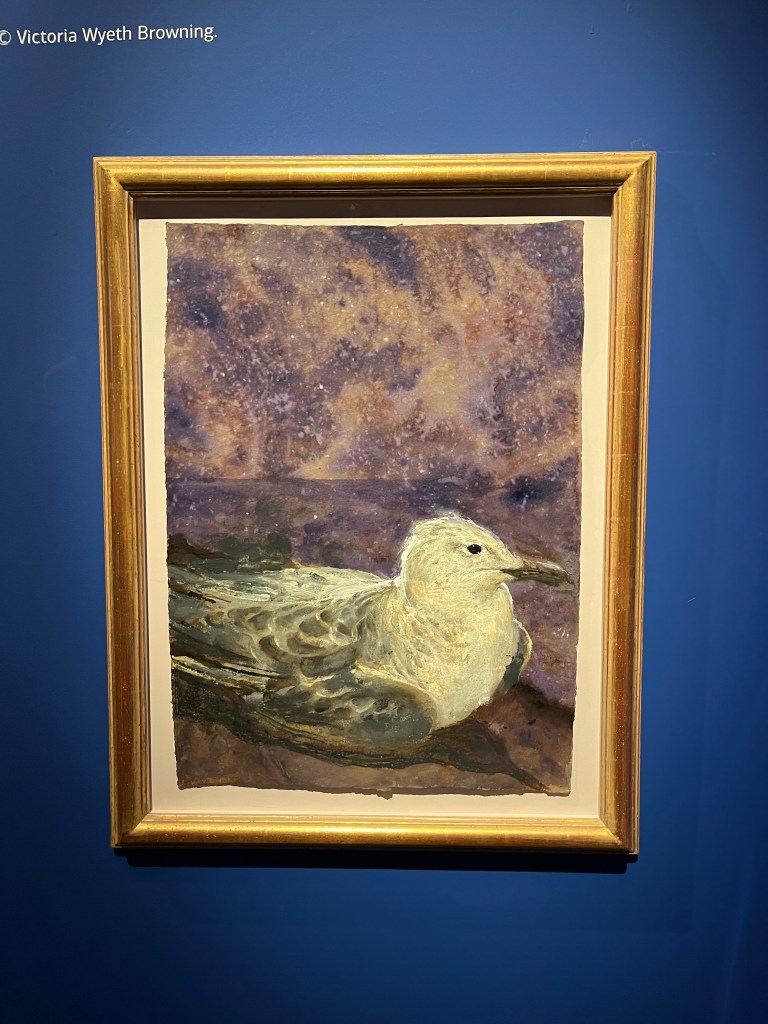
The MAC is a very small museum that often features traveling exhibits. This summer the big draw is an exhibit about three generations of the Wyeths, featuring work by N. C. (the prolific American illustrator), Andrew (likely the most well known of the Wyeths), and Jamie (son of Andrew, a respected artist and illustrator in his own right).

It’s a great exhibit, for a lot of reasons — the featured work is wonderful and the curation is thoughtful. N. C. Wyeth is in the pantheon of 20th century American illustrators influenced by Howard Pyle. His work was made to be reproduced, and he demonstrated incredible mastery of lighting and color.

Wow wow wow. This hits me where I live. It was an incredible opportunity to see some of the paintings that became book illustrations.

One thing that struck me is how different approaches to work become when the reason for the work changes. N. C. Wyeth was an illustrator. His work, commissioned by others, required a specific narrative quality, with attention to the details that would have allowed for photography, reduction, and printing. The ability to be sensitive to those issues requires a sophisticated knowledge of technology, in addition to narrative and artistic sensibilities.

When Andrew and Jamie made/make work, it was/is more often a personal expression in response to their lives or environments. Freed from the constraints of technology, their work tends to be more softly lit and less obviously narrative.

Also wow wow wow… but for different reasons.

There is another exhibit on display right now that is worth the price of admission: Frank S. Matsura: Portraits from the Borderland. Matsura was a Japanese immigrant who settled in Okanogan County in the early 20th Century. He made portraits of the Syilx (Okanogan) people who were his neighbors. In a time when photographers were using their work to create the settler narrative that Indigenous people were disappearing, Matsura photographed his neighbors as they were: people who were trying to figure out how to assimilate (in order to survive!) and hold onto their cultural identities.

The portraits are beautiful and deeply moving, and in them you see a sense of understanding that might only have been available to Matsura (an immigrant newcomer who was also seen as “other”).

In the last couple of years, I have seen a couple of exhibits at the MAC that have given me better perspective on the Indigenous people of this region, and I am deeply grateful for this kind of context. Last year there was an amazing exhibit of hand-carved canoes from the peoples of this area — one of which went off display for a while during the exhibit because they are not artifacts from the past!

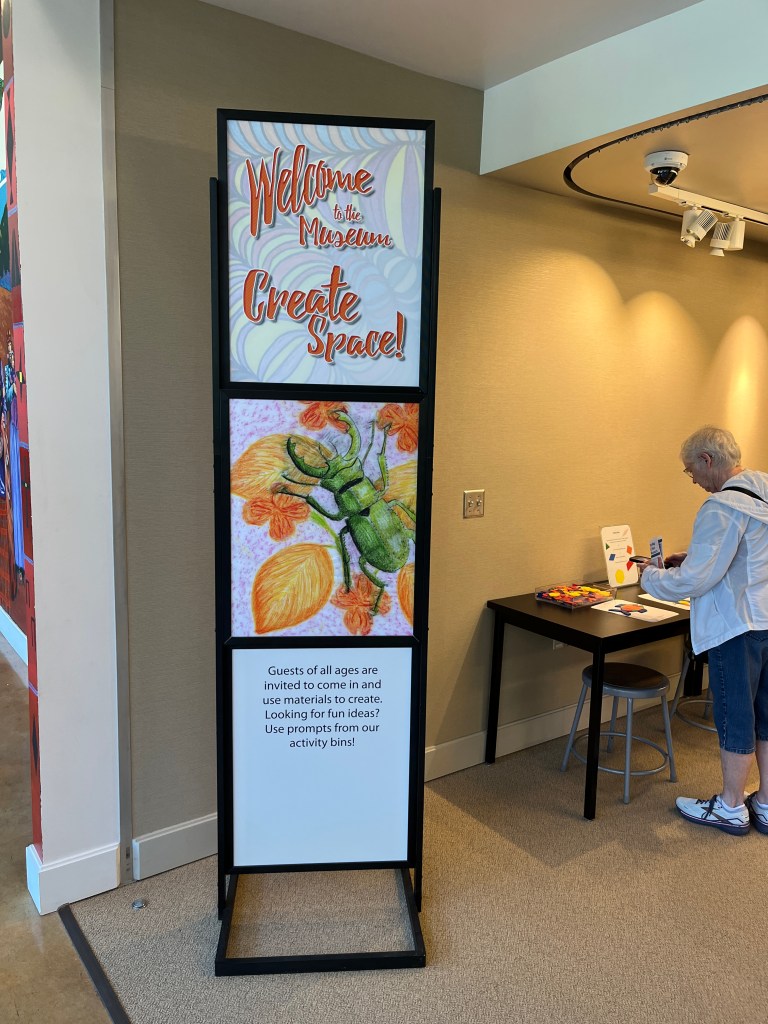
Museums can be difficult places for kids, even a small museum like the MAC. One of the neatest things I’ve seen over the last couple of years is a space set aside (for kids of all ages) for activities.

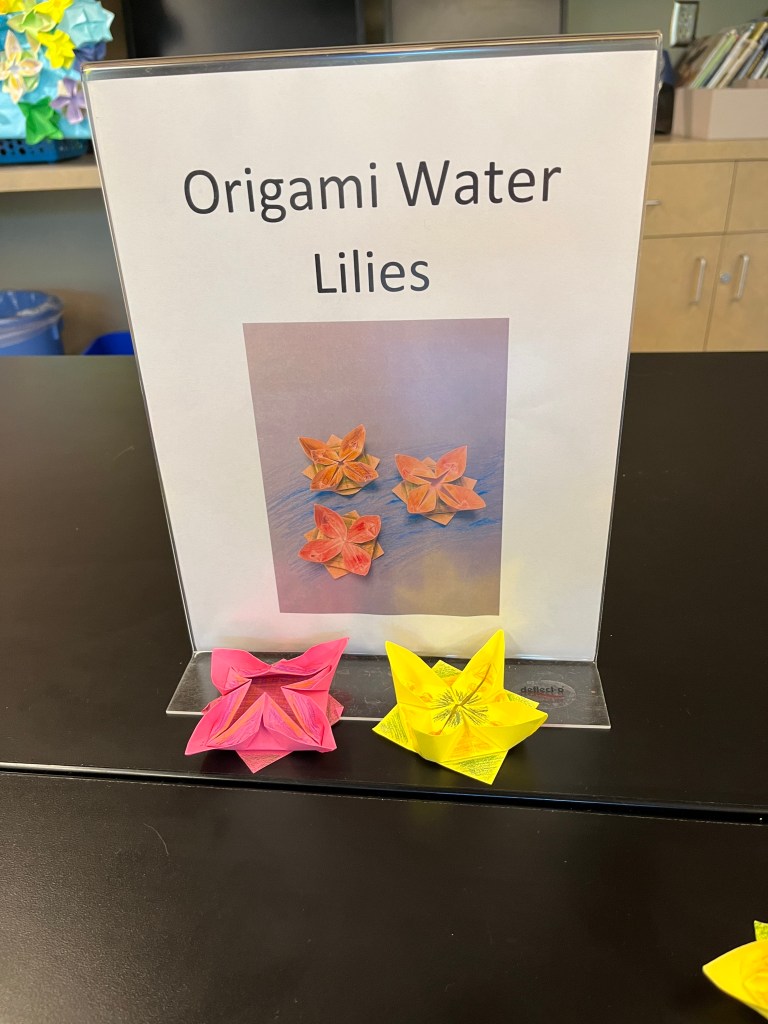
There were drawing and coloring activities, a table with an origami activity, kinetic toys for builders, tangram-like puzzles, and some children’s books. Last year for the Dreamworks exhibit, this space was set up with computer animation equipment for people to try.

This is a really good idea. The tables and stools were intermediate height, not specifically for tiny humans, but not out of reach for them. The activities are designed engage different kinds of interests and abilities. It’s a part of the museum where people who aren’t interested in the exhibits can participate, which would be particularly important for times like now, when the exhibits are designed for people who are, you know… um… likely a bit older.

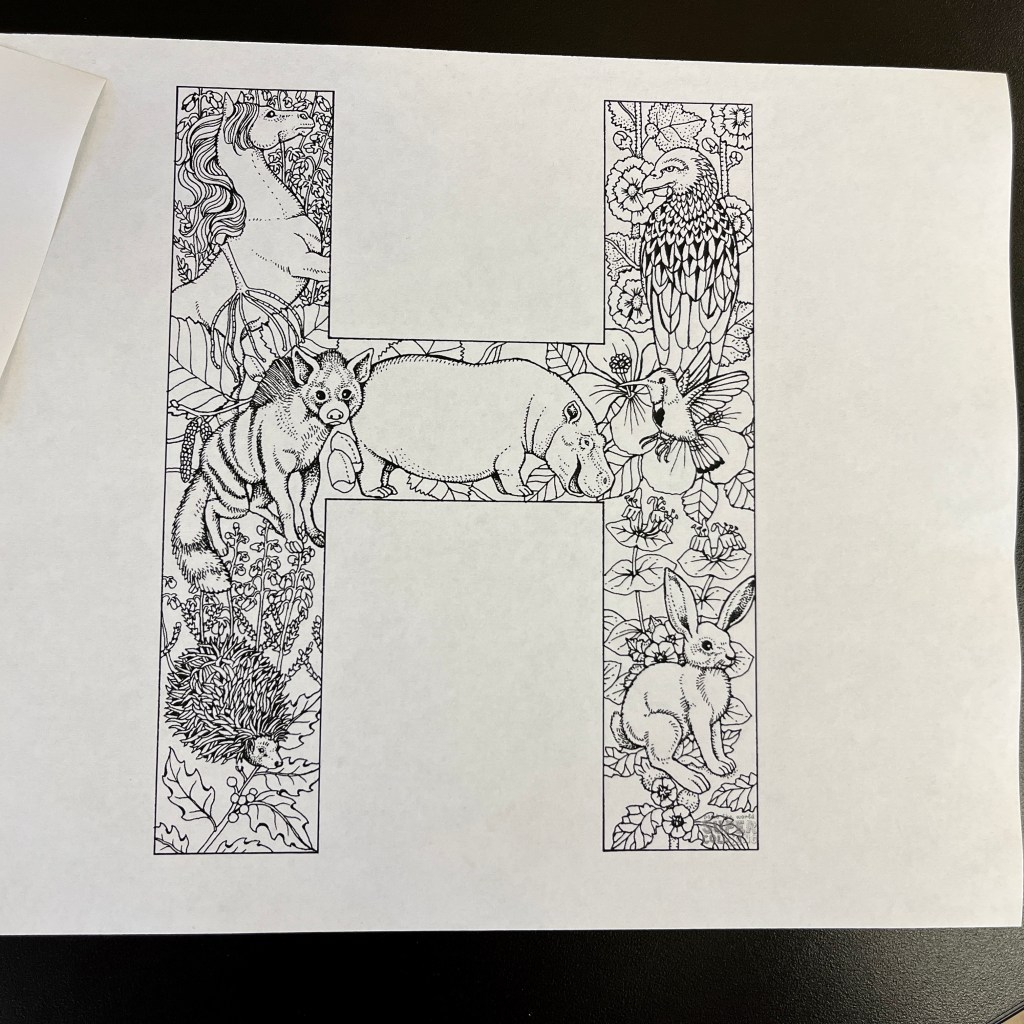
The animal alphabet coloring pages, which I loved, can be found here: https://www.supercoloring.com/coloring-pages/letters-and-alphabet/english-alphabet-with-animals.

Outdoor Learning Center · Raptors

Basalt… ‘Bee’ for short

One of the most joyous things for a raptor volunteer at the Outdoor Learning Center is to get to meet a new bird. It’s somewhat bittersweet, because we all understand that this is not the natural order of things, and it would be better for everyone if the bird were able to be released.

But by the time the birds get to us, the option to be released has been taken off the table by people who are in a position to know what’s possible: the bird’s rehabilitator and the bird’s veterinarian. When release is no longer an option, places like the Outdoor Learning Center become an option (if space is available).

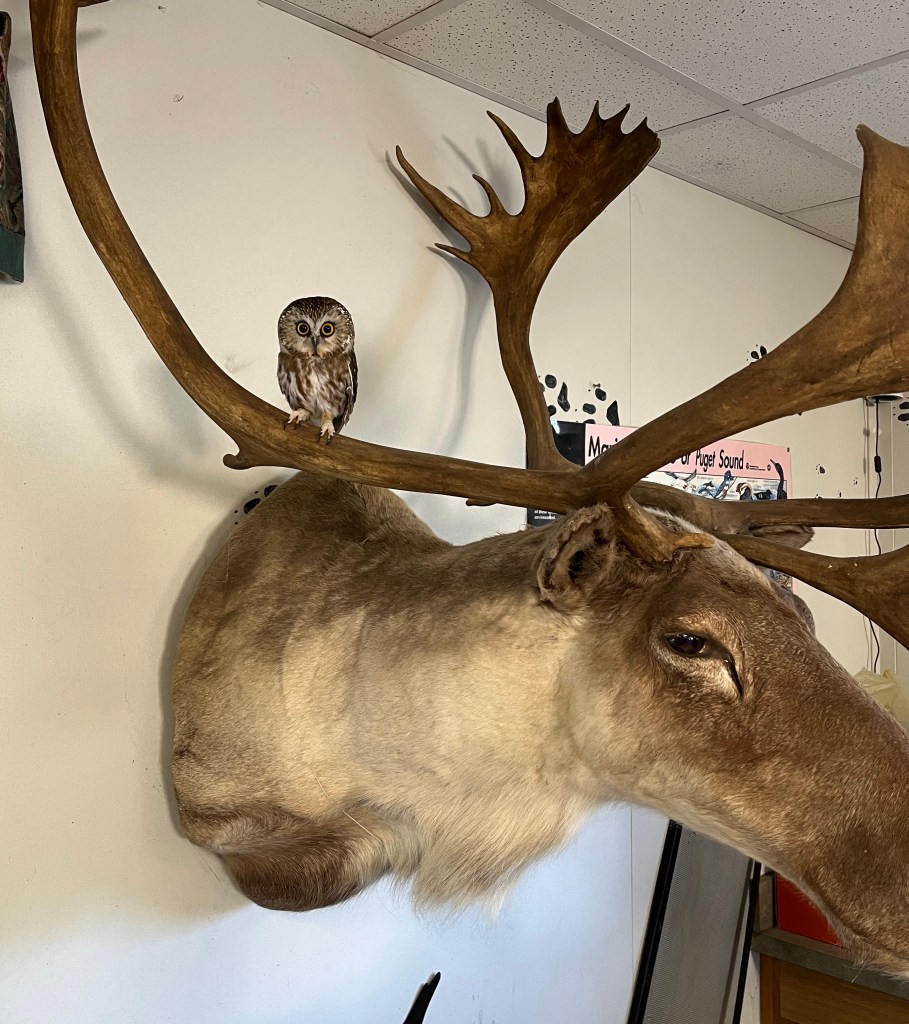
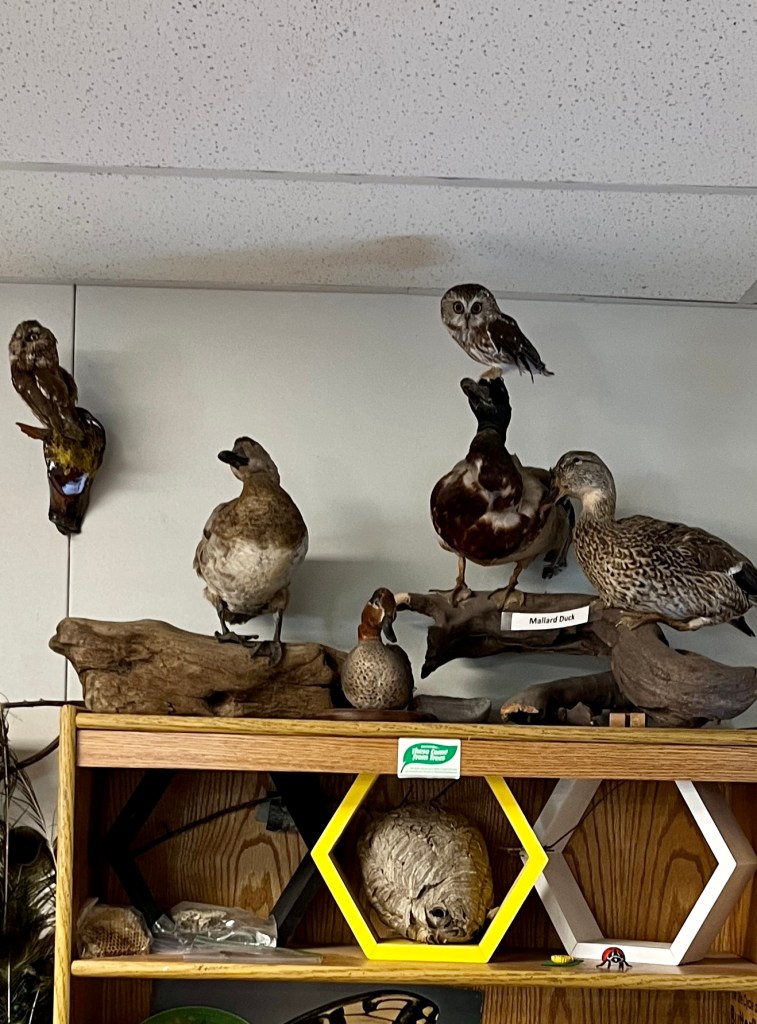
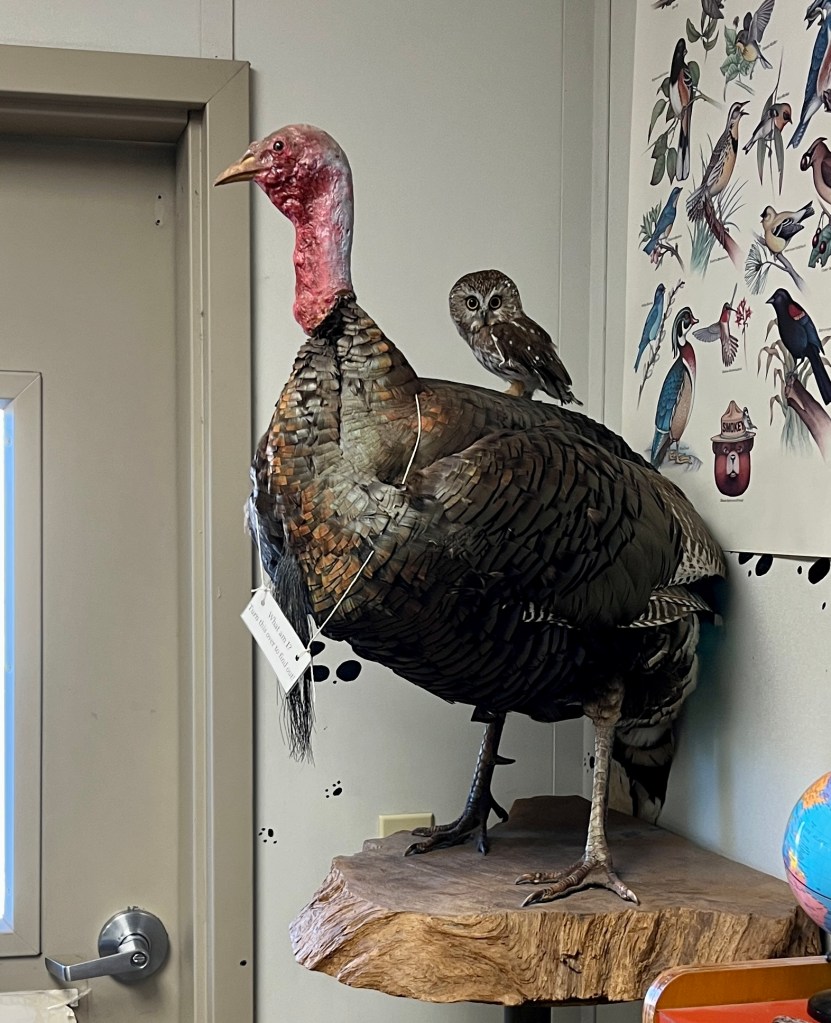
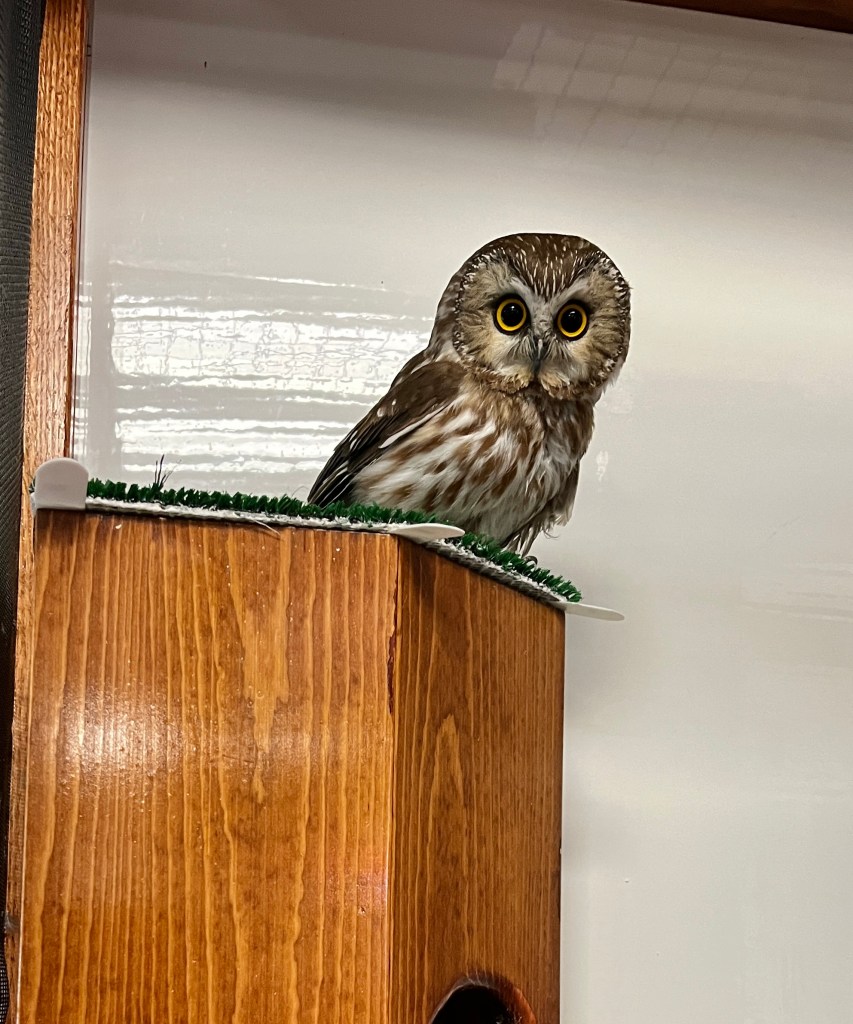
Saw-whet owl Basalt (recovered from Basalt Rd. in Spokane, WA) injured one of his shoulders in a window strike. His flight is compromised (he cannot gain altitude), and there is some speculation that he may have some mild neurological damage (though it does not manifest in his appearance or movement). He has been in care with his vet for the last several months while we waited for our federal permits and transfers to go through. We welcomed him to the OLC two weeks ago.

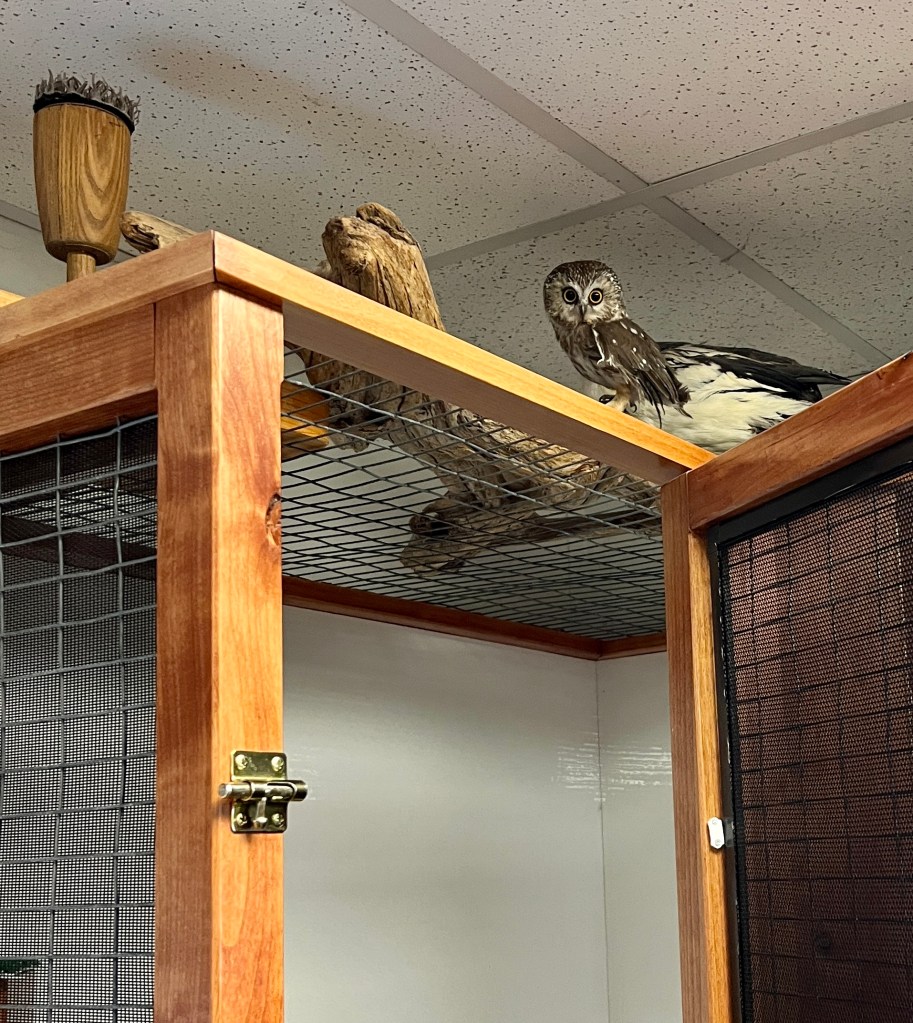
We’re in the process of getting used to each other. This morning, for the first time since he arrived, I was able to get into the enclosure to clean his house and add a piece of outdoor carpet to the top of it (he spends a lot of time perching there, so it needs to be cleaned often). He watched me quietly from another platform — no panic, just a desire to not be where I was.

And when I was done working on his house, he headed right back up there.

Basalt, no doubt wishing I would put the phone away and leave.

Lack of panic at my presence, and a quick return to a perch that has been altered — those are good signs with new birds. He recognizes that the enclosure is his space, and even though he was wary of my presence, he seemed to be reasonably sure that I was only there to clean. When I removed myself, he immediately went back to the place where’s he’s comfortable, even though something about it had changed.

Saw-whet Owls are tiny — Basalt weighed 74g when he was transferred to us. For the sake of comparison, Arden (female red-tail) weighed 1,310g this morning.

We haven’t had a long-term resident “pocket owl” since Tilt (screech owl) died a few years ago, so we’re excited to get to know, and work with, Basalt.

Drawing · Thoughts about Stuff

Productivity & Anxiety

Yesterday I sat down to do a 10-minute drawing exercise yesterday, on illustrator Wendy MacNaughton’s suggestion: do a circle drawing.

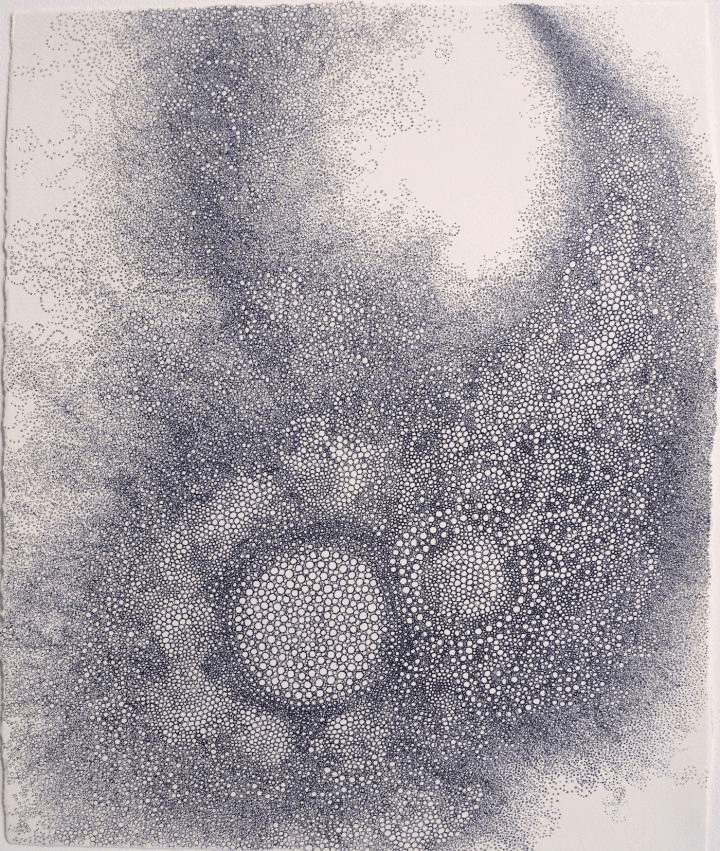
The technique is inspired by Japanese artist Hiroyuki Doi, who does this incredibly beautiful compositions based entirely on repeating circles:

Image by Hiroyuki Doi, from an article at hyperallergic.com about his work.

So I set my timer for ten minutes, and off I went.

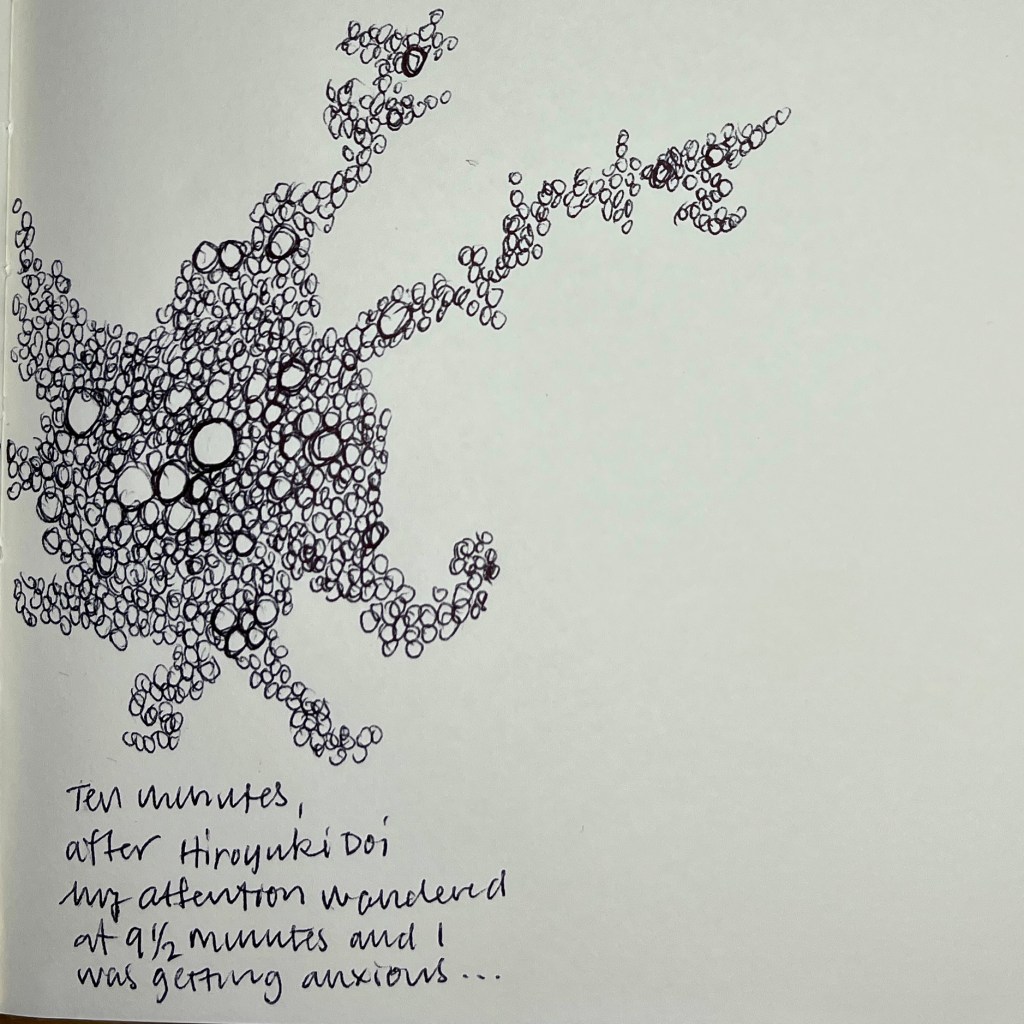
There’s nothing special about the 10-minute drawing. Like many 10-minute drawings, it’s awkward, and unfocused.

The interesting part of the experience had nothing to do with the drawing. But maybe everything to do with it… not sure. I started feeling antsy, and anxious, and needing to check the timer, at about 9.30. It was not a relaxing, flow-based feeling. I was feeling bad.

So I decided to lean into it for a little bit.

I suspect that this impulsive, let’s-try-something-new, little drawing — based on a prompt — didn’t feel productive enough. I was taking time out of my day to do something completely frivolous, something that was supposed to be kind of relaxing, and instead I felt like I was stealing time.

But from what? From whom? I wasn’t working on anything, or volunteering. I’m working my way through a class, but I’m not on a hard deadline at the moment. I didn’t have somewhere else I needed to be — no one was waiting for me, or depending on me, for anything in that moment.

I think that this kind of anxiety comes from some very old stuff. While I’m uncomfortable with the notion of an inner child (I don’t have any specific issue with it, but it feels weird), I think that this is the kind of thing that requires some acknowledgement and remediation (is that the right word?).

So, for myself — or anyone else — who needs to hear it: please take some time today to do something the rest of the world (or your family of origin) might not approve of because it’s not “productive.” It doesn’t have to be a grand gesture… maybe a 10-minute circle drawing will do the trick.

Nature Journal

Nature Journal Educator Workshop

This weekend I’m participating in the 2023 Nature Journal Educator Workshop presented by the WildWonder Foundation.

These are my people. People who like to go outside and hang out… and write things down, or draw them, and consider them deeply. And then help other people figure out how to do the same in a way that works for them.

Cognitive science. Pedagogy. Natural science.

I am in heaven. (Note: there are a lot of academic papers to read in this area of heaven.)

I notice. I wonder. It reminds me of…

Attention. Curiosity. Creativity.

Words. Pictures. Numbers.

My brain is exploding, in the best way.

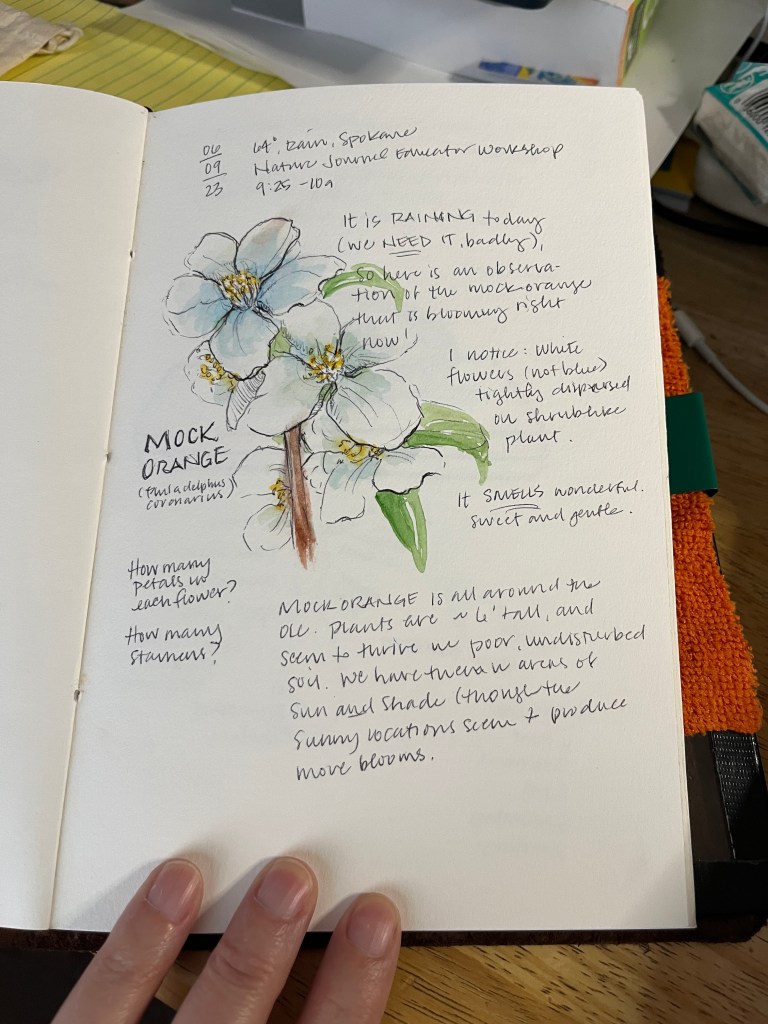
25 minutes yesterday. It was raining (not a drizzle, actual rain) — going outside would have soaked everything, so I had to work from a photo.

My background is in natural science illustration and writing, so words and pictures are my jam. I’m working on expanding my visual vocabulary to include charts, scatter plots, maps and such.

And numbers… I’ve been a mathphobe forever. I got lost in Algebra 1 and never quite got caught up. (I really enjoyed statistics and trigonometry, but the other stuff… ugh.)

[As an aside, there’s a magical unicorn/drag queen — IG: @mathisadrag — Carrie the One, who explains mathematical concepts via Instagram Reel. I wish she were around when I was struggling with math learning… this is great content.]

So yes, I am also working on including more number-related content in my journals.

I was in a small group yesterday for just a few minutes, and one of the folks mentioned that, as a scientist, they use their nature journals to describe behaviors, using an orb weaver as the day’s example. It was so interesting to hear them talk about their process.

I talked about how I get so distracted by the things I gravitate to that I don’t get to the stuff I’m less aware of/comfortable with, and then a grade 4-5 teacher in the group said that they focus their kids with prompts, like, “Today we’re going to focus on numbers.” That seems like a good strategy to keep in mind, even for our personal practice.

Today’s focus on issues for community educators (there is a separate track for school educators).

My brain is full, and so is my heart… which feels kind of weird, in an unusual and lovely way.

Lucy the Pup · Outdoor Learning Center

I’m whipped.

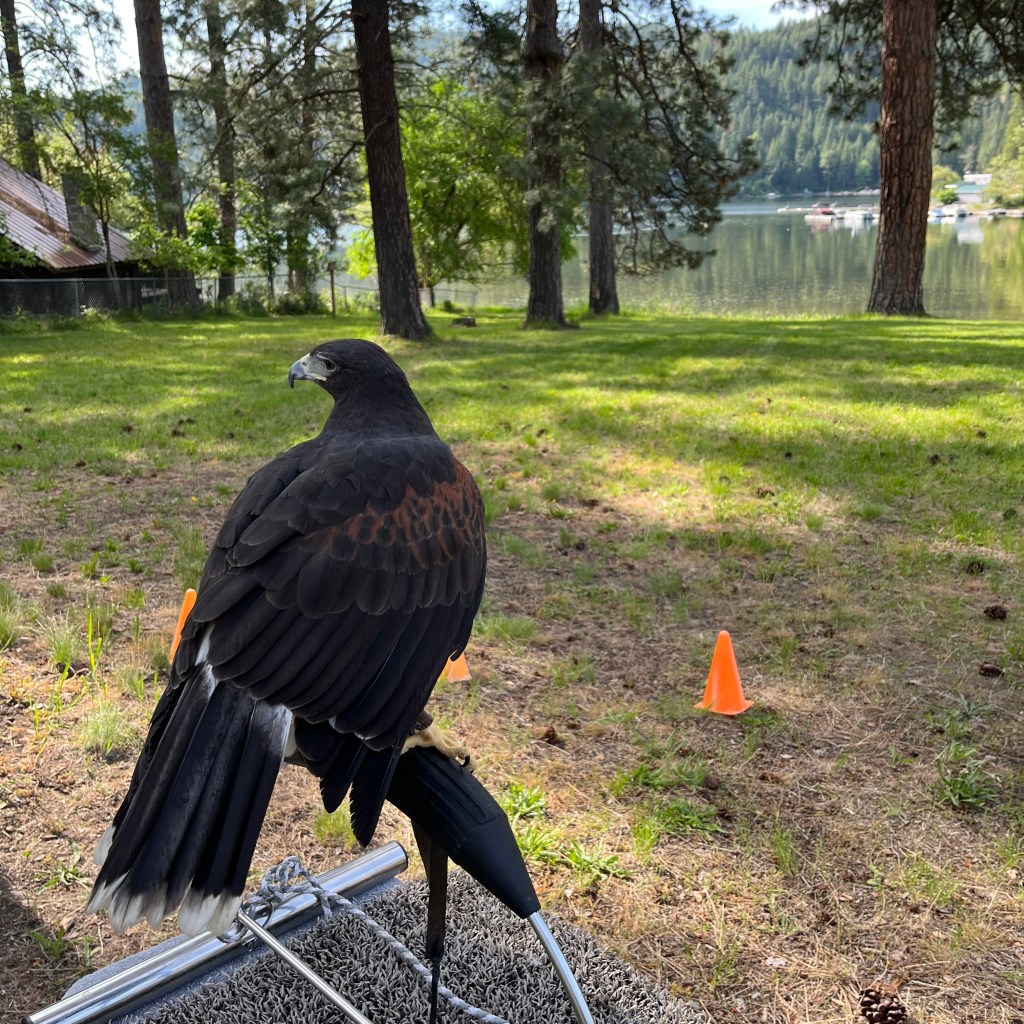
This was my “office” on Friday:

Stan (the Harris’s Hawk) waiting for the kids to show up.

Stan and I went to Deer Lake with six other OLC folks (teachers and interns) to spend the day with the Deer Park School District’s fifth graders. They spent the day rotating through seven stations of science-based activities.

I’m just a volunteer, and I have to say, I do not know how “real” teachers do this every day. Give these folks a raise. For real. Between the teaching and the driving (~100 miles, round trip from my house), it was an exhausting day.

Fifth graders are, on the whole, amazing people. They’re smart, curious, and observant, and they ask great questions. (I suspect fifth grade is just before most of the massive social pressure kicks in.) I have a prepared presentation, but if I’m with a group on a field trip (in other words, no curriculum requirements have to be met), and they want to talk about something else related to the bird I’m using, I’m all in for that. Those are some great conversations. Yeah, ok, sure, the kids can be all over the place, but geez, if they’re out at a lake on a beautiful Friday around the end of the school year? Entirely understandable.

Stan was, as always, completely charming. Harris’s Hawks are more social than other birds of prey, and Stan (a retired falconer’s bird with a significant (healed) wing injury) seems to like being the center of attention… so long as everybody keeps their distance. He spent the day preening, and rousing, and jumping onto the ground to foot something, sometimes stopping to watch the kids watch him.

Being outdoors means there are lots of distractions, but there’s also some really great stuff going on! In the morning, there were crows looking (and sounding) like they were getting set to mob Stan (and me), so it was a relief when the kids got there. There was a bumblebee wandering around the space we were in — I suspect we were near the bee’s nest, so the kids and I got to talk about bumblebee life cycles, and how to respect a bumble when they look like they’re wandering around near the ground. A pair of local bald eagles made an appearance around lunchtime. I got there a little bit early, and saw a great blue heron hunting at the lake’s edge (and later some red-winged blackbirds mobbing the heron as they flew across the lake).

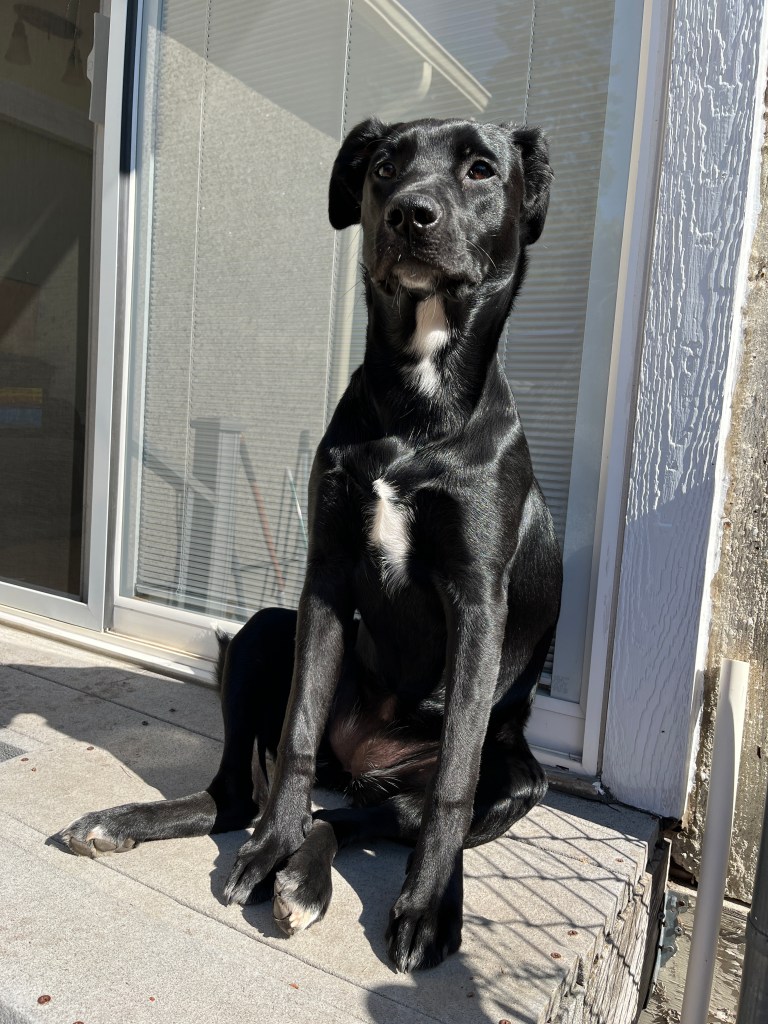
It was a great — and exhausting day. And then yesterday, Lucy (the menace like Dennis) “graduated” from puppy kindergarten, part 2. We’re laying a foundation for recall, and waiting/staying (yesterday I learned that those are two very different ideas), and learning how to greet people without knocking them over (work in progress, but improving!). She loves training — the interaction, and the treats — and I’m starting to be able to use a short session of whatever we’re working on to redirect her when her short-circuiting puppy brain gets all wound up.

Lu was so wary when she came to us almost four months ago, I was concerned that she was going to be afraid of other people or dogs. So far it does not look like that’s the case, although she needs a minute to warm up to new people or situations. I’m not sure she’ll be a dog who will tolerate random strangers walking up to her for pets — she has to observe and assess the situation in a way and place she feels safe in — so we’ll have to advocate for her in those instances.* Once she’s determined that everything is OK, she’s all in. (She starts wiggling and whining if she just hears Allie, one of our puppy-K teachers.)

Lucy this morning, just before she came inside, counter-surfed my journal, and chewed up the back cover… sigh. (I’m bummed, but it was my fault. I had to go to the bathroom and I left my journal within reach on the dining room table.)

The thing about puppy school is that it’s work for everybody. Lucy is almost seven months old. Her attention span is short. Trying to pay attention to the wonderful, can’t recommend them enough trainers and keep track of Lucy for an hour and a half is… something. So a session of puppy school, after a long teaching day… I’m going to need a minute.

(One of the things I’m excited to work on is teaching Lucy how to give hugs, so she can have the experience of an intimate greeting in a gentle and orderly way. That’s going to take some work, but it will be worth it.)

* On IG, MyBoyRudder’s person Maddie said something I’ve been thinking about a lot: everyone would be better off if we assume that no one wants anything to do with our dogs. We’re working with Lucy so that she will be attentive to us when we’re out in the world — we want her to notice, and be aware of, other people and other dogs, but to turn her attention back to us. Our goal is to work with her so we can act calmly in tandem, even when other people or dogs can’t. If someone wants Lucy’s attention, they can proactively ask for it and we can mediate the interaction in a way that’s safe for them and for her. We have a long way to go to get there (we’re starting by asking her to sit and look at us when she hears the phrase “can I pet your dog?”)… we will work on it.

AI · Thoughts about Stuff

ChatGPT in Real Life

So, apparently, one thing that ChatGPT is good at is bullshitting its way through research.

From The New York Times: Here’s What Happens When Your Lawyer Uses ChatGPT.

Apparently, an attorney (who had been practicing law for three decades), used ChatGPT to help with research on a brief. It made up legal rulings and opinions. And when pressed about whether those things were real… it lied.

The making-stuff-up part is not all that unexpected; it’s an algorithm that synthesizes existing information and fills in the details to make a more authoritative product. The lying part is a bit disconcerting.

In a bit of teaching brilliance, Twitter user @cwhowell123 did an experiment with his students:

The thread is incredibly interesting. Highly recommended.

All of his students generated essays using ChatGPT and then read them critically. He says that his students were surprised to learn (just as the lawyer from above) that ChatGPT could mislead them.

The pièce de résistance (for me), was found here:

I have not (as of yet) tried to use ChatGPT. It’s good to know that it’s not (yet) ready for primetime as a content generator. It seems that at least some of its “learning” has been devoted to creating content that sounds authoritative, without actually being reliable.

Frankly, I have memories of being a college student and doing the same thing. Although, some credit to me: I know that it’s not good practice to cite a source without laying eyes on the source. (Even if I misunderstand the intent of the author(s), or draw different conclusions from the research, I need to actually read the article before I use it as a reference.) I’m not smart enough to make up sources out of thin air, so that’s not a practice I would attempt either. (Yeah, the AI may know more than I do, but I know how to use what I know in ways that are mostly appropriate.)

My husband did an exercise with ChatGPT where he fed a 600-word NYTimes story about a Supreme Court ruling, and asked it to summarize the article in 300 words. He said that ChatGPT did a reasonable job, but it still got one point wrong. (He knew that because he read the NYTimes article first.)

This is all very interesting, and is helpful to me as I try to figure out how AI works and what it’s capabilities actually are. I’m coming around to the idea that ChatGPT, rather than being a generator of original content, is a natural language search algorithm that’s capable of synthesizing information based on its “learning,” and producing a natural language result. If I assume that that’s the case, then I should be prepared to subject every bit of its product to critical analysis (just as I would have to for any other kind of search results).

Raptors · Thoughts about Stuff

Maxime’s Minion

A couple of days ago, The Raptor Center at the University of Minnesota announced that one of their bald eagles, Maxime, had passed away. She had been at The Raptor Center for more than 20 years. In her later years, she developed severe arthritis that interfered with her quality of life. On May 19, she was humanely euthanized.

In 2016, I had the opportunity to visit The Raptor Center to take a week-long workshop on the care and maintenance of captive raptors. Some of Minnesota’s birds are like ours at the Outdoor Learning Center. That is to say, at least a few of them came into care from the wild, and have ongoing concerns resulting from injuries sustained in the world.

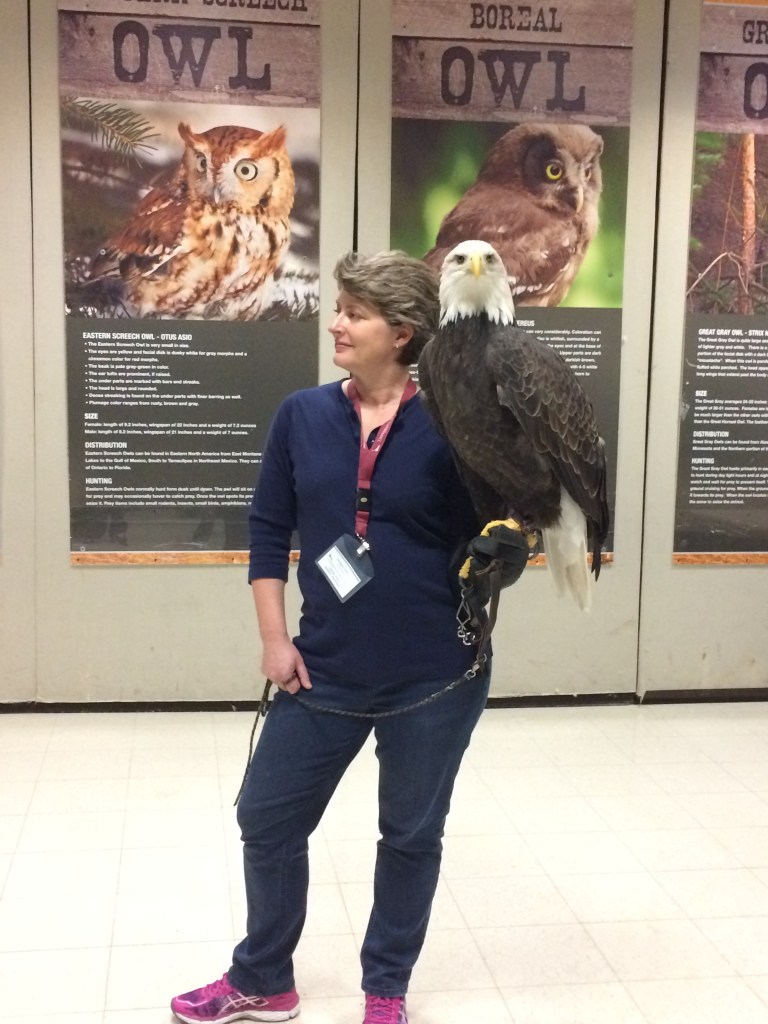
I’ve only ever worked with one bald eagle, and only for a few minutes, and it was at The Raptor Center. It was Maxime.

Maxime and Me, 2016

First thing, bald eagles get heavy in that position. I had her on my hip for stability for almost the entire time I worked with her. I was closely supervised by two of her handlers. They were very patient with me, and so was she.

By the time I went to that workshop, I had worked with the OLC’s birds for about 3.5 years, so I had experience working with great horned owls, a barn owl, a barred owl, a screech owl, and American kestrel, a Harris’s hawk, a rough-legged hawk, and a red-tailed hawk. I knew how to keep myself, and the birds, safe during our handling and husbandry sessions.

I knew that raptors aren’t props, pets, or toys. I knew that most raptors aren’t social (unless they’re migrating or nesting), and that “friendship” between our species just isn’t a thing. I knew how to tie a falconer’s knot. The OLC’s facilities are much smaller and less sophisticated than The Raptor Center’s, but we had checked in with other rehabbers and vets, and Fish & Wildlife, to make sure they’re good for the birds. I understood that our goals at the OLC were (and are) habituation, and tolerance.

The most profound thing I learned at The Raptor Center was how to incorporate cooperation into the relationship. The birds are sentient individuals who have preferences, and personalities, and it’s important for those of us who get to work with them to honor those preferences when we can. It’s not always possible, but to the extent that it is possible, it’s our responsibility to try.

These thoughts are still front-of-mind today:

Do not lie to the bird.

Do not try to conceal what’s going on, especially in situations where you know that bird isn’t going to enjoy it (like restraint for medical procedures).

Project what’s going to happen.

Be safe.

Be efficient.

Let the bird recover quietly, without interference from you.

If you’re going to be involved in activities the bird doesn’t enjoy, and you want to be a regular handler of the bird, you have to put in extra time, so time spent trimming beaks and talons isn’t the only time you’re handling the bird.

It’s 2023, and I’m still working on this stuff, with our birds (many of them new since 2016) and other volunteers. It’s aspirational, particularly if a bird came into care as an adult. But I think about it often, and I’m grateful to have had the opportunity to learn it from The Raptor Center, with Maxime.

At the workshop, we broke into groups for some games, and my group was named Maxime’s Minions.

AI · Studenting

Academic Integrity

I’m so old that I started learning to type on my mom’s typewriter. (I was a child who thought that typewriters were cool, and I wanted to learn to use it. I’m not a particularly fast typist, so it turns out I was more interested in figuring out how it worked than learning to use it.)

When I started having to write papers for every class I took in college, I had a Mac, but I still took notes and drafted my papers longhand (only the first draft — every other iteration happened on the computer).

As a graphic designer, I used version naming conventions (052123_filename.indd, 052223_filename.indd, 052223_filename1a.indd…) for all my files, so that I could present different ideas, or step back if I needed to.

As I learn front-end web development, I’m getting a little bit more familiar with version control, using Git and GitHub.

I’m thinking about all of these practices as they relate to academic integrity in the age of ChatGPT. Teachers are trying to figure out how to prevent students from cheating. And we, as students, have to figure out how we are going to make sure that we can demonstrate that the work we are presenting is ours. In other words, as students, we need to develop a kind of “hygiene” to make sure that they we show the evolution of a project or paper.

(In other words, we all need to figure out how to avoid this sort of thing: Professor Flunks All His Students After ChatGPT Falsely Claims It Wrote Their Papers. )

In my case, I still tend to take notes longhand (I think better with a pen in hand); notes are artifacts, so that’s a reasonable start. Another thing I already do if I’m working on a group project is keep local files of the work I’ve shared (or with Google apps, I’ll make a copy of a file and share the copy) — not because I think my work is of higher quality than the group can produce (it is most assuredly not), but because it creates a situation where I can point to the part of the project I contributed to as an individual.

I think I’m going to start implementing version naming conventions for files if I’m working on a solo project. Also, I need to start getting better at getting to know my professors, so they have a sense of who I am, and how I approach assignments. (For online students, I think discussions are a good way to demonstrate that you’re engaging with the material in a thoughtful way, in your own style, in a less formal context.)

I’ve been pretty fortunate that most of my academic endeavors involve writing and project work, where you have to demonstrate progression of thought through the course of the work. It’s difficult to cheat that process (or the cheating involves so much more work and creativity than the assignment calls for that it should probably be lauded).

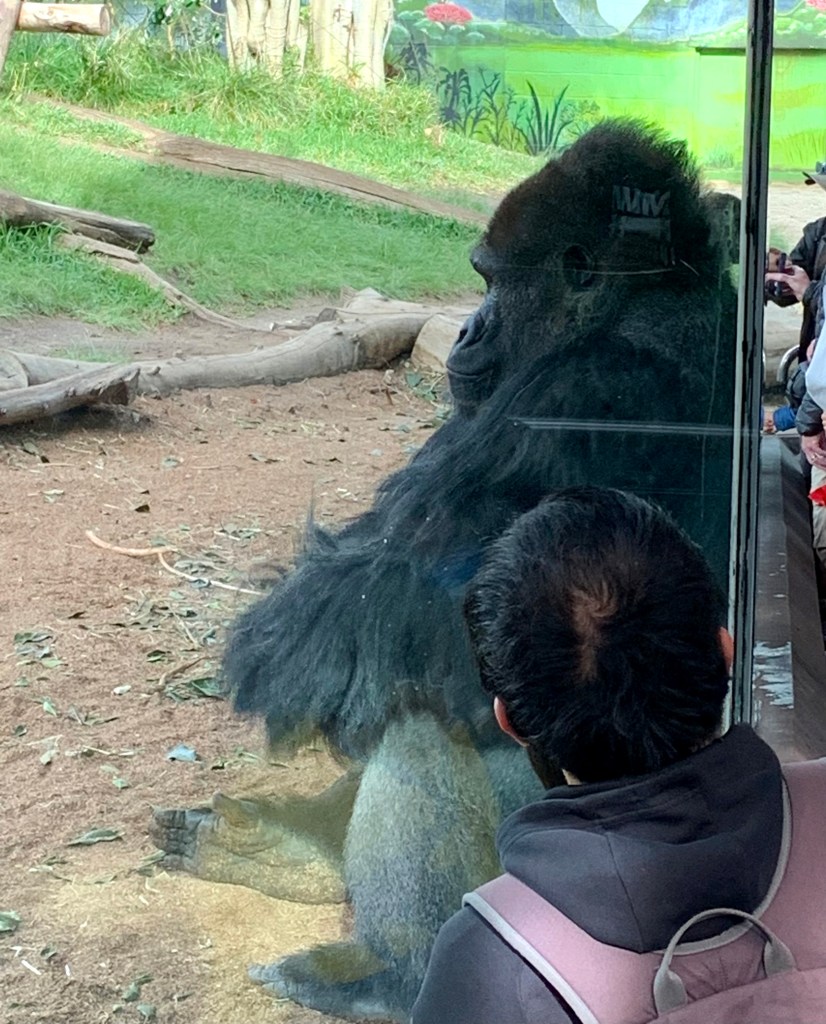
Photo offering of the day: this gorilla from the San Diego Zoo, who chose to walk right up to the viewing area, turn his back on all of us, and sit down. He decided that if he had to interact with us, he was going to do it in his own way. (Animals are capable of complex communication.)

We went to the San Diego Zoo on Christmas Day in 2021. This gorilla did an amazing job of letting us know that he was going to do his thing in his way, never mind the rest of us. I appreciate it when any animal has enough autonomy to express themself.
AI · Thoughts about Stuff

Artificial Intelligence

I’ve been hearing a lot about AI lately. More than I would like, in fact. I suspect that’s true for many of us.

For school, we received a warning that we need to check with our professors about the use of AI to do assignments. I’ve seen examples on Twitter, from teachers, about students using AI inappropriately. I follow some artists who have had their work “appropriated” (stolen) to train AIs. I’m seeing authors concerned about how their work is being used.

One law school professor advocates for teaching students how to use it effectively and ethically. I was surprised by the recommendation, but I see the utility in it — it’s here, and becoming more pervasive. We should probably all know at least the basics. The APA agrees that ChatGPT can have the potential to advance learning, in some situations.

Recently, I experienced how health care and business are trying to use AIs to do customer service. It’s not going well. It’s not ready to do anything more than the most basic of business functions. But businesses are plugging them in and letting go of their customer service reps. (Newsflash: it’s really frustrating to navigate this new landscape as a patient or customer.)

It’s causing no small amount of consternation, but I’m not naive enough to think that it’s going to go away, or that we can legislate it out of existence. It’s here, and some of it is getting pretty sophisticated.

And there are some good ways to use the technology. IBM’s Watson seems to be adept at complex medical diagnoses (in part, I suspect, because Watson can “read” everything about a particular subject much more quickly than doctors can). Here’s the thing, though: a doctor has to decide if that diagnosis is correct, based on their experience and their interactions with the patient. Watson may identify potential problems and solutions, but there’s a doctor that has to assess that information and decide if it is correct, or useful.

If I, a mere mortal (an MLIS student, not a doctor, lawyer, or artist) were going to use an AI, it would be to help with foundational work on projects by suggesting new avenues for exploration, or creating visualizations to illustrate research (more on this later, because I feel like this is inching close to a line that shouldn’t be crossed).

A couple of the more interesting uses I’ve seen:

  • An urban planner friend used an AI to generate images to illustrate an urbanist philosophy he espouses. The images are for demonstration purposes only; they are not going to be passed off as original work, are not going to be sold, and are not going to be integrated into a proposed or existing design framework.
  • Somebody on the internet used ChatGPT to come up with a week of meal planning, and then asked it to come up with recipes and a shopping list for the week.

Because there are some legitimate uses for AI, and it is a whole thing, I suspect it behooves us all to figure out what different AIs do, and whether they might be useful in some capacity. And if so, maybe to go one step further and figure out how to incorporate them into whatever workflow we use.

That said, I can see many, many red flags. There are some huge ethics challenges there, and I suspect that we are not thoughtful enough to figure those out before some really bad stuff happens.

For example, this business where entities are stealing content (images, likenesses, and text) to “train” AIs is hella problematic.

The perception that prompting an AI is the same as creating a work is not quite right. The perception that an AI-generated work is an original work is wrong. The fact that students are turning in AI-generated work, and trying to pass it off as their own is… something. (More training about what plagiarism is and how to avoid it seems to be in order.)

Culturally, we are already terrible at recognizing the work of artists and illustrators, photographers, authors, and actors, and paying for their work in a way that is equitable. Using AIs to avoid paying creators altogether is morally bankrupt. (But it is probably profitable… welcome to the icky part of capitalism.)

And then there’s the idea that you shouldn’t have to disclose if you’ve used and AI to produce work. That is… how can I say this… bullshit. If you’re going to use a tool, use it, but that doesn’t mean you should be able to hide behind it. (Looking squarely at news organizations that are producing “stories” based on data. I’m not arguing the legitimacy or efficacy of using an AI to “write” the stories. I am arguing that the AI needs to get the byline so that we know that you’re doing it.)

Those of us who choose to use AIs to help with our research should have an academically sanctioned way to cite them in references1 (maybe even with new requirements that we disclose if and how we used the AI, which one we used, and how our work with it impacted our research). People who use AIs for artistic endeavors should be bound by copyright (held by the original creator, not the AI), and again, should have a way to cite and credit (and pay, if necessary) both the creator, and the AI.

This is fairly new to me, so I can’t pretend to understand the potential of this technology, or all of the ethical issues surrounding it. But I’m diving into it, because it’s something I suspect we will all have to reckon with, sooner rather than later.

And because blog posts should have a photo, here’s an oddity quite unrelated to AI: a dandelion with fused stems and flowers.

Something weird going on with this dandelion… compound stems and flowers.

1As it turns out, the APA has a way to cite ChatGPT in references. Cool.

In the Kitchen

Pandemic Coffee, part 2

It’s been July-level hot here this week. At the beginning of May, it was rainy with highs in the 50s. Within a week, the weather turned around and it was high 70s, and for the last several days, highs have been in the high 80s, with nighttime temps in the high 50s/low 60s.

The no-see-ums are out with a vengeance, and it seems that every time I come in from the backyard, I have a new set of bites on my arms or head. (Thankfully I haven’t encountered any more black flies… knock wood.)

We missed out on a nice spring… thanks for nothing, climate change. On top of the warm temps, we’ve got smoke from the Alberta fires, and it’s only a matter of time before the fires start closer to home.

Hot temps, bug bites, and smoke… no, thank you.

Long days and iced coffee? Yes, please!

During the pandemic, one of the most useful things I learned was how to make coffee I like to drink. I learned to make an iced version, too.

Iced mocha, very light on the chocolate, made by yours truly.

This is how I do it:

  1. Brew coffee. (I like to use the most basic moka pot, with Indaba High Rise coffee.)
  2. Grab a cocktail shaker and chuck some ice cubes into it.
  3. Mix your choice of milk with chocolate syrup (or not, up to you) in your glass.
  4. Pour the milk into the shaker.
  5. Add the coffee.
  6. Shake it until the shaker feels cold.
  7. Add ice to your glass.
  8. Pour cooled mocha over ice.
  9. Enjoy.

This is not a new or original idea — I read an article in one of the food magazines in 2021(?), and this technique was suggested there. (I can’t find the article online… are we trying to memory-hole the pandemic?) I like it because the drink doesn’t dilute so quickly. And it’s refreshing on warm mornings, because it’s, you know, iced.

The ability to make a decent coffee at home has been a blessing, and a bit of a curse. I’ve been out and about in the mornings for a while now, because it’s easier to get a couple of hours of classwork done when I’m not trying to accommodate a puppy and a parrot. But coffee drinks are expensive, and frankly, a lot of them aren’t that great. (I should say that they may be objectively great, but they’re not what I enjoy.)

Life is complicated, I guess.