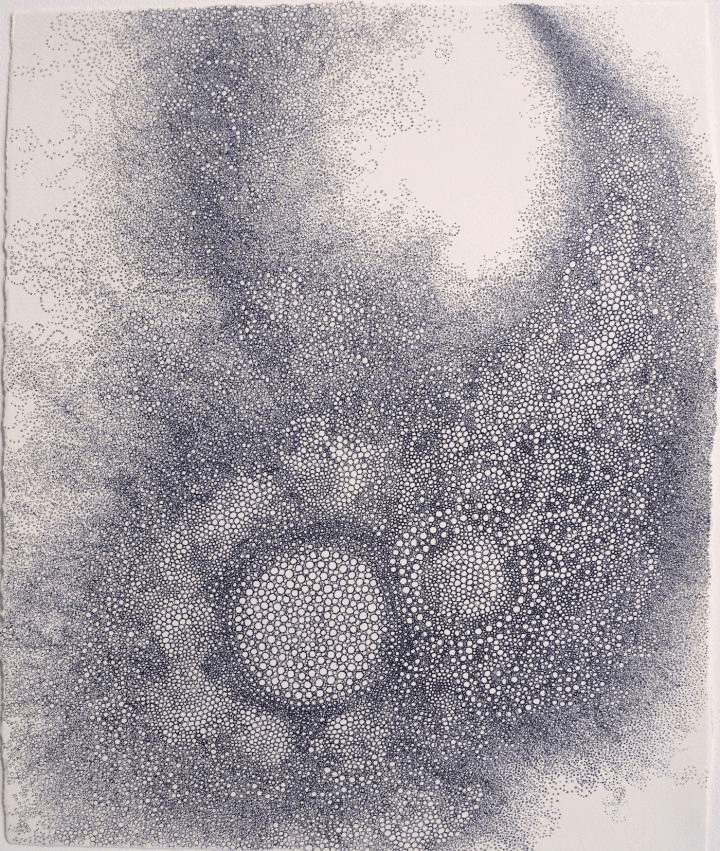
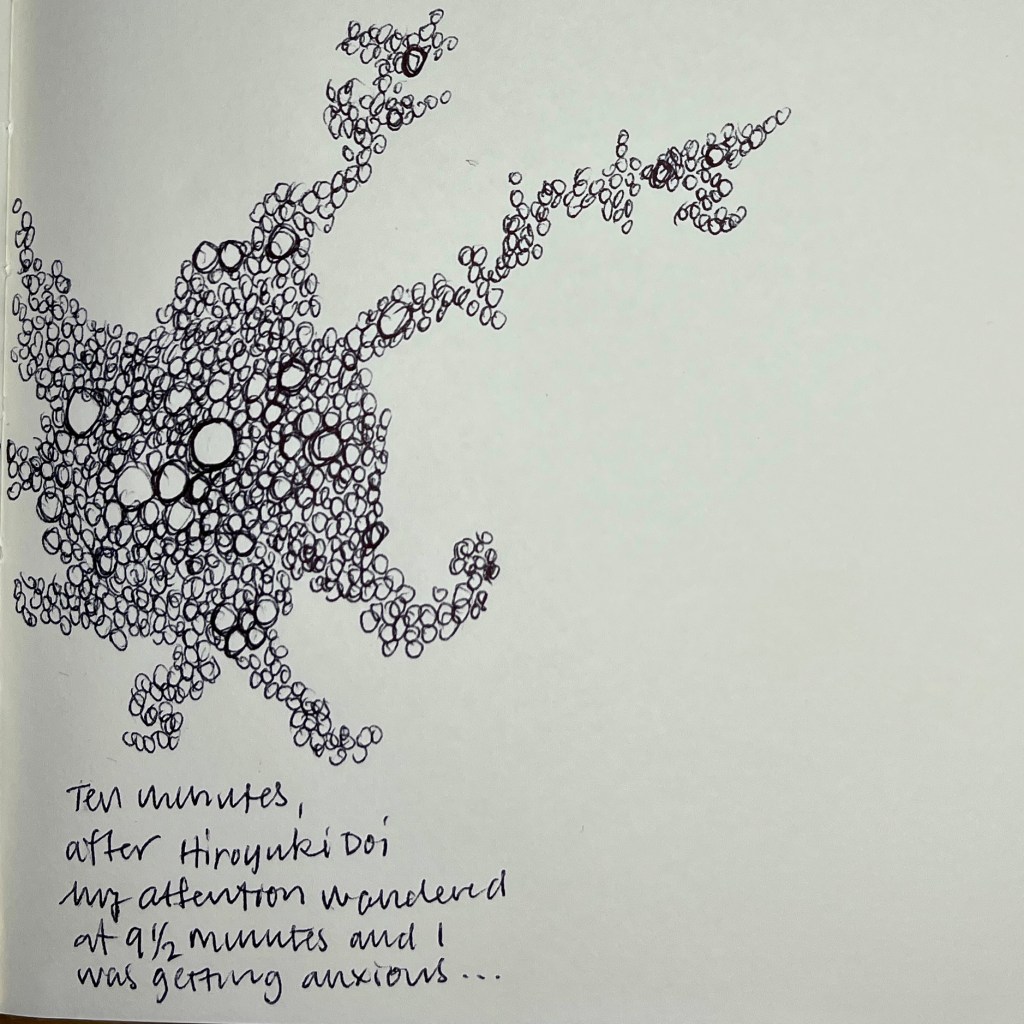
So I set my timer for ten minutes, and off I went.
There’s nothing special about the 10-minute drawing. Like many 10-minute drawings, it’s awkward, and unfocused.
The interesting part of the experience had nothing to do with the drawing. But maybe everything to do with it… not sure. I started feeling antsy, and anxious, and needing to check the timer, at about 9.30. It was not a relaxing, flow-based feeling. I was feeling bad.
So I decided to lean into it for a little bit.
I suspect that this impulsive, let’s-try-something-new, little drawing — based on a prompt — didn’t feel productive enough. I was taking time out of my day to do something completely frivolous, something that was supposed to be kind of relaxing, and instead I felt like I was stealing time.
But from what? From whom? I wasn’t working on anything, or volunteering. I’m working my way through a class, but I’m not on a hard deadline at the moment. I didn’t have somewhere else I needed to be — no one was waiting for me, or depending on me, for anything in that moment.
I think that this kind of anxiety comes from some very old stuff. While I’m uncomfortable with the notion of an inner child (I don’t have any specific issue with it, but it feels weird), I think that this is the kind of thing that requires some acknowledgement and remediation (is that the right word?).
So, for myself — or anyone else — who needs to hear it: please take some time today to do something the rest of the world (or your family of origin) might not approve of because it’s not “productive.” It doesn’t have to be a grand gesture… maybe a 10-minute circle drawing will do the trick.
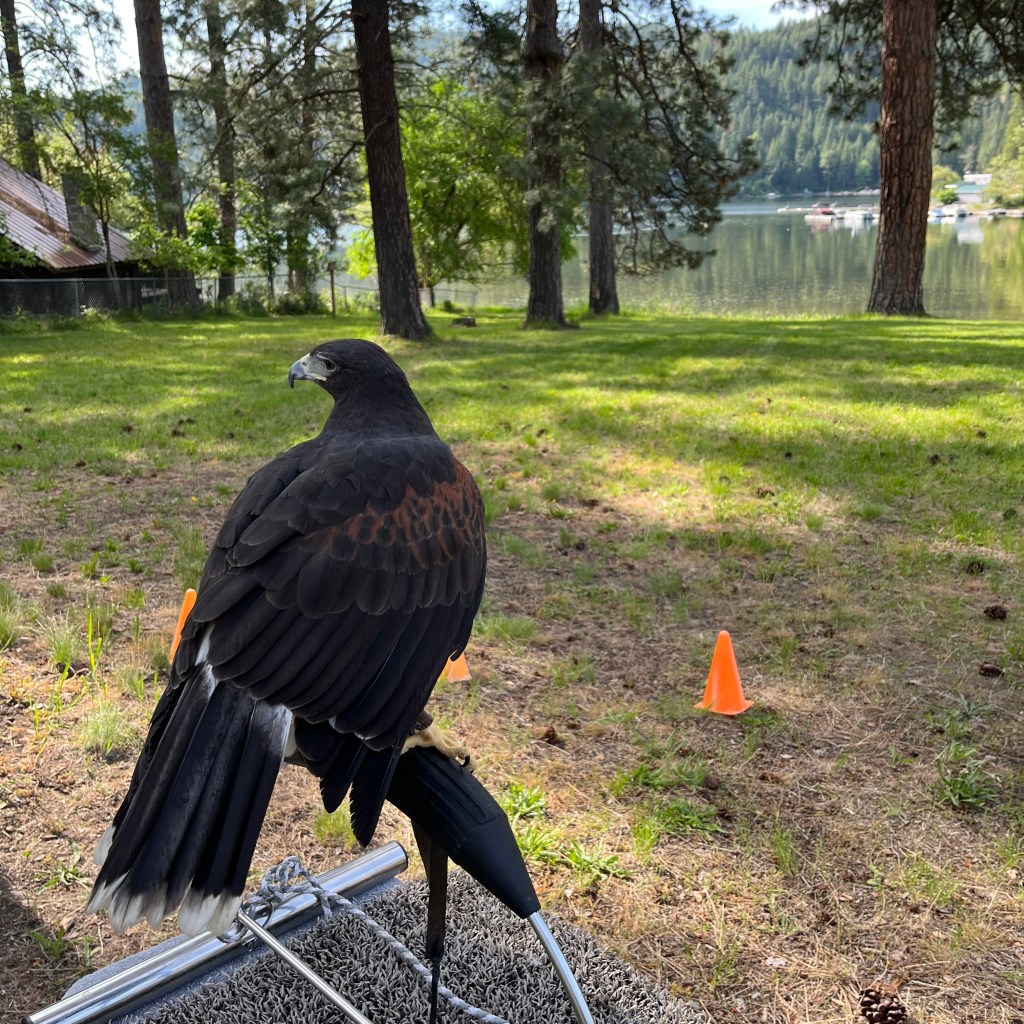
Stan (the Harris’s Hawk) waiting for the kids to show up.
Stan and I went to Deer Lake with six other OLC folks (teachers and interns) to spend the day with the Deer Park School District’s fifth graders. They spent the day rotating through seven stations of science-based activities.
I’m just a volunteer, and I have to say, I do not know how “real” teachers do this every day. Give these folks a raise. For real. Between the teaching and the driving (~100 miles, round trip from my house), it was an exhausting day.
Fifth graders are, on the whole, amazing people. They’re smart, curious, and observant, and they ask great questions. (I suspect fifth grade is just before most of the massive social pressure kicks in.) I have a prepared presentation, but if I’m with a group on a field trip (in other words, no curriculum requirements have to be met), and they want to talk about something else related to the bird I’m using, I’m all in for that. Those are some great conversations. Yeah, ok, sure, the kids can be all over the place, but geez, if they’re out at a lake on a beautiful Friday around the end of the school year? Entirely understandable.
Stan was, as always, completely charming. Harris’s Hawks are more social than other birds of prey, and Stan (a retired falconer’s bird with a significant (healed) wing injury) seems to like being the center of attention… so long as everybody keeps their distance. He spent the day preening, and rousing, and jumping onto the ground to foot something, sometimes stopping to watch the kids watch him.
Being outdoors means there are lots of distractions, but there’s also some really great stuff going on! In the morning, there were crows looking (and sounding) like they were getting set to mob Stan (and me), so it was a relief when the kids got there. There was a bumblebee wandering around the space we were in — I suspect we were near the bee’s nest, so the kids and I got to talk about bumblebee life cycles, and how to respect a bumble when they look like they’re wandering around near the ground. A pair of local bald eagles made an appearance around lunchtime. I got there a little bit early, and saw a great blue heron hunting at the lake’s edge (and later some red-winged blackbirds mobbing the heron as they flew across the lake).
It was a great — and exhausting day. And then yesterday, Lucy (the menace like Dennis) “graduated” from puppy kindergarten, part 2. We’re laying a foundation for recall, and waiting/staying (yesterday I learned that those are two very different ideas), and learning how to greet people without knocking them over (work in progress, but improving!). She loves training — the interaction, and the treats — and I’m starting to be able to use a short session of whatever we’re working on to redirect her when her short-circuiting puppy brain gets all wound up.
Lu was so wary when she came to us almost four months ago, I was concerned that she was going to be afraid of other people or dogs. So far it does not look like that’s the case, although she needs a minute to warm up to new people or situations. I’m not sure she’ll be a dog who will tolerate random strangers walking up to her for pets — she has to observe and assess the situation in a way and place she feels safe in — so we’ll have to advocate for her in those instances.* Once she’s determined that everything is OK, she’s all in. (She starts wiggling and whining if she just hears Allie, one of our puppy-K teachers.)
Lucy this morning, just before she came inside, counter-surfed my journal, and chewed up the back cover… sigh. (I’m bummed, but it was my fault. I had to go to the bathroom and I left my journal within reach on the dining room table.)
The thing about puppy school is that it’s work for everybody. Lucy is almost seven months old. Her attention span is short. Trying to pay attention to the wonderful, can’t recommend them enough trainers and keep track of Lucy for an hour and a half is… something. So a session of puppy school, after a long teaching day… I’m going to need a minute.
(One of the things I’m excited to work on is teaching Lucy how to give hugs, so she can have the experience of an intimate greeting in a gentle and orderly way. That’s going to take some work, but it will be worth it.)
* On IG, MyBoyRudder’s person Maddie said something I’ve been thinking about a lot: everyone would be better off if we assume that no one wants anything to do with our dogs. We’re working with Lucy so that she will be attentive to us when we’re out in the world — we want her to notice, and be aware of, other people and other dogs, but to turn her attention back to us. Our goal is to work with her so we can act calmly in tandem, even when other people or dogs can’t. If someone wants Lucy’s attention, they can proactively ask for it and we can mediate the interaction in a way that’s safe for them and for her. We have a long way to go to get there (we’re starting by asking her to sit and look at us when she hears the phrase “can I pet your dog?”)… we will work on it.
Apparently, an attorney (who had been practicing law for three decades), used ChatGPT to help with research on a brief. It made up legal rulings and opinions. And when pressed about whether those things were real… it lied.
The making-stuff-up part is not all that unexpected; it’s an algorithm that synthesizes existing information and fills in the details to make a more authoritative product. The lying part is a bit disconcerting.
In a bit of teaching brilliance, Twitter user @cwhowell123 did an experiment with his students:
So I followed @GaryMarcus's suggestion and had my undergrad class use ChatGPT for a critical assignment. I had them all generate an essay using a prompt I gave them, and then their job was to "grade" it–look for hallucinated info and critique its analysis. *All 63* essays had
The thread is incredibly interesting. Highly recommended.
All of his students generated essays using ChatGPT and then read them critically. He says that his students were surprised to learn (just as the lawyer from above) that ChatGPT could mislead them.
The pièce de résistance (for me), was found here:
opined that AI both knew more than us but is dumber than we are since it cannot think critically. She wrote, "I’m not worried about AI getting to where we are now. I’m much more worried about the possibility of us reverting to where AI is."
I have not (as of yet) tried to use ChatGPT. It’s good to know that it’s not (yet) ready for primetime as a content generator. It seems that at least some of its “learning” has been devoted to creating content that sounds authoritative, without actually being reliable.
Frankly, I have memories of being a college student and doing the same thing. Although, some credit to me: I know that it’s not good practice to cite a source without laying eyes on the source. (Even if I misunderstand the intent of the author(s), or draw different conclusions from the research, I need to actually read the article before I use it as a reference.) I’m not smart enough to make up sources out of thin air, so that’s not a practice I would attempt either. (Yeah, the AI may know more than I do, but I know how to use what I know in ways that are mostly appropriate.)
My husband did an exercise with ChatGPT where he fed a 600-word NYTimes story about a Supreme Court ruling, and asked it to summarize the article in 300 words. He said that ChatGPT did a reasonable job, but it still got one point wrong. (He knew that because he read the NYTimes article first.)
This is all very interesting, and is helpful to me as I try to figure out how AI works and what it’s capabilities actually are. I’m coming around to the idea that ChatGPT, rather than being a generator of original content, is a natural language search algorithm that’s capable of synthesizing information based on its “learning,” and producing a natural language result. If I assume that that’s the case, then I should be prepared to subject every bit of its product to critical analysis (just as I would have to for any other kind of search results).
A couple of days ago, The Raptor Center at the University of Minnesota announced that one of their bald eagles, Maxime, had passed away. She had been at The Raptor Center for more than 20 years. In her later years, she developed severe arthritis that interfered with her quality of life. On May 19, she was humanely euthanized.
In 2016, I had the opportunity to visit The Raptor Center to take a week-long workshop on the care and maintenance of captive raptors. Some of Minnesota’s birds are like ours at the Outdoor Learning Center. That is to say, at least a few of them came into care from the wild, and have ongoing concerns resulting from injuries sustained in the world.
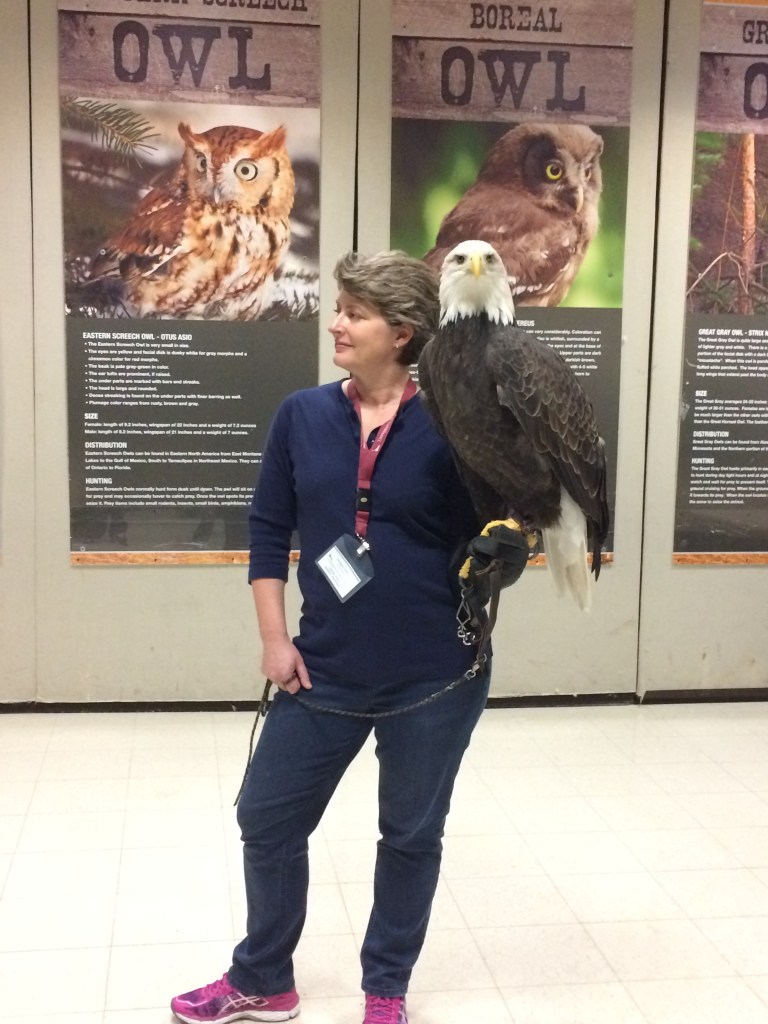
I’ve only ever worked with one bald eagle, and only for a few minutes, and it was at The Raptor Center. It was Maxime.
Maxime and Me, 2016
First thing, bald eagles get heavy in that position. I had her on my hip for stability for almost the entire time I worked with her. I was closely supervised by two of her handlers. They were very patient with me, and so was she.
By the time I went to that workshop, I had worked with the OLC’s birds for about 3.5 years, so I had experience working with great horned owls, a barn owl, a barred owl, a screech owl, and American kestrel, a Harris’s hawk, a rough-legged hawk, and a red-tailed hawk. I knew how to keep myself, and the birds, safe during our handling and husbandry sessions.
I knew that raptors aren’t props, pets, or toys. I knew that most raptors aren’t social (unless they’re migrating or nesting), and that “friendship” between our species just isn’t a thing. I knew how to tie a falconer’s knot. The OLC’s facilities are much smaller and less sophisticated than The Raptor Center’s, but we had checked in with other rehabbers and vets, and Fish & Wildlife, to make sure they’re good for the birds. I understood that our goals at the OLC were (and are) habituation, and tolerance.
The most profound thing I learned at The Raptor Center was how to incorporate cooperation into the relationship. The birds are sentient individuals who have preferences, and personalities, and it’s important for those of us who get to work with them to honor those preferences when we can. It’s not always possible, but to the extent that it is possible, it’s our responsibility to try.
These thoughts are still front-of-mind today:
Do not lie to the bird.
Do not try to conceal what’s going on, especially in situations where you know that bird isn’t going to enjoy it (like restraint for medical procedures).
Project what’s going to happen.
Be safe.
Be efficient.
Let the bird recover quietly, without interference from you.
If you’re going to be involved in activities the bird doesn’t enjoy, and you want to be a regular handler of the bird, you have to put in extra time, so time spent trimming beaks and talons isn’t the only time you’re handling the bird.
It’s 2023, and I’m still working on this stuff, with our birds (many of them new since 2016) and other volunteers. It’s aspirational, particularly if a bird came into care as an adult. But I think about it often, and I’m grateful to have had the opportunity to learn it from The Raptor Center, with Maxime.
At the workshop, we broke into groups for some games, and my group was named Maxime’s Minions.
I’m so old that I started learning to type on my mom’s typewriter. (I was a child who thought that typewriters were cool, and I wanted to learn to use it. I’m not a particularly fast typist, so it turns out I was more interested in figuring out how it worked than learning to use it.)
When I started having to write papers for every class I took in college, I had a Mac, but I still took notes and drafted my papers longhand (only the first draft — every other iteration happened on the computer).
As a graphic designer, I used version naming conventions (052123_filename.indd, 052223_filename.indd, 052223_filename1a.indd…) for all my files, so that I could present different ideas, or step back if I needed to.
As I learn front-end web development, I’m getting a little bit more familiar with version control, using Git and GitHub.
I’m thinking about all of these practices as they relate to academic integrity in the age of ChatGPT. Teachers are trying to figure out how to prevent students from cheating. And we, as students, have to figure out how we are going to make sure that we can demonstrate that the work we are presenting is ours. In other words, as students, we need to develop a kind of “hygiene” to make sure that they we show the evolution of a project or paper.
In my case, I still tend to take notes longhand (I think better with a pen in hand); notes are artifacts, so that’s a reasonable start. Another thing I already do if I’m working on a group project is keep local files of the work I’ve shared (or with Google apps, I’ll make a copy of a file and share the copy) — not because I think my work is of higher quality than the group can produce (it is most assuredly not), but because it creates a situation where I can point to the part of the project I contributed to as an individual.
I think I’m going to start implementing version naming conventions for files if I’m working on a solo project. Also, I need to start getting better at getting to know my professors, so they have a sense of who I am, and how I approach assignments. (For online students, I think discussions are a good way to demonstrate that you’re engaging with the material in a thoughtful way, in your own style, in a less formal context.)
I’ve been pretty fortunate that most of my academic endeavors involve writing and project work, where you have to demonstrate progression of thought through the course of the work. It’s difficult to cheat that process (or the cheating involves so much more work and creativity than the assignment calls for that it should probably be lauded).
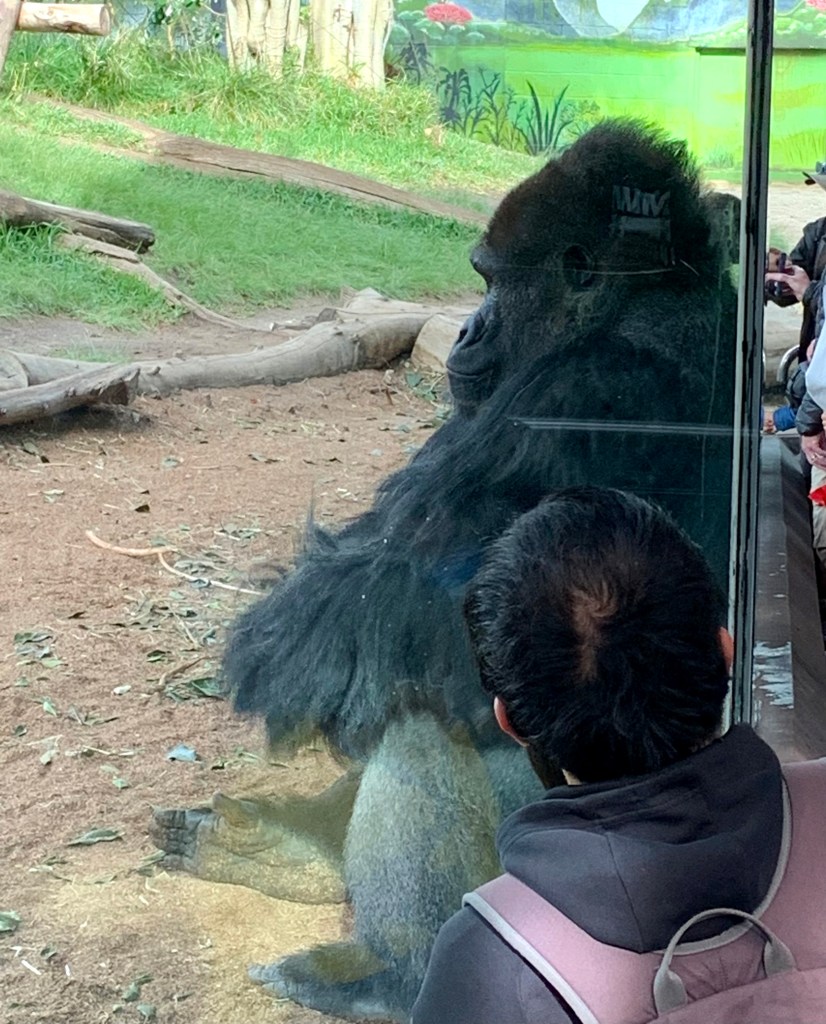
Photo offering of the day: this gorilla from the San Diego Zoo, who chose to walk right up to the viewing area, turn his back on all of us, and sit down. He decided that if he had to interact with us, he was going to do it in his own way. (Animals are capable of complex communication.)
We went to the San Diego Zoo on Christmas Day in 2021. This gorilla did an amazing job of letting us know that he was going to do his thing in his way, never mind the rest of us. I appreciate it when any animal has enough autonomy to express themself.
I’ve been hearing a lot about AI lately. More than I would like, in fact. I suspect that’s true for many of us.
For school, we received a warning that we need to check with our professors about the use of AI to do assignments. I’ve seen examples on Twitter, from teachers, about students using AI inappropriately. I follow some artists who have had their work “appropriated” (stolen) to train AIs. I’m seeing authors concerned about how their work is being used.
One law school professor advocates for teaching students how to use it effectively and ethically. I was surprised by the recommendation, but I see the utility in it — it’s here, and becoming more pervasive. We should probably all know at least the basics. The APA agrees that ChatGPT can have the potential to advance learning, in some situations.
Recently, I experienced how health care and business are trying to use AIs to do customer service. It’s not going well. It’s not ready to do anything more than the most basic of business functions. But businesses are plugging them in and letting go of their customer service reps. (Newsflash: it’s really frustrating to navigate this new landscape as a patient or customer.)
It’s causing no small amount of consternation, but I’m not naive enough to think that it’s going to go away, or that we can legislate it out of existence. It’s here, and some of it is getting pretty sophisticated.
And there are some good ways to use the technology. IBM’s Watson seems to be adept at complex medical diagnoses (in part, I suspect, because Watson can “read” everything about a particular subject much more quickly than doctors can). Here’s the thing, though: a doctor has to decide if that diagnosis is correct, based on their experience and their interactions with the patient. Watson may identify potential problems and solutions, but there’s a doctor that has to assess that information and decide if it is correct, or useful.
If I, a mere mortal (an MLIS student, not a doctor, lawyer, or artist) were going to use an AI, it would be to help with foundational work on projects by suggesting new avenues for exploration, or creating visualizations to illustrate research (more on this later, because I feel like this is inching close to a line that shouldn’t be crossed).
A couple of the more interesting uses I’ve seen:
An urban planner friend used an AI to generate images to illustrate an urbanist philosophy he espouses. The images are for demonstration purposes only; they are not going to be passed off as original work, are not going to be sold, and are not going to be integrated into a proposed or existing design framework.
Somebody on the internet used ChatGPT to come up with a week of meal planning, and then asked it to come up with recipes and a shopping list for the week.
Because there are some legitimate uses for AI, and it is a whole thing, I suspect it behooves us all to figure out what different AIs do, and whether they might be useful in some capacity. And if so, maybe to go one step further and figure out how to incorporate them into whatever workflow we use.
That said, I can see many, many red flags. There are some huge ethics challenges there, and I suspect that we are not thoughtful enough to figure those out before some really bad stuff happens.
For example, this business where entities are stealing content (images, likenesses, and text) to “train” AIs is hella problematic.
The perception that prompting an AI is the same as creating a work is not quite right. The perception that an AI-generated work is an original work is wrong. The fact that students are turning in AI-generated work, and trying to pass it off as their own is… something. (More training about what plagiarism is and how to avoid it seems to be in order.)
Culturally, we are already terrible at recognizing the work of artists and illustrators, photographers, authors, and actors, and paying for their work in a way that is equitable. Using AIs to avoid paying creators altogether is morally bankrupt. (But it is probably profitable… welcome to the icky part of capitalism.)
And then there’s the idea that you shouldn’t have to disclose if you’ve used and AI to produce work. That is… how can I say this… bullshit. If you’re going to use a tool, use it, but that doesn’t mean you should be able to hide behind it. (Looking squarely at news organizations that are producing “stories” based on data. I’m not arguing the legitimacy or efficacy of using an AI to “write” the stories. I am arguing that the AI needs to get the byline so that we know that you’re doing it.)
Those of us who choose to use AIs to help with our research should have an academically sanctioned way to cite them in references1 (maybe even with new requirements that we disclose if and how we used the AI, which one we used, and how our work with it impacted our research). People who use AIs for artistic endeavors should be bound by copyright (held by the original creator, not the AI), and again, should have a way to cite and credit (and pay, if necessary) both the creator, and the AI.
This is fairly new to me, so I can’t pretend to understand the potential of this technology, or all of the ethical issues surrounding it. But I’m diving into it, because it’s something I suspect we will all have to reckon with, sooner rather than later.
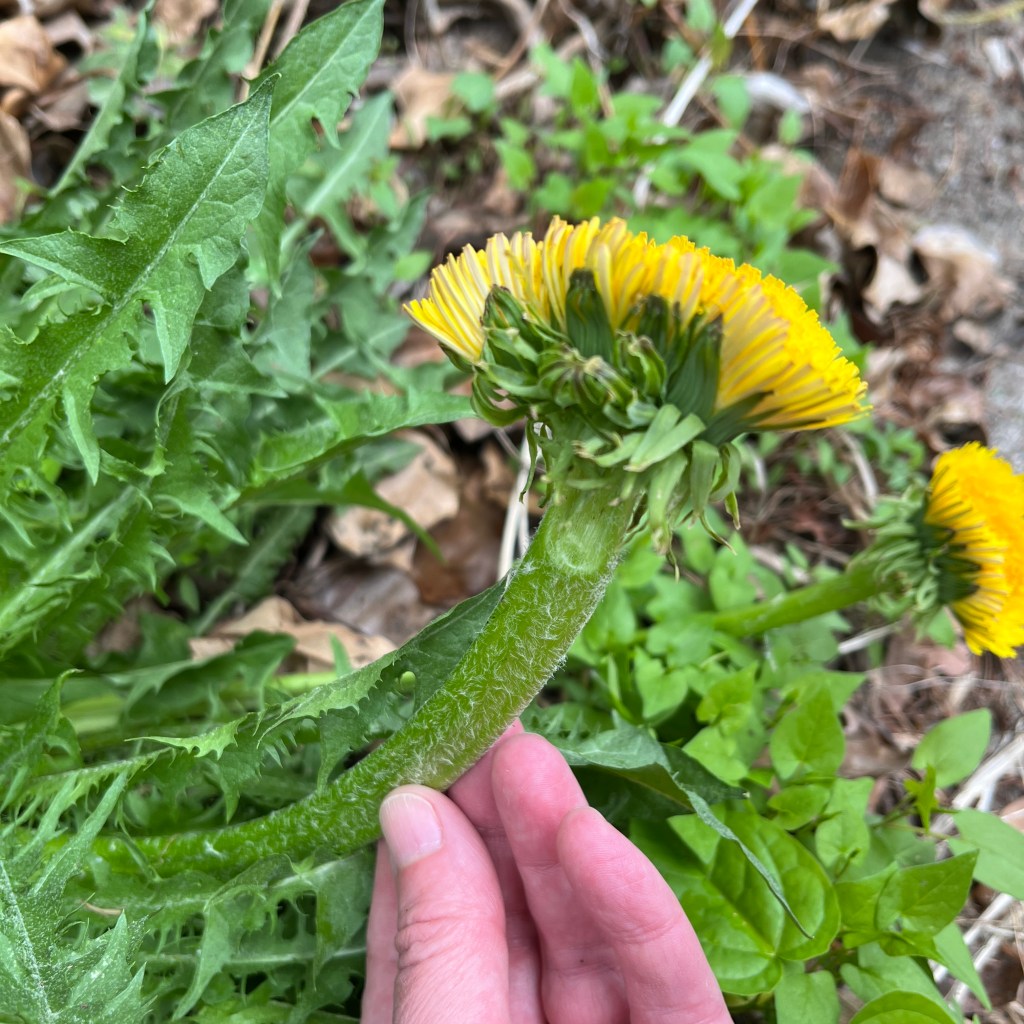
And because blog posts should have a photo, here’s an oddity quite unrelated to AI: a dandelion with fused stems and flowers.
Something weird going on with this dandelion… compound stems and flowers.
It’s been July-level hot here this week. At the beginning of May, it was rainy with highs in the 50s. Within a week, the weather turned around and it was high 70s, and for the last several days, highs have been in the high 80s, with nighttime temps in the high 50s/low 60s.
The no-see-ums are out with a vengeance, and it seems that every time I come in from the backyard, I have a new set of bites on my arms or head. (Thankfully I haven’t encountered any more black flies… knock wood.)
We missed out on a nice spring… thanks for nothing, climate change. On top of the warm temps, we’ve got smoke from the Alberta fires, and it’s only a matter of time before the fires start closer to home.
Hot temps, bug bites, and smoke… no, thank you.
Long days and iced coffee? Yes, please!
During the pandemic, one of the most useful things I learned was how to make coffee I like to drink. I learned to make an iced version, too.
Iced mocha, very light on the chocolate, made by yours truly.
Grab a cocktail shaker and chuck some ice cubes into it.
Mix your choice of milk with chocolate syrup (or not, up to you) in your glass.
Pour the milk into the shaker.
Add the coffee.
Shake it until the shaker feels cold.
Add ice to your glass.
Pour cooled mocha over ice.
Enjoy.
This is not a new or original idea — I read an article in one of the food magazines in 2021(?), and this technique was suggested there. (I can’t find the article online… are we trying to memory-hole the pandemic?) I like it because the drink doesn’t dilute so quickly. And it’s refreshing on warm mornings, because it’s, you know, iced.
The ability to make a decent coffee at home has been a blessing, and a bit of a curse. I’ve been out and about in the mornings for a while now, because it’s easier to get a couple of hours of classwork done when I’m not trying to accommodate a puppy and a parrot. But coffee drinks are expensive, and frankly, a lot of them aren’t that great. (I should say that they may be objectively great, but they’re not what I enjoy.)
Over the last couple of weeks, I have been trying to track down, and then replace, a lost shipment of medication.
Because I have chronic conditions that require daily medication, I use a mail pharmacy. I can get a 90-day supply for less than it would cost to go to the retail pharmacy three times for 30-day supplies. Win – win.
Except when it gets lost in the mail.
Express Scripts will not let you talk to a human being, so everything has to be done by email. It took a week to establish that the package was shipped from Express Scripts, and that it had not been delivered to me.
It took another week to establish that yes, I understand that it’s important for me to keep taking my medicine, and that yes, I understand that I will have to pay for the new prescription (lame, but another conversation for another time), and that I have run out of the medication in question and NEED YOU TO SHIP A REPLACEMENT.
So a refill was ordered. But it’s out of cycle (BECAUSE IT SHOULD BE A REPLACEMENT, NOT A REFILL), so it was flagged for being too early (BECAUSE IT’S REPLACING SOMETHING THAT WAS LOST IN THE MAIL.) That caused another delay, because someone had to approve it at that point.
I actually have no idea if I was corresponding with people who are overworked and have no influence over how these conversations should be handled, or it was an AI at work. It felt like I was dealing with an AI.
While this isn’t a life-or-death situation (yet), and is highly unlikely to become one, it needs to be resolved sooner rather than later.
I’m trying to keep an open mind for things like chatbots, automated systems and AI. I’ve actually seen some good uses for all of them… but customer service isn’t one of them.
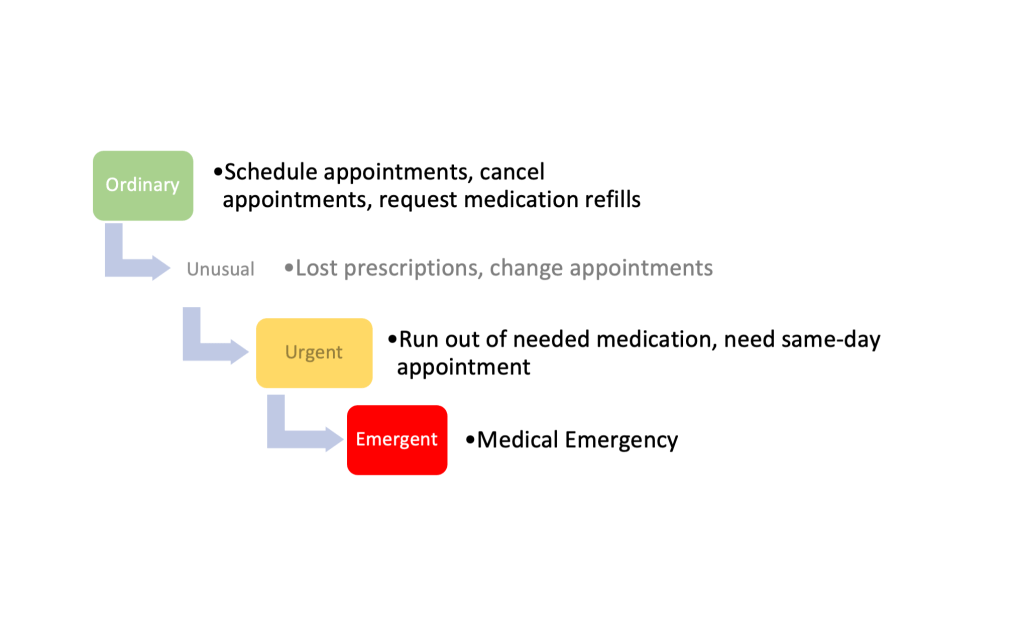
Chatbots and AI can handle the ordinary, which, presumably, makes up the greatest volume of communication. Most of the time, I would prefer to not have to go through a person, for things that involve calendaring, or reordering prescriptions for which I have remaining refills. It’s easier for everyone if I can have some autonomy.
A conversation with a person is usually the best way to handle the unusual.
Microsoft SmartArt is not easy to use… just sayin’.
If a situation is or becomes urgent or emergent, it requires human intervention. While health care has infrastructure for handling the urgent and emergent, neither health care organizations, nor retail organizations, have accounted for handling the unusual; they either treat the situation as if it is ordinary, ignore you, or try to push you off to somewhere else.
In my case, the unusual (a missing shipment of medication) has become urgent (I’m out of medicine that I need to take daily, and need a small supply to bridge the gap until the refill arrives), and I’m having exactly the same communication issues with my primary care clinic that I have had with Express Scripts.
If you are an organization that wants to use automation for customer service, you need to train that AI to recognize when it can’t answer the question, and make sure you have representatives on hand to manage those unusual situations.
Off my soapbox.
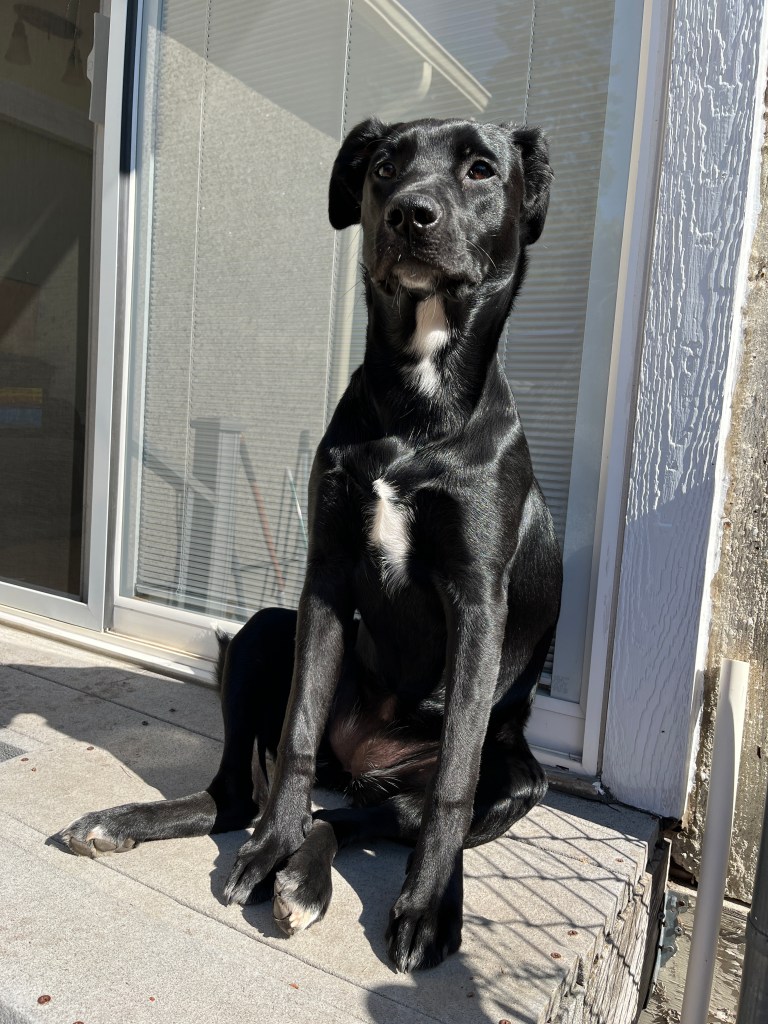
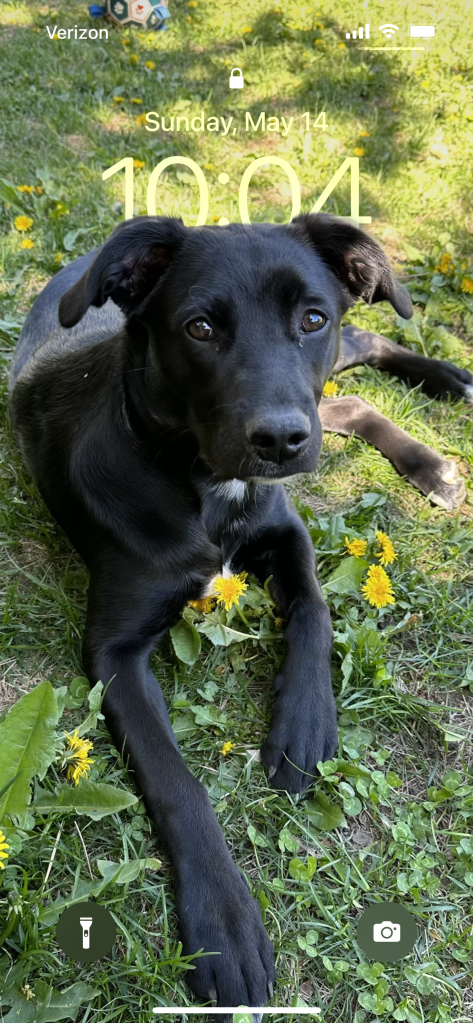
Have a photo of Lu, the sweetest puppy, who is also a menace like Dennis.
“Seems like there should be hot dogs for being this cute, yes?”
We started puppy kindergarten, part 2, yesterday… it was a trip.
Lucy was so excited to be back amongst her best friends in the whole world, Michelle and Allie (the trainers), and she wanted so badly to meet the other dogs (one of which looks like a little bit smaller version of Lu!).
It’s not great to have a dog that’s so excited she can’t focus, but 1) she’s 6 months old, so she’s still very much a puppy, and 2) given that she was found, abandoned, in a laundry basket, our earlier concern was that she would grow up to be afraid of/reactive to everything. Thankfully, that’s not the case.
She still has no recall, loves to counter surf, steals the TV remote (and shoes, and things off of tables and desks) — everything is a game to her. And she’s overwhelmed with excitement when meeting new people and dogs. We definitely have a ways to go before she’s ready for primetime.
But, even in her excited state, she can sit, lay down, sit pretty, twirl, and boop (touch her nose to our hand in exchange for a treat). She thinks that training is a very fun thing to do, and we’re working on the first part of place (having her go to designated spot and sit — we’ve been working with a low agility platform, and the goal is to be able to get her on the scale at the vet’s office, among other things).
There are a couple of things I’m glad I learned during the pandemic, back when everything was closed because we couldn’t breathe on each other.
One of them is how to make coffee that I like to drink.
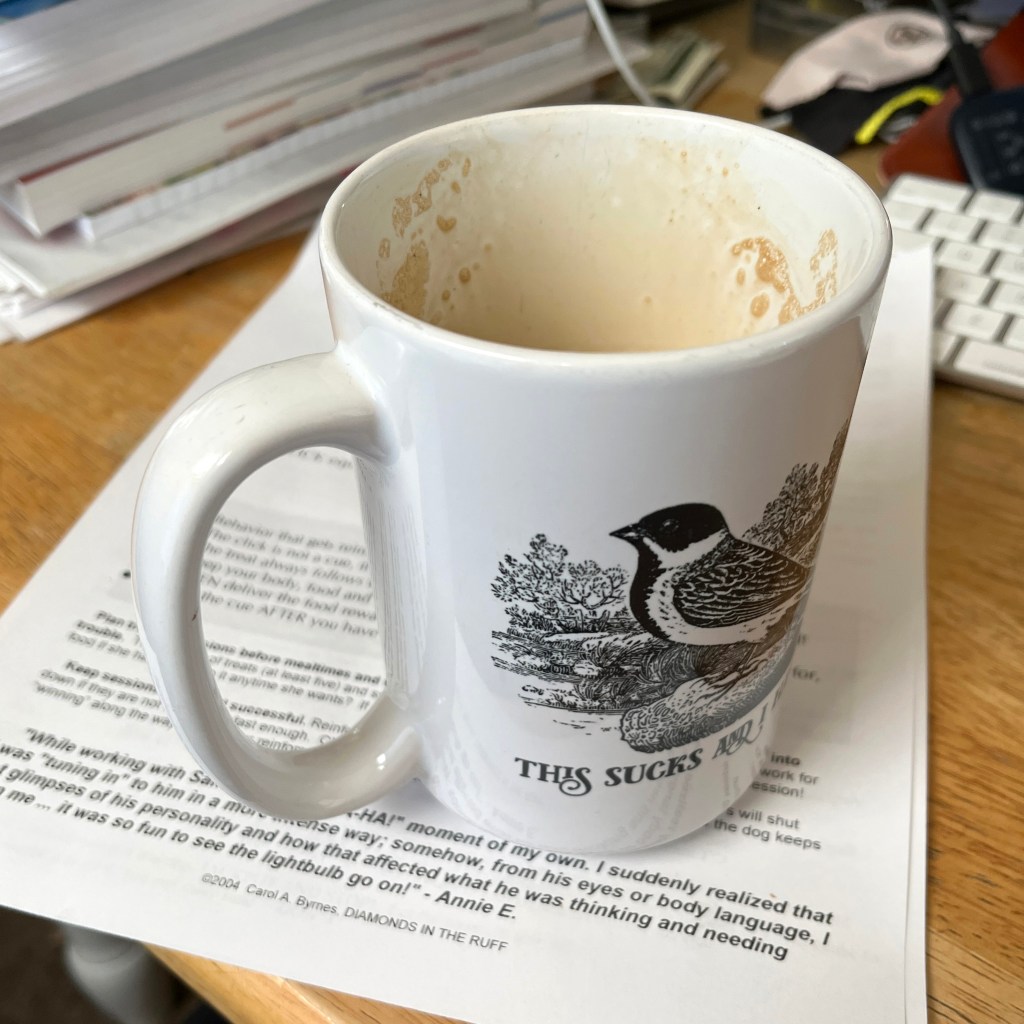
Mocha/latte in the commemorative pandemic mug (“This sucks and I hate it,” by Effin’ Birds.) Lu starts puppy kindergarten, part 2, today, and the document under the mug is for that.
Here’s how I do it: Moka pot coffee (High Drive roast, from Indaba Coffee, here in Spokane), with soy milk (agitated in a Bodum milk frother), and about 2tsp of chocolate syrup (Hershey dark chocolate syrup, to add a subtle chocolate flavor and cut the bitterness of the coffee with a little bit of sweet).
The coffee continues to be the highlight of every week. But this week was memorable for a couple of reasons:
I got my first black fly (Buffalo Gnat) bite of the season… on my face. (OK, that’s not a highlight, but it was significant.) Black flies inject you with a numbing agent and then saw a small, impressively round, hole in your skin. The wound bleeds, and then swells up like a mosquito bite and remains itchy for several days. Usually they get you on the hairline… this one is just to the front of my ear. I was bitten on Monday afternoon, and on Saturday morning, it’s still itchy and a little bit swollen. I’m pretty sensitive to bug bites anyway, but I hate black flies… at least their season is short. (Treatment: hydrocortisone cream and antihistamines (Allegra or Zyrtec — we probably shouldn’t use Benadryl anymore).)
I finished my first semester of graduate school. For our final project, my group had to rethink and redesign the navigation structure of a website, and we finished it on Thursday. I suggested the OLC’s district site, because it doesn’t (at present) adequately represent what the OLC does, how, or for whom.
(For what it’s worth, school districts generally don’t do a lot of great web development; funding is inadequate, and school employees don’t have time to maintain a complex site, because they’re, you know, teaching kids. It’s unfortunate, because there are significant information needs for students, parents, and the community, that are just not being met. And yes, I know, not all school districts.)
We got to do a card sort with the OLC staff, which was amazing. Card sorting is a really great way to get a glimpse into other people’s ideas about how the world should be organized. There are apps and orgs that allow you to do them online. We used index cards, which for a group hybrid sort, is an easy, tactile experience (nice after the teachers had worked with kindergarteners all day).
Since I’m the one who suggested it (and the OLC is where I live), I got to do some of the heavier lifting with the foundational pieces. I’m lucky the group had a tech person who could read my early drafts. It was a gift to have someone who could check to make sure she could visualize what I was describing. And then to be able to hand it off to writers and editors who could take our observations and ideas (~ 12 pages, at that point, with some photos and sitemaps) and create a cohesive report about the project. (It was quite a bit of work for 10 points.)
[5/14/23: We got full credit! Yay, us!}
I’m (still) not a huge fan of group work, but not for the reasons you might think. I enjoy collaborating with people, one-on-one or in small groups — different perspectives often makes for stronger work. And I was lucky to have landed in the group I was in; everyone was interesting and insightful, hugely talented, and wanted to be involved and get things done in a timely manner. That said, we all have lives outside of school that need to be attended to, and matching schedules and availability for project work turned out to be a bigger challenge than doing the actual work of the project. That’s a little too “real world” for work that has hard deadlines and offers no compensation.
I spent yesterday morning decompressing with a tropical smoothie. (Shakes and smoothies are like donuts to me. I really enjoy them… about twice a year. Anything more ends up being… too much.)
And now it’s on to the next semester. This summer I will be coding… a lot. I’m taking SJSU’s MLIS foundation front-end coding class, and working my way through a front-end coding certificate through the University of Washington.
(And hopefully, continuing to work with the Outdoor Learning Center on building out their district website.)
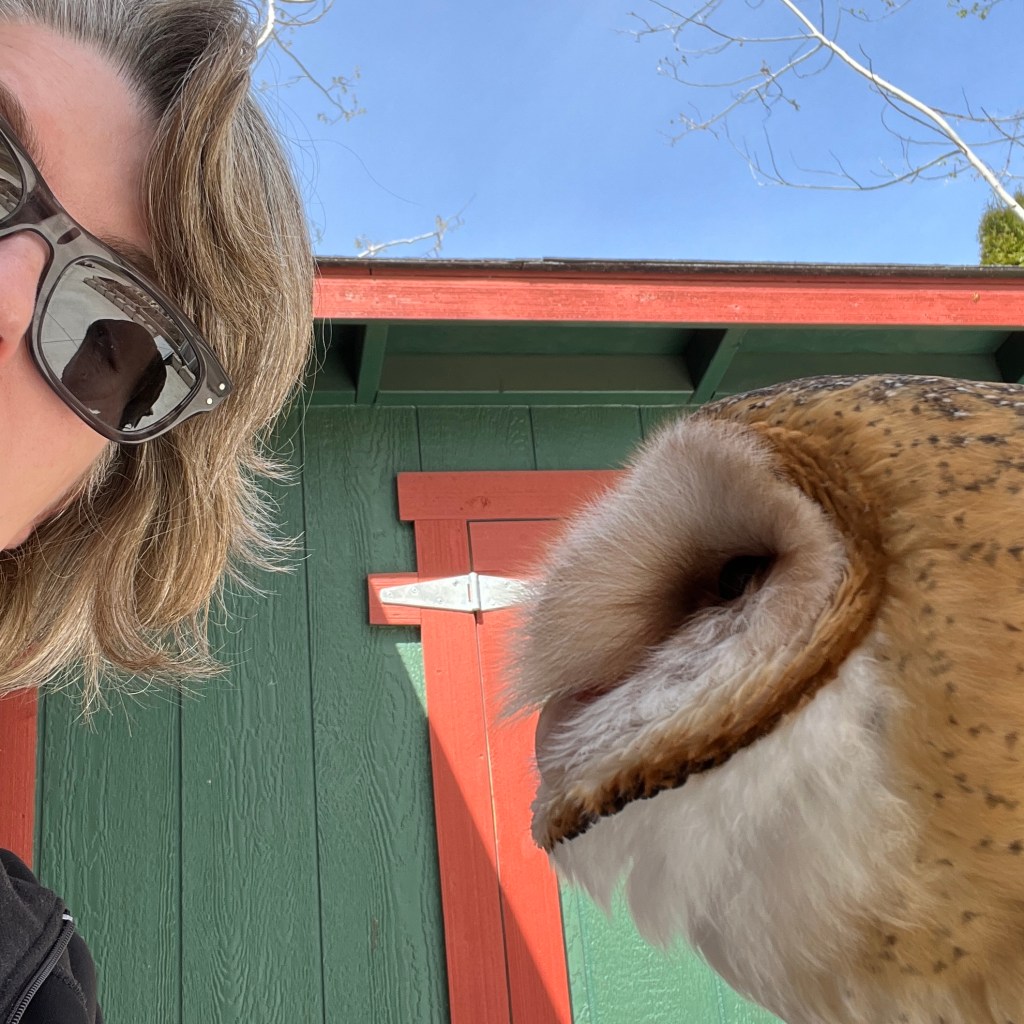
At the OLC with Ruby (the Barn Owl) last month, while the district guys were replacing the windows in the sanctuary. She spent most of the day in her crate, where it was dark and quiet, but we got to hang out in the shade for a little while in the afternoon.



 Carmen Yount