Not a magic than can be controlled or manipulated, or one that demands slavish devotion or servitude.
But I believe that there is mystery in the world. There’s a lot that is incomprehensible, and while I’m not saying that I think we shouldn’t try to understand it, I think it’s okay to appreciate that it’s a mystery right now, without feeling like you need to assign a logical explanation to it.
Sometimes we can experience magic that is explainable: baking, for example, or airplanes, or bumblebees, or studying something so hard you can’t see straight, giving up in frustration and then going to sleep, and then waking up to discover that you do understand. I mean… wow. Knowing why some things happen doesn’t take away from their magic — it is possible to be in awe of things you can explain or understand.
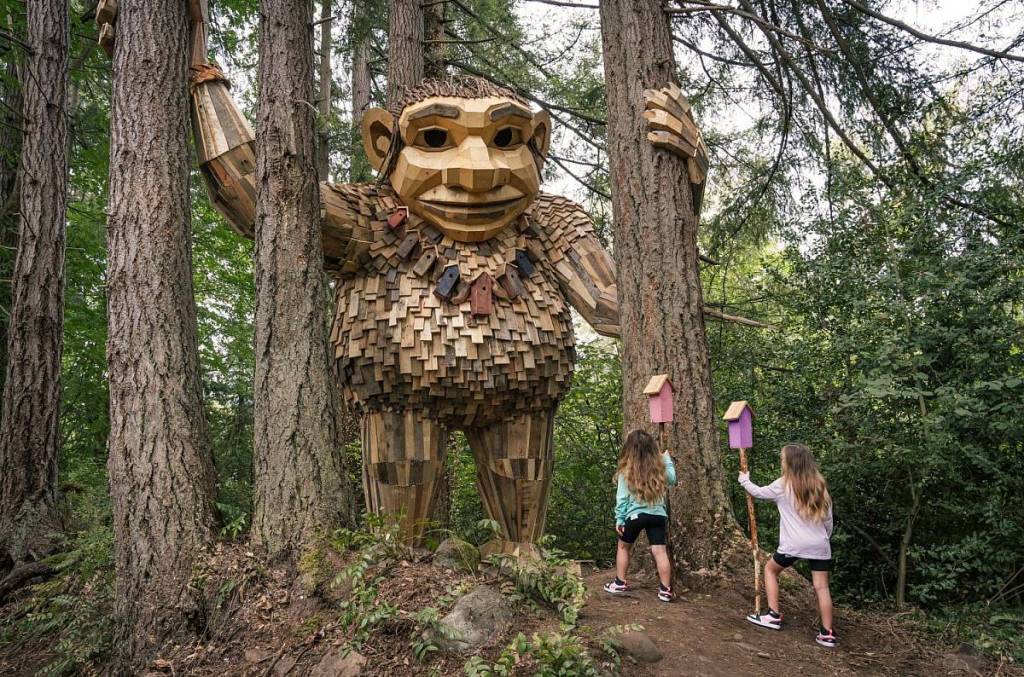
Artist Thomas Dambo creates giant trolls from reclaimed materials and places them in whimsical settings. This photo is of Jakob Two Trees, in Issaquah, WA. Jakob is real in some profound ways, and I suspect I would weep in his presence while I admire the work it took to create him. At the very least I would want to sit at the base of one of his trees and rest for a while. I think there’s some pretty potent magic there.
Part of what made last year so difficult was that it was necessary to keep a very tight focus, even when life circumstances were really distracting (and infuriating, and sad, and chaotic). I did it, but I’m not better for it. I haven’t discovered inner strength, or the power of discipline; I am burned out.
In search of a little bit of magic, I participated in a new-to-me ritual: Rauhnächte (here’s a lovely explanation of it from Anja Poehlmann). I wrote 13 intentions (not resolutions) on slips of paper, and then every day for 12 days — starting at the solstice — I burned one of the slips of paper (outside, in a container that isn’t flammable). The idea, apparently, is that by writing your intentions and then burning them, you internalize them and then release most of them. By keeping one, you’re able to direct your attention and effort toward it.
I’ve seen a couple of different explanations for the timing of this ritual: solstice to Jan. 2 (which I did), or the span from Christmas to Epiphany (Dec. 25 – Jan. 6). I didn’t follow all of the “rules.” I did not burn every one of them after sunset (some days because I was busy or forgot, and sometimes because there was weather I didn’t want to be outside in). And as I was writing the intentions, I chose the final intention to keep, because it is deeply personal and important, and I want to focus primarily on that one.
Maybe these deviations invalidated the exercise, maybe they didn’t — it wouldn’t really matter to me if they did. My goal was to acknowledge that magic is there, and in a very small way, align myself with it.
In 2025, I completed almost half a little more than a third of the units of my graduate degree. I have one calendar year left, with one class in the spring, one in the summer (ugh), and my ePortfolio in the fall. When all is said and done, this will have been a four-year endeavor. (This is a terminal professional degree — 43 units instead of 29-32 — that is designed for working adults, so we have seven years to complete it.) This year I did some instructional design and data visualization, studied copyright law and cultural competence, and did a refresher HTML/CSS course and an introductory PHP and Javascript course. The content of my schoolwork was fascinating (a lot of reading, writing, and coding). I learned a lot, and got a glimpse of how much I still don’t know. I met a lot of interesting classmates. And I performed well (gold star for me).
Both of my in-laws had significant medical challenges this year, starting in May and running through December, when my father-in-law died from complications from lung cancer. My mother-in-law’s situation is ongoing and will hopefully resolve — positively — soon… knock wood. We do not live close to either of my in-laws, so in addition to all of the other accompanying issues, my husband travelled a lot in 2025. As challenging as my year has been, multiply it by infinity and you *might* approach the level of challenge my fabulous-and-talented husband faced in 2025.
My contribution to all of this: I kept the household running (taxes and bills paid, animals fed and cared for, laundry done, minor repairs managed). Of course, it was not the only thing, not the main thing, and not the most important thing. Butit was a thing.
The upshot: 2025 was a lot. Much of it was unavoidable, but there were some painful realizations that I need to do a better job at managing the things I can control. My limitations, in terms of attention span, time management, and real life, are becoming more apparent the older I get; my willingness to ignore them is increasingly problematic. 0/10, do not recommend.
Sure, many things did get done, like school, keeping the house going, and volunteering ~180 hours at the OLC. In the plus column, I added another walk with Lu every day (we do two now, and she gets an after-dinner perambulation with fabulous-and-talented husband), which is good for both of us.
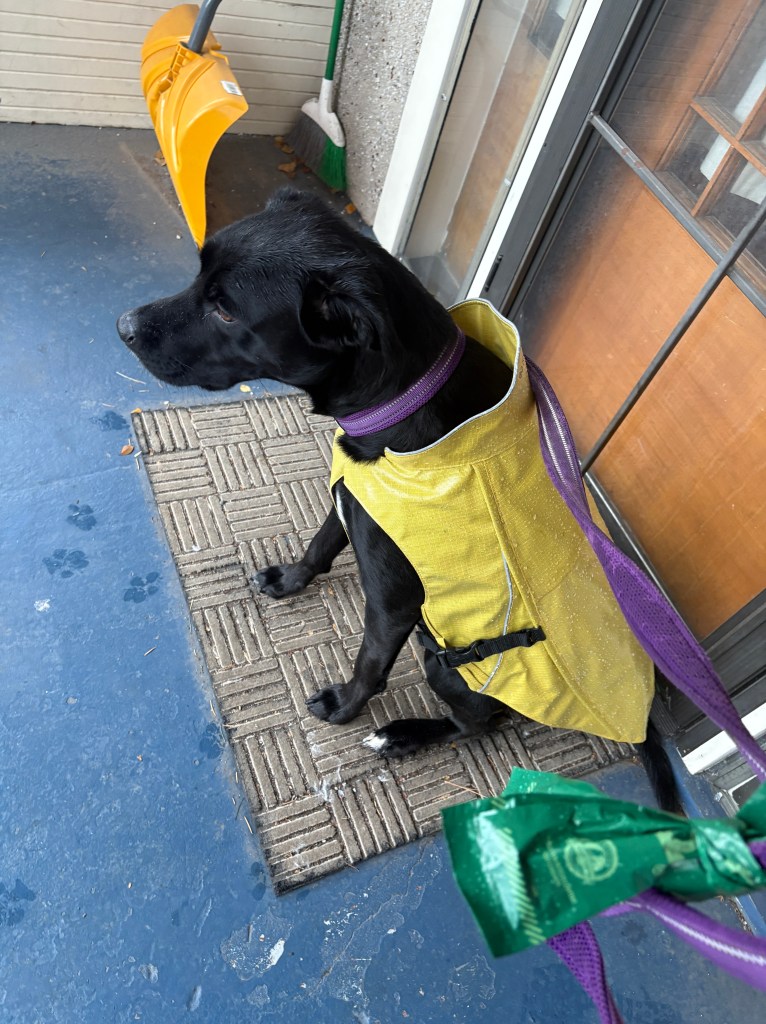
No, she does not like the raincoat, but she likes to walk (and it does help keep her body dry).
While I got a lot done, many things fell by the wayside: nature journaling, writing, my social life, cooking/baking, any kind of future career planning. These things are important, even if they (rightly) aren’t top priorities. I could say something about the difference between unscheduled time and availability, but the truth is that this year it would not have mattered; I didn’t have as much unscheduled time (that was my choice), and much of the rest of my time was used to attend to other pressing matters (that were out of my control).
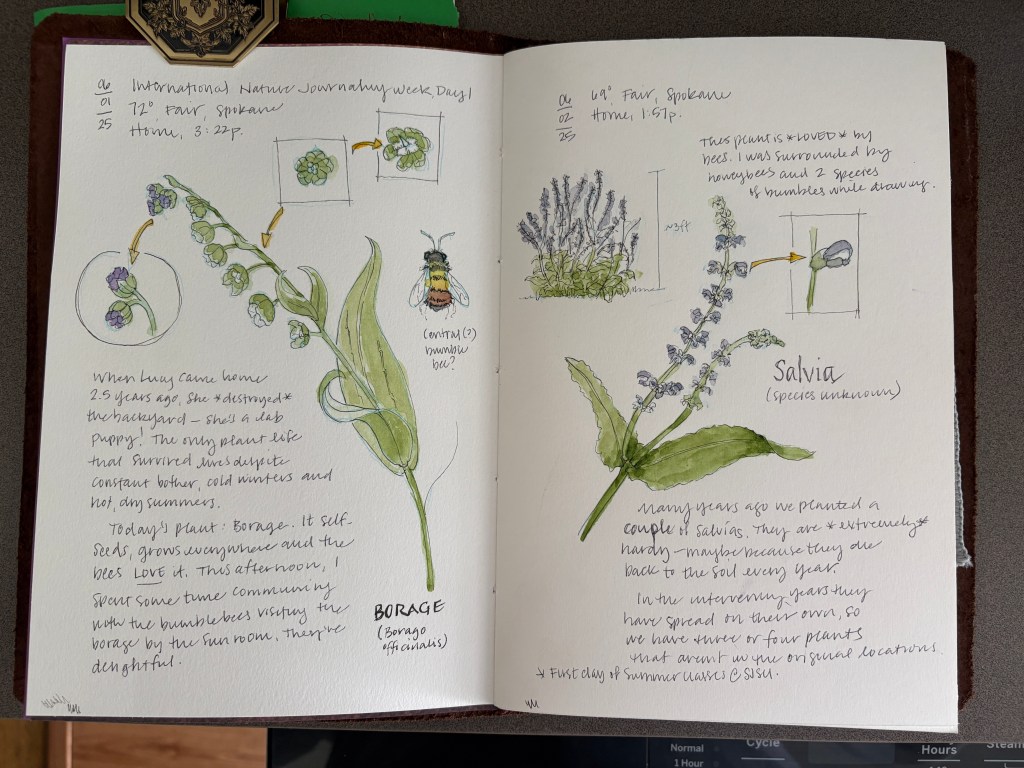
I only did a little bit of nature journaling this year. In the spring the bumblebees visit to forage native wildflowers, so I spent a couple of days sitting on a stool with the bumbles (and a mason bee!). Great times.
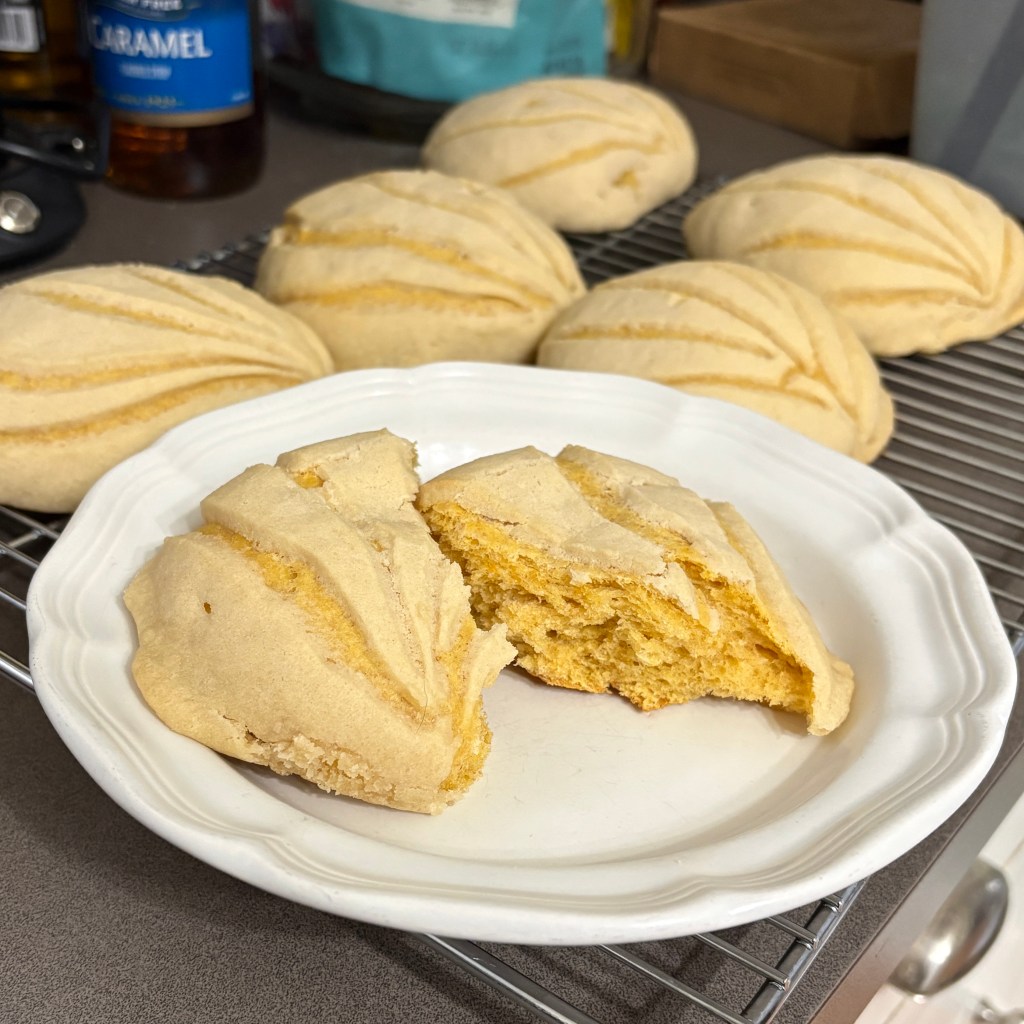
I made some conchas for Christmas, from a recipe by Dora Ramirez. The recipe I followed is from her cookbook, Comida Casera (highly recommend). (She published a similar one on her website: https://dorastable.com/vegan-concha-recipe/). These were delicious and fun to make; they use cooked sweet potato to replace egg in the enriched dough. 10/10, will make again.
2025 was challenging in some unpleasant ways, which makes the bar for improvement in 2026 pretty low. Backing off of my school schedule will hopefully help a little bit. And the missing things I can easily identify point to things I can hopefully find time to add more of… knock wood.
July 4th ended up being a very busy day. I had an early volunteer shift that had morphed into doing animal care for the whole place (instead of just the birds) — for me that adds more than an hour to my shift (I’m not terribly efficient with the other animals because I don’t work with them all that often). I had to finish a school assignment that — technically — was not due until today, but I’ve had a bunch of other, unrelated stuff on my plate and just didn’t have time to mess around with it. I have a standing date on Fridays to talk to my mom, and we had a lovely conversation.
And then Lu and I got to spend some time in the evening with friends. It was a comfortable day outside (thankfully), so getting her in the car and spending time in their backyard was lovely. This is her after spending a few hours playing with her special friends Jennifer and Kevin (special friends because she loves them unequivocally, and loves to play with them — she’s more wary around new-to-her people and men):
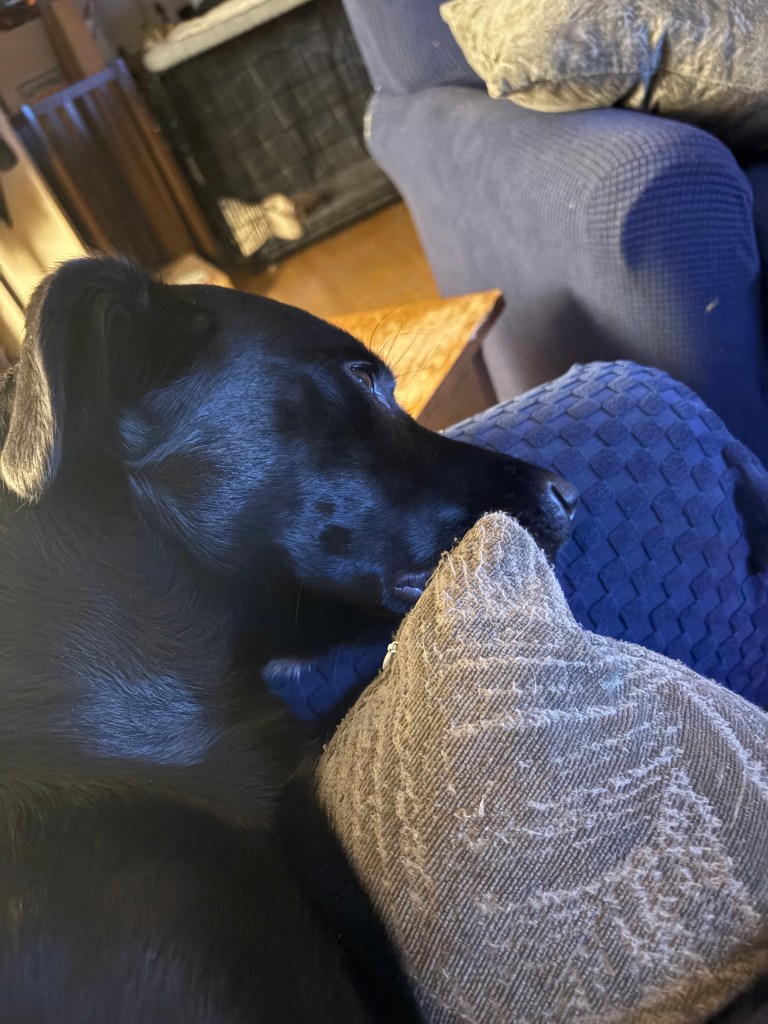
Lu needed a nap, but she wasn’t *sure* she needed a nap.
We got home kind of early to make sure we were tucked in before the fireworks got going. We’re lucky that (so far, knock wood) Lu hasn’t shown any reaction to boom booms, other than to make a note and go back to sleep, but I wanted to make sure that she was at home and could spend time in her crate if something had changed between last year and this year… thankfully, her experience of the fourth this year was similar to her first two years, in that she could not have cared less about what was going on outside. (I’m not sure how we have lucked out on this front, but I’m grateful we have… at least so far.)
Lu’s special friend Kevin is great on the grill, and I got sent home with a care package that included some bell pepper slices and grilled corn on the cob. Last night for dinner, I “repurposed” both and made a coconut curry with tofu and vegetables, which I topped with chili oil.
YUM.
It. Was. DELICIOUS. And there are leftovers!
The world feels heavy right now; it was a nice reprieve from (waves arms) everything to spend some quality time in community with friends. The leftovers were a nice (and tasty) reminder of our time together.
A couple of nights ago, there was a mid-air collision between a military helicopter and a commercial flight on approach to Reagan National Airport. Sixty-seven people were killed, including the crew of the helicopter, and the crew and passengers on the jet.
Although we saw what happened, we will have to rely on the skill and experience of air crash investigators to sort it out. [In the meantime, apparently the FAA has restricted the helicopter route along the Potomac to police and medical helicopters.]
In my personal search for helpful information, my husband alerted me to this video, made by a former F-15 pilot. In my limited experience with pilots, this is how the really good ones talk about flying — as analytical, careful practitioners. This creator has a YouTube channel, and is at https://pilotdebrief.com/. (One of my first questions was about why TCAS didn’t seem to be in play in the jet, and he answered that question — because of the low altitude of both aircraft.)
I’m sure there are many other smart, experienced people, with relevant experience as pilots or controllers, who can help us make sense of the publicly available information we have so far. I watched another video where the creator (a pilot) talks about the tower and ground response being quick and professional, and another where the creator broke down (in more technical terms) the routes each aircraft were taking and the challenges presented by busy airspace in nighttime, urban, conditions. Although “visual separation” is a recurring theme in these videos, one of the most important features of them is that each of the creators says that they are working with publicly available data, and that there’s still a lot that we don’t know…
… which is an excellent reminder that air crashes tend to be complex, often cascading, events. A lot of the time, they can’t be explained easily, and sometimes, investigations raise more questions.
The NTSB investigated the air accident that killed my dad, many years ago. The report was comprehensive, and fair, and included not just information about the weather (nighttime, poor visibility due to fog, near-freezing conditions), and the equipment involved (which I can’t remember off the top of my head), but information about the pilot’s (my dad’s) qualifications, his decision making on the ground before the flight, and in the air. They also sought information about the conditions and operation of the airfield, and the quality of information from the tower just before the crash. In their final report, the NTSB pointed out decisions that probably should have been made differently (including by my dad), but stopped short of assigning blame for the accident. (This may be wrong, but I get the sense that they avoid assigning blame when they can, particularly if no one is behaving recklessly, or purposely acting against their training.)
Of course, in my dad’s accident, the investigator knew what had happened immediately (the pilot was dead, the plane was destroyed, the tower was damaged), but they took the time to examine multiple factors that may have contributed to the accident, to get a better sense of how it happened, why it happened, and how to prevent it from happening again. None of it could bring my dad back (closure is not a word I would reach for, here). There have been other small-craft air accidents in similar situations with similar outcomes, because when weather issues, human perception issues, and navigation issues converge, bad things can happen. But I hope that, with more information and understanding, these kinds of accidents are rarer than they might have been otherwise.
Point is, I think the NTSB does excellent, important, work. I expect they will do the same here. The rest of us should avoid coming to conclusions based on easy explanations and/or speculation, and let the NTSB and the FAA investigate the accident without pressure or interference.
But it’s also important to understand that even if the NTSB’s report is helpful, and this kind of accident never happens again, there is no making sense of this event for the families of those killed in it; it is a terrible tragedy.
–*–*–
Confession: I’m a fan of the TV show Air Disasters (Smithsonian Channel, and now Paramount+), not because of the flashy recreations, but because they highlight the work of air crash investigators (often the NTSB, but they have featured agencies from around the world). The work these folks do is creative, evidence-based, interesting, and important, and has improved safety for both aviators and passengers.
If you’re expected to be one of the smarter people in the room, I understand that it’s tempting to wade in to a topic you know nothing about and make stuff up, to sound smart.
Bit of unsolicited advice: don’t do that. Particularly if you don’t know what you don’t know. Fudging around the edges? Still not great, but if you really don’t know what you’re talking about, best to avoid the practice altogether.
On Friday, President Trump visited California to meet with leaders about the recent fires. During a press conference, he said this:
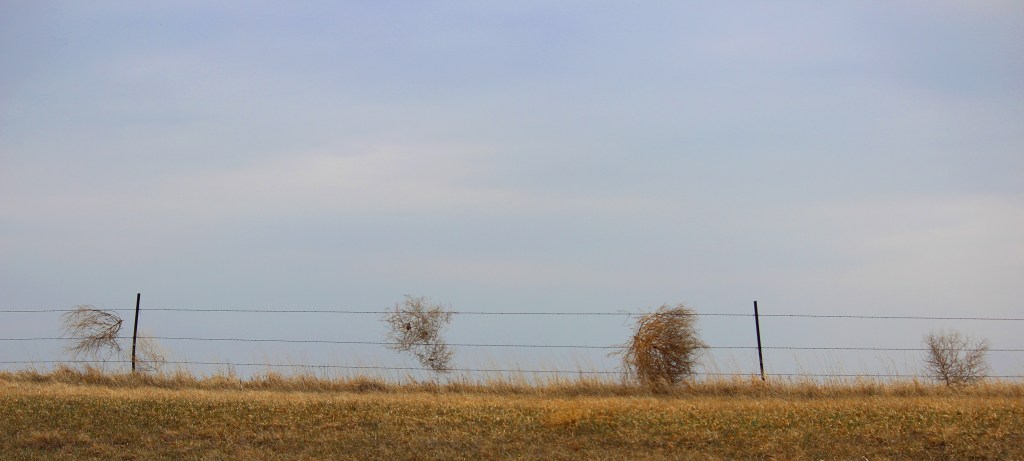
“We shouldn’t be in a position where you have tumbleweed that’s dry as a bone. Even tumbleweed can be nice and green and rich and it’s not gonna burn. You don’t even have to remove it. It’s not gonna burn. But it’s just dry. So I hope you can all get together and say I’m so happy with the water that’s gonna be flowing down.”
Here’s one reason the President’s statement is problematic: with *my meager credentials* (they are neither comprehensive, nor sterling), I can say — with some confidence — that there is no contextwhere that statement is correct.
I have no special knowledge about tumbleweeds. I’m actually allergic to them, which seems kind of weird, but whatever. In Spring 2020, I took a community-college-level botany class, because I think plants are pretty amazing and it seemed like a good opportunity to learn some new stuff (good class, highly recommend). Because of where I live (Eastern Washington), and other interests (I’m a master naturalist), I have a passing interest in (but not a lot of knowledge about) fire ecology.
At least one species of tumbleweed commonly found in the West is invasive: Russian Thistle (Salsola tragus). This plant is an annual. And yes, it is green for part of its life cycle, but it’s the early part, when the landscape still has access to some water ( –> lower fire risk). Near the end of its life cycle, as its above-ground structure starts to senesce (begins the process of dying), it dries out and breaks off at its stem. And then, like the name says, it tumbles. The agitation helps to disperse its seeds. The plant evolved to work this way.
By the time this structure breaks off as a tumbleweed, it’s combustible. I think everyone agrees that in fire conditions, a rolling mass of dried out plant plant matter is bad. But the solution here is not to water the tumbleweeds. Setting aside the botany, the economics of that strategy don’t check out; even if you could locate every stand of tumbleweeds in California, it would be a tremendous waste of water that could be used for agriculture (or, you know, whatever). It would be great to figure out how to mitigate (or eradicate) invasive weeds in the West (LA County is working on this!) — our native landscapes would likely be healthier (less competition for resources from invasive species)… and maybe even a bit more fire-resistant.
To take this a bit further, even if there were no tumbleweeds, at least some of our ecosystems rely on periodic fire to maintain growth and foster regeneration. When I mention fire here, I’m not referring to the conflagrations we’ve seen in recent years. Those are a combination of factors, including climate change, decades of fire suppression, and human activities. (Good, recent article about this at the United Nations Office for Disaster Risk Reduction (UNDRR) website, PreventionWeb.)
Fire is a complex challenge in North America, with no one-size-fits-all solutions. But there are experts who know a lot about this very complex issue, because they study it, have experience with it, work with others on it, and think about it… a lot. Some of these experts include, but are not limited to: local indigenous land managers, local ecologists and fire ecologists, emergency managers, and with their first-hand experience, wildland firefighters (who do incredible work, under very trying circumstances, every year). I’m spitballing here, but it’s probably a good idea to defer to these folks when trying to suss out solutions for this, particular, very complex challenge.
The broader point is this, and we should all take a note: none of us has to be the smartest person in the room. If you run into a topic you don’t know anything about, it’s a really good idea to stop talking (or better, start asking questions!). Bullshitting can create misinformation, and it undermines your credibility, particularly if you’re screwing up on the lowest of low-hanging fruit by workshopping a poorly-reasoned organismal solution to a community problem.
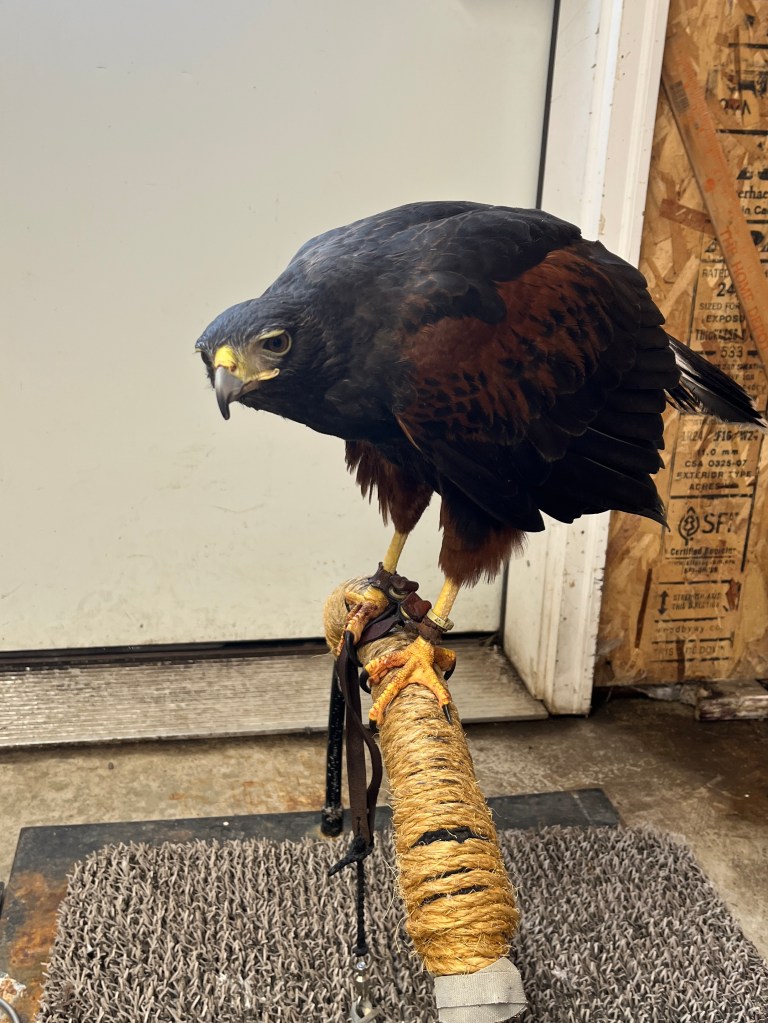
From Stan, the I’m-so-horny-I-need-to-land-on-your-head Harris’s hawk. I love you buddy, but no. Have some perching time in the warm room.
Do I have resolutions? No, no I do not.
Do I have things I want to accomplish this year?
Yes, yes I do.
More of this:
More intentional yoga. This is an extension of last year, which has gone pretty well; I do 25-30 minutes of yoga, 5 days a week. This year I would like to continue with that, but create a practice more focused on strength and flexibility.
Walking. I walk 1.5 – 2 miles a day, four or five days a week. I’d like to continue that, maybe commit to five days a week.
Reading. I’m using the library (both for books and Libby) more now, which I’d like to continue, because… the library!
Journaling and illustration. Another one of those things that I already do — but on a way-to-limited basis — I’d like to introduce more intentionality, and more sharing. I want to upgrade my rendering skills, and engage with more storytelling. Also, nature journaling.
Work with birds. I’m in a weird situation with my volunteer gig right now, where I really only have one volunteer shift every other week. It involves feeding and watering all of the OLC’s animals (reptiles, mammals, insects, fish, amphibians, and raptors), so there’s no dedicated time to work with the birds (unless I turn it into a 4-5 hour shift). But, I would like to do more training with some of the birds (looking at Stan the Harris’s hawk, Arden the red-tail, and Basalt the saw-whet owl), so I’ll have to make time to pop in once a week. I have a membership to Avian Behavior International’s online programs, so that’s going to be my classroom.
News from media not owned by billionaires. Right now I subscribe to The Guardian, The Philadelphia Inquirer, and a couple of newsletters. The Atlantic is my last wealth-owned holdout, and frankly, it’s on the bubble. I may resubscribe to my local newspaper, or a local independent media outlet, for news about my congressman.
School. I want to do 12 units this year, and no summer classes.
Less of this:
Cooking. Hear me out. I have been making full-onevening meals, 5 nights a week. It’s time-consuming to plan, shop for, and cook that much, that often. I’m not going to stop making food at home, or make food at home less often, but I’d like to create a rotation of about, say 10 dinners, that are simple and quick to make, and save more composed meals for special occasions, or for times when I’m itching to try something new.
Social media. Egads. I post very little, but I spend too much time doomscrolling, and it’s not a healthy situation for me. Frankly, I’m not sure that most of us need to be that dialed in.
Perfectionism. Do not let the perfect be the enemy of the good, and all that.
I’ve been thinking quite a bit recently about values, particularly since the U.S. election. I worked in media for more than a decade, and in that role, I was not allowed to become involved in partisan politics. It actually suited me just fine — I’m objectively bad at all kinds of politics (organizational, legislative, election, etc.), and I straight up do not enjoy participating in that discourse.
But I have values and opinions, and particularly right now, I think it’s important to be clear about them, so that everyone can make their own decisions. Some of them include, in no particular order:
Body autonomy. Even in situations where I would make a different decision, or I do not understand or agree with the decision being made… especially if that’s the case. I do not have to understand you (or agree with you) to believe that you have a right to thrive as yourself. Reproductive issues? Assisted suicide? Gender-affirming care? If it involves your body, it’s not appropriate for me to insert myself into the decisions you’re making.
Hold up a second, because there’s a caveat here: if you choose not to vaccinate yourself or your kids against the advice of your doctor, you’re creating the potential to harm others.
If you are a person who thinks it’s okay to hurt puppies, you are not welcome here.
Equity. Our society would be better served if, as a matter of policy, everyone had access to education and services, even if creating that level of access requires different funding, or additional work, from the rest of us. I want to live in a society that values and honors Black/Asian/Indigenous/Latino(a), disabled, LGBTQ+, Jewish/Muslim/Buddhist, and female perspectives, as much as White, male, cis-het, Christian perspectives.
I cannot help but suspect that humanity would be much further along if we didn’t spend so much time and energy othering people… like, maybe we would have already found cures for a bunch of cancers, and at least some degenerative diseases. Maybe we could have mitigated some of the more awful impacts of climate change. Heck, for those into the idea of going to Mars, we might have been able to get there — and back.
Caring for others. As a policy discussion, this is closely related to the idea of equity. For example, there’s talk of eliminating the VA, which should be a nonstarter. I’m not saying the VA couldn’t be improved; in my region, the fact that so many veterans have had to rely on help from our congressperson to make things happen is not good. But if you eliminate the VA, what is the alternative, and how long is it going to take to implement it? How many veterans will experience additional suffering in the interim? What is the goal of “efficiency” in this context — because it looks like a plan to cause harm to people who need/have earned/deserve help.
Also, children, need to have reliable access to food and to health care, and if the only place they can get it is when they’re at school, then that’s where they should have access to food and to health care. (And so we’re absolutely clear: there’s no such thing as gender reassignment surgery in schools. Just stop it.)
Preserving — and creating — access to information. Even if it’s information I don’t like or vehemently disagree with. And yes, I’m uncomfortable with that point of view sometimes; I occasionally run across book displays that I wouldn’t mind throwing paint on. But here’s the thing: I don’t have to consume information I’m not interested in, or don’t want. Neither do you. If you’re a parent, you’re entitled to make decisions for your family… but you should not be making those decisions for other families. You have a right to hold your beliefs/values/morals; it’s true that I should not be able to prescribe morality to you… but that goes both ways.
Going outside. Walking, hiking, skiing, kayaking… taking a few minutes to sit under a tree while you get the lay of the land. Watching birds and other wildlife, and learning who lives with us. Protecting public lands. Building out both our public and private outdoor spaces to accommodate both beauty and utility. Addressing climate change in ways that mitigate harm and find new ways forward. Helping people establish relationships with the “outside” they have access to is one of my greatest interests.
Not arguing with strangers on the internet. Social media is great for a lot of things; I follow artists, writers, registered dietitians, religious leaders and scholars, politicians, activists, and scientists, and I have learned a lot from them. But some conversations require nuance that’s difficult to convey in short form interactions between people who don’t know each other very well. Bad faith actors seem drawn to the format, and so does the “I’m just asking questions”/”do your own research” crowd. Frankly, there’s a lot of work to do out here, and nobody’s got time for that.
TL;DR: Pluralism, good. Taking care of each other, and the world, good. Working to level the playing field, good. Choosing not to engage with bad-faith actors, good. Doing my best to not be a dick, very good.
I hope I have been clear.
Postscript:
Looking for a smart person who is amazingly good at explaining where we are, and how we got here? (Dr.) Tressie McMillan Cottom, a sociologist and professor at UNC’s iSchool, is worth seeking out. (She’s also a columnist for The New York Times.) I see her on Instagram every now and again (username: tressiemcphd — not going to tag her because she doesn’t know me from a hole in the wall). She’s been on The Daily Show a number of times, and is an occasional guest on Trevor Noah’s podcast (which is also worth a listen).
This morning I read something that I found helpful, by Joan Westenberg: Rebel Optimism: How We Thrive in a Broken World. This part, in particular, perfectly described a mindset I’ve been trying (unsuccessfully) to formulate (and cultivate) for myself over the last few weeks:
“Lately, I’ve been digging deeper into the case for radical, stubborn, rebel optimism—a philosophy that doesn’t sugarcoat reality but stares straight into the void and says, “Not today, you fucker.” It’s not naive cheerleading; it’s weaponizing hope as a refusal to bow to the inertia of despair. The data backs it, history proves it, and action demands it.”
Fearless Girl is the energy I’m trying to cultivate right now:
Fearless Girl sculpture by Kristen Visbal. Photo by Volkan Furuncu/Anadalu Agency/Getty Images, featured in an article on TeenVogue.com: ‘Charging Bull’ Artist Calls for Removal of ‘Fearless Girl’ Statue. (Fearless Girl and its placement was part of a financial firm’s marketing strategy for International Women’s Day in 2017. Pretty good marketing, I think.)
Remember the chocolate muffins, the ones they were serving in the Olympic Village in last summer’s Paris Olympics and Paralympics, the ones the athletes were posting all over social media?
(Good luck looking for actual news stories about the popularity of the muffins; an internet search now just gets you a ton of recipe suggestions.)
We didn’t get to eat any of the cake at our wedding, so every year for our anniversary we find (or make) some kind of cake dessert. It’s a fun way to share our memories of a lovely day.
I had been wanting to try making the Olympic muffins (or, rather, a dupe), but 1) as it turns out, neither of us is a huge fan of sweets larger than, say, an Oreo, 2) one of us can’t do dairy without facing significant, unpleasant, consequences, and 3) frankly, our summer stayed hot for longer than usual and I haven’t wanted to spend a lot of time baking.
I made the muffins! (I used Genevieve Ko’s recipe from The New York Times.)
They were (are… we still have several of them) good. Texturally, they’re more like muffins than cupcakes. They’re very chocolate-y, and rich, so definitely dessert. (It’s unlikely you’ll need or want more than one at a time.) The recipe uses a lot of sugar, so I was surprised that they aren’t too sweet.
Non-dairy baking options have come a long way in the last few years, so I swapped the butter and heavy cream 1:1 for non-dairy options, and the recipe worked well (at least the chemistry worked as I expected it to — I can’t say whether there are significant flavor differences). I also used allergen-free chocolate chips, because you’d be surprised how many chocolate makers list milk as an ingredient.
Next time I make these, I’m going to make the filling before working on the muffins, so it has more time to cool. I followed the order of the recipe, and felt like the filling was still too warm to work with when it was time to fill the warm muffins.
One of the best sentences in American Democracy: Your ballot has been accepted.
In Washington State, we vote by mail. It’s great. 10/10, highly recommend.
Ballots are mailed to voters about 3 weeks before Election Day. Voters have the option to mail their ballots using USPS (Election Day — Nov. 5th this year — is the last day they can be postmarked), or by dropping them off (by Election Day) in ballot boxes (at public libraries and other strategic places around town), or the county elections office.
I’ve used all three methods successfully. This time around I went to the county elections office. It was a beautiful day, so I walked downtown to catch the bus to get home.
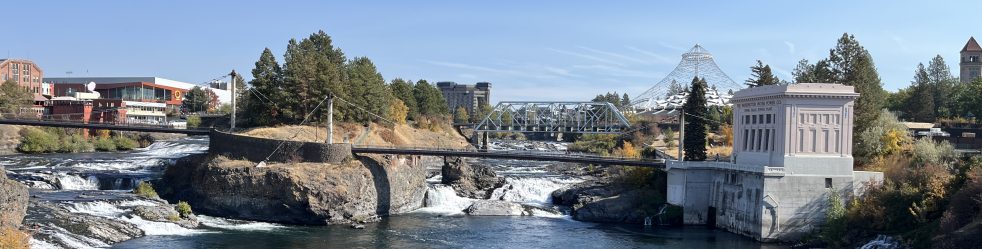
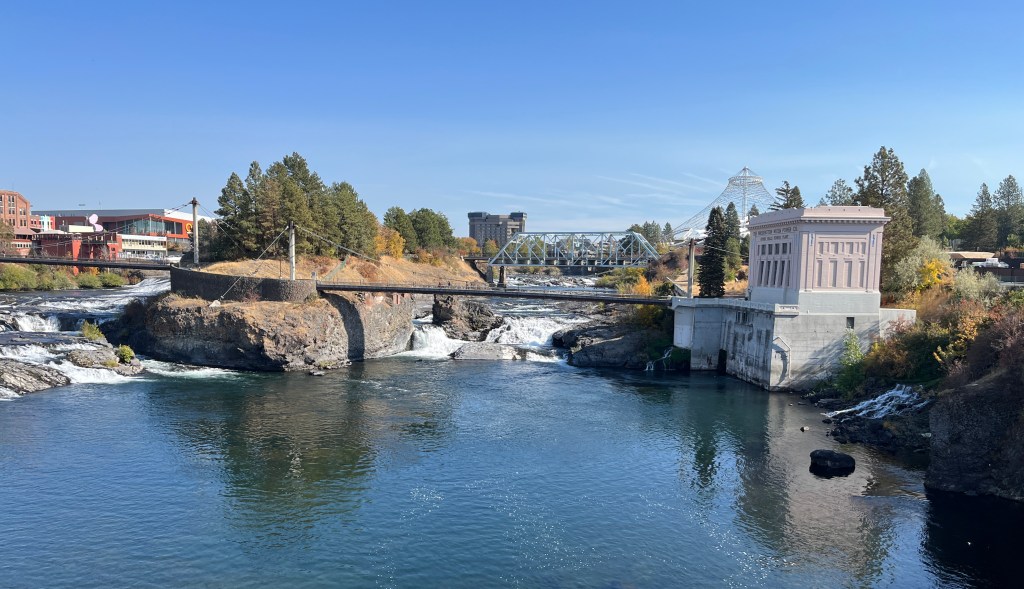
Spokane cleans up pretty well!
If you have the ability to vote, please do. And pay attention not just to federal and state races, but local races as well.
Lately, I have noticed that my writing does not read as smoothly as I would like, and since I don’t have regular access to an editor, it means I need more practice… and less social media (which has become my preferred time suck).
I prefer not to opine about the work of other people. Don’t get me wrong, there’s a lot going on, and opinions are things I have in seemingly unlimited supply. It goes back to being disappointed that most of the writing I did as an undergraduate was criticism. It’s a valuable skill, but it didn’t feel like I was making anything.
Also, I have no patience for the you’re-a-liar/debate-me/do-your-own-research crowd. I’m the first to admit that I make mistakes (often, sometimes big ones), and I try to be gracious about accepting both correction and criticism. But life is too complicated enough already, and too short, to respond to trolls.
So I guess I’ll stick more to slice-of-life, and pointing out the cool stuff I come across (because there’s plenty of that, too). And hoping that more noticing, and more writing about noticing, will bring with it some improvement.
And so we begin…
Warm food season is coming (for me, that’s the season when you can cook without feeling like you’re being cooked while you’re cooking), and I found a delightful recipe on Instagram — it’s easy, comes together fairly quickly, and uses mostly pantry ingredients (including beans, so it also has some fiber in it). We enjoyed it last night.
Pasta with a Chickpea Cream Sauce from IG: cocolarkincooks
1/2 onion, roughly chopped 2 cloves smashed garlic (I used 5, because garlic) small sprig of rosemary piece of arbol chili
15 oz can of chickpeas broth
vinegar or lemon juice parmesan
Heat some olive oil. Sauté onions, garlic, and rosemary, on medium/medium low heat, with a pinch of salt, for 15 minutes (until vegetables are very soft).
Add one can of drained and rinsed chickpeas to the pot. Add enough broth to cover. Let simmer for another 15 minutes.
Remove rosemary sprig. Add a few drops of vinegar or lemon juice, and some parmesan* (measure with your heart). Add chickpea mixture to a blender and blend until smooth. Pour sauce back into the pan.
Prepare some small pasta. (She used quadratti, but I had ditalini so that’s what I used.) Reserve about 1/2c of pasta water. Drain pasta and add it to sauce. Add pasta water as needed to loosen the sauce.
Serve with chopped chives or parsley, and a drizzle of olive oil. Add parmesan* to taste.
* We can’t do dairy in our household, so I used a handful of nutritional yeast in the blending step, and a very small amount of non-dairy parmesan at the end.



 Carmen Yount