Doing a couple of things this fall that I’m really looking forward to.
Thing 1:
Montana Master Naturalist program (online, via Zoom)
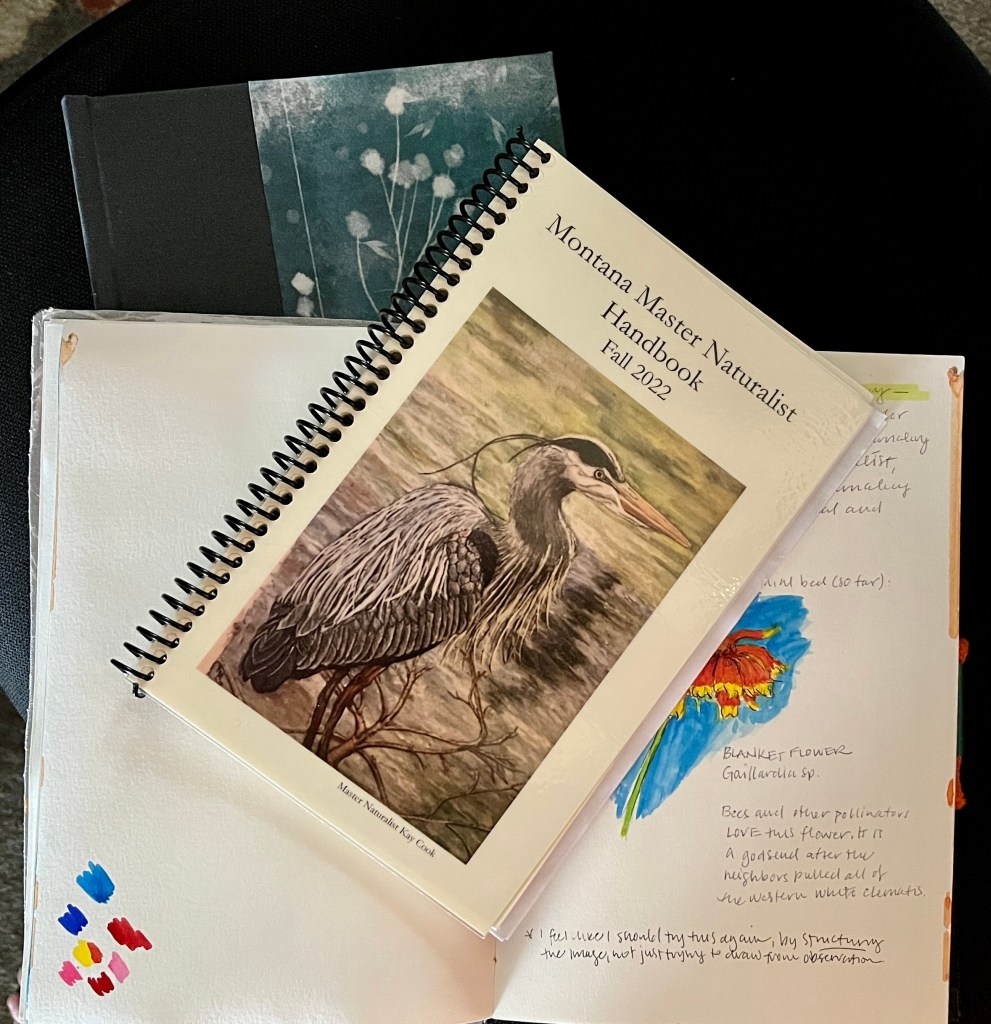
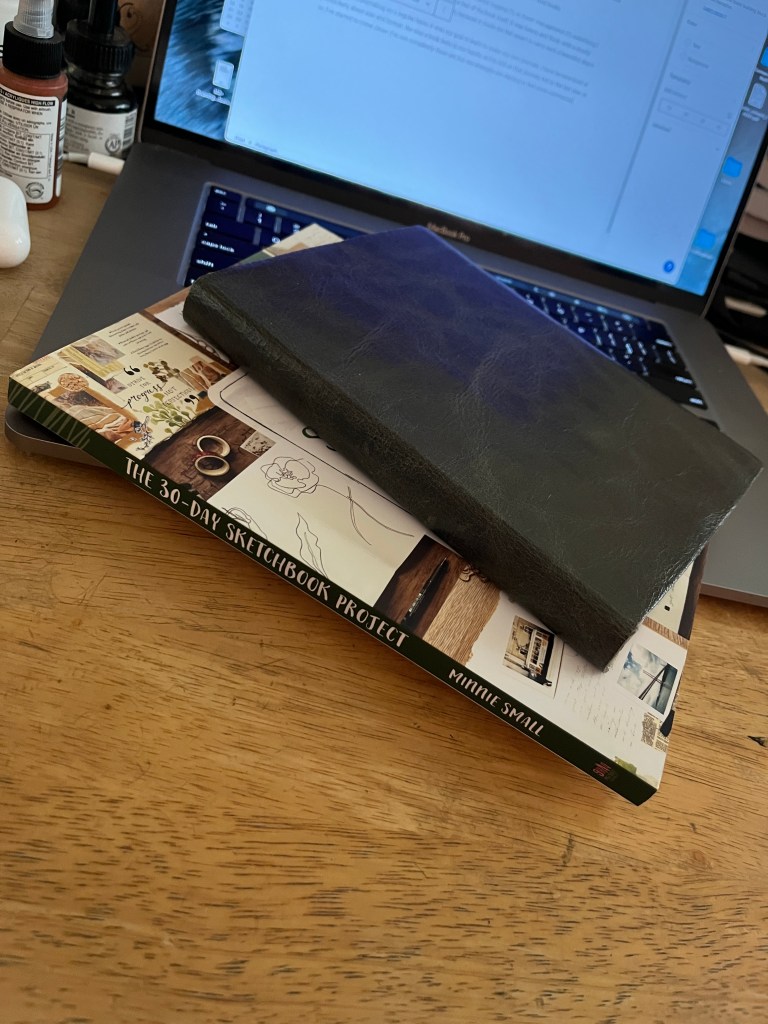
Montana Master Naturalist handbook, sitting on top of my nature journal, which is sitting on top of a handmade blank book for note taking.
I’ve been wanting to do a naturalist course for a while, but we don’t have one here, so my options are to do one for Oregon (Channeled Scablands –> ecoregion adjacent), one for Idaho (nothing in the panhandle, which might have been doable), or Montana (based out of Missoula, in the Northern Rockies ecoregion (level III). (To be more granular, if you look at the level IV designations, both Missoula and Spokane are in valleys adjacent to the mountains. Spokane is in the “Spokane Valley Outwash,” which is kind of amazing, in that water rushed through here on the way to the basin after some ice dams burst.) Montana had a few different options, and they focus on nature journaling, which aligns perfectly with my interests… and reasonably closely with my ecoregion… so, win-win.
Thing 2:
Last fall I took a sketching class with Sorie Kim. I loved everything about it (except cars… I cannot draw cars, or trains… anything with wheels might as well be from another planet).
This fall I get to take an animal sketching and creature design class with her, and I. AM. PSYCHED.
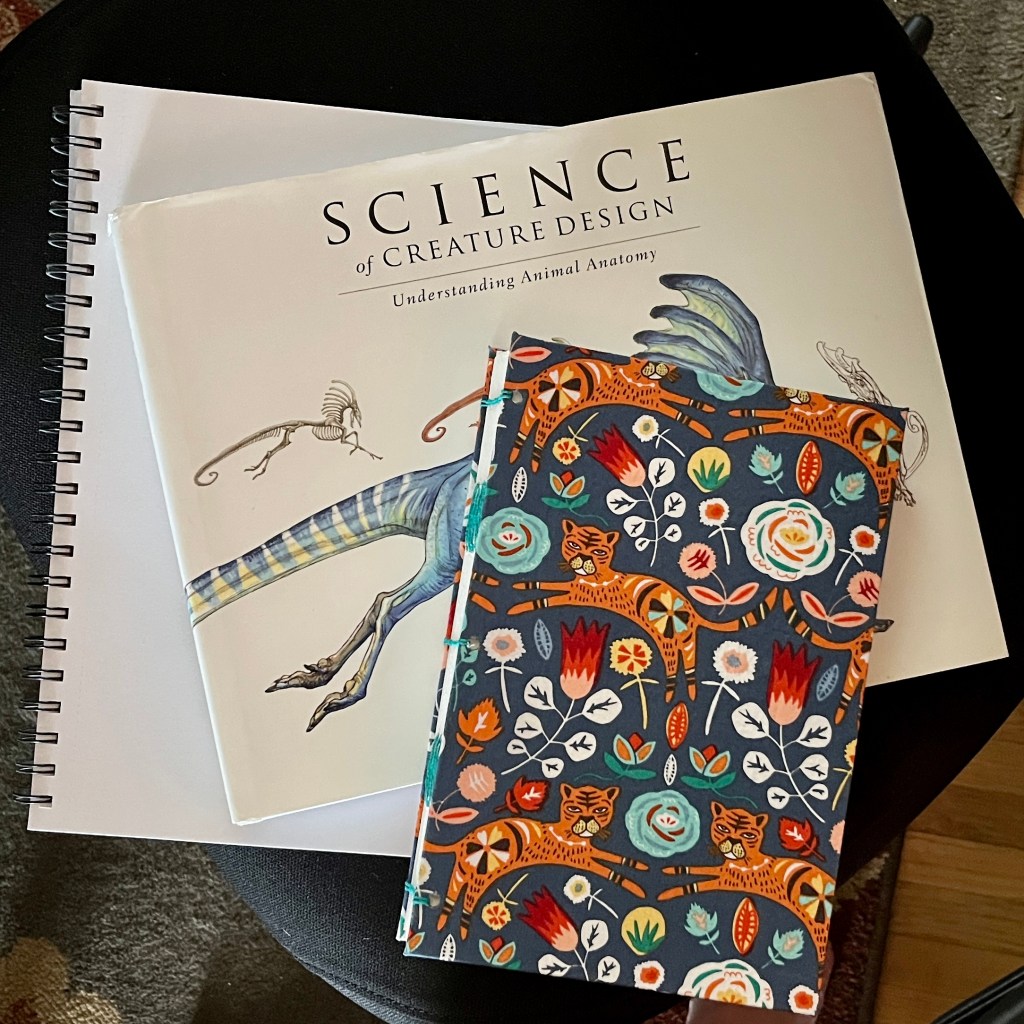
Sketchbook, Terryl Whitlatch book, handmade blank book for note taking.
It should be kind of intense, which is fine. I like drawing animals, and creature design, while out of my reach at the moment, is intriguing.
And, because I am a person who likes to draw and paint in my nature journals, any sort of structured way of thinking about sketching is helpful for me.
I’m glad to get to do these things right now, because it will likely be a while before I can concentrate on drawing and nature journaling…
The kitchen is closed. I, the cook of my household, am on strike.
Friends, when you are a grown person and your partner is the one who plans, shops for, and cooks the meals, please do not come home to a dish you have eaten several times without complaint and announce that you do not want that dish because you do not like one part of it.
In other words, don’t say this: “If you could just adjust the dish it would be fine… say, if you could just take the “parm” off of the chicken, that would be great. It’s not that hard, right?”
First, please consider that your partner is not your short order cook. Maybe it’s an easy pivot, but if the ingredient you’re objecting to is in the name, what you’re actually asking for is a different meal because that named ingredient is likely part of a cooking process… it’s not just a condiment. Sometimes that adjustment takes some thought… is it just the ingredient you don’t like, or is it the entire concept of the dish? Is it your expectation that your partner will suss out that distinction while making the meal?
Second, if you’re not into the dish that’s being offered, the time to mention it was right after you ate it the last time, especially if you’ve had the meal a few times before and haven’t ever mentioned that it’s not your cuppa. YMMV, but I can *almost* guarantee that nobody wants to feed you food you don’t want to eat. It’s much easier to take a meal out of the rotation than it is to shift stuff around right after you walk in the door. (Trust me when I say that the cooking partner does this kind of thing all the time to account for ingredient availability, seasonality, or personal preference.)
Third, please consider that your partner might not actually be all that into planning/shopping/cooking, but there are odd combinations of dietary restrictions in the household, and the division of labor works out more easily this way. (And somebody has to do it or we’ll eat too much cereal for dinner.)
The cooking partner, may, in fact, be looking for ways to simplify meals to free up some time. If you’re not into what’s being offered, maybe offer to take on some of the planning/shopping/cooking yourself, or offer to bring dinner home… or go out to eat!
I have a list of almost 50 meals I can make (including a few different pizza and dumpling variations). There is an active rotation of about 15 of them at any given time – that expands or contracts depending on how much time I have, the weather, and how interested I am in food at the moment.
For the record, I don’t mind cooking, particularly because I’m a pretty picky eater and I like knowing how to make what I like to eat… but I wouldn’t say I’m passionate about it.
I’m a utilitarian cook at best, so there are very real limitations to my skills, abilities, and interests in the kitchen. I compensate for this by trying lots of different recipes, so that there is some variety (you may see the same recipe fairly often, but it will come up every two or three weeks instead of every Tuesday), even when I’m in a bit of a rut.
What I am definitely not good at in the kitchen is pivoting on the fly. I can do it sometimes, but I don’t find it easy or fun. There are people in the world who are amazing at that sort of thing; I am not one of them. Taking that one step further, I don’t have the desire to put in the time or effort to try to become one of them.
Everyone is allowed to not like my food. I’m not offended by that, and hope that they’ll tell me so that I don’t try to feed them food they don’t like. It’s easy for me to take a meal off my list…
… but I have to know that you don’t like it…
… and it’s really bad timing to identify the issue when I’m about to feed you the food you don’t want to eat.
As I’m sure you’ve gathered, this isn’t a hypothetical situation. It’s how I ended up on strike in my own kitchen. But you know what? It’s the end of August. It’s hot. I think we’re perfectly fine to snack for the next week.
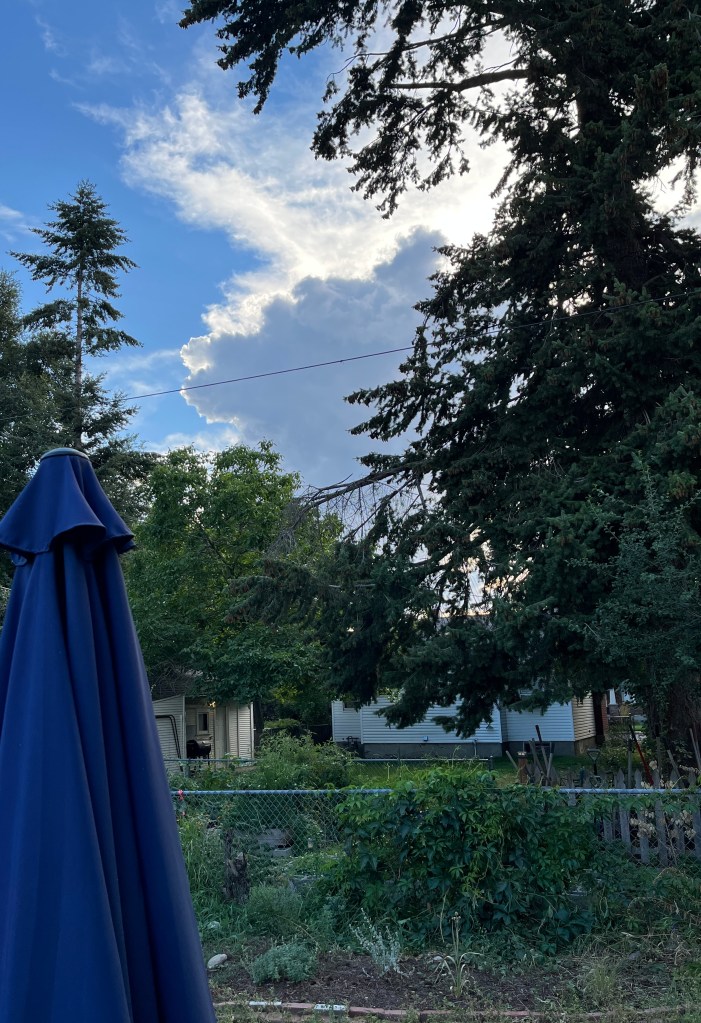
View from the patio of some striking clouds off to the west.
Sometimes, I am in awe of the world.
I had coffee with a friend the other day, and we got to talking about how amazing the world can be. Sure, lots of times it’s a dumpster fire, but there are moments that just… take your breath away. We agreed that it’s not so much that we should spend all of our time chasing those moments.., but when they just show up it seems prudent to stop for a minute and take notice.
When I was just starting out in calligraphy, a gazillion years ago, I fell in love with handmade books. (I no longer practice calligraphy, but I’m starting to get into the handmade books.)
For the record, I have always loved books. When I was four years old, I believed with my whole heart that knowing how to read and write was an adult conspiracy, meant to keep the kids down. There had to be some kind of magic contained in books.
There is. Legit. For real. I became a voracious reader, and a lover of pens and pencils. And books.
When I was in elementary school, I checked out an old book about logging (?), or forest management (?), something I wasn’t even remotely interested in, because I liked the feel of the book itself. It was heavy and thick, with a sturdy binding. I loved that book (even though I never read it), because it made me feel smart to carry such a beautiful object.
When I started journaling on a regular basis, it was my goal to learn to make my own journals. I have become kind of persnickety about size and format, the way a book feels in my hands, so I’m still on that journey, but in the last year or so, I’ve started to come closer (I’m not completely there yet, but my attempts are starting to feel more substantial.)
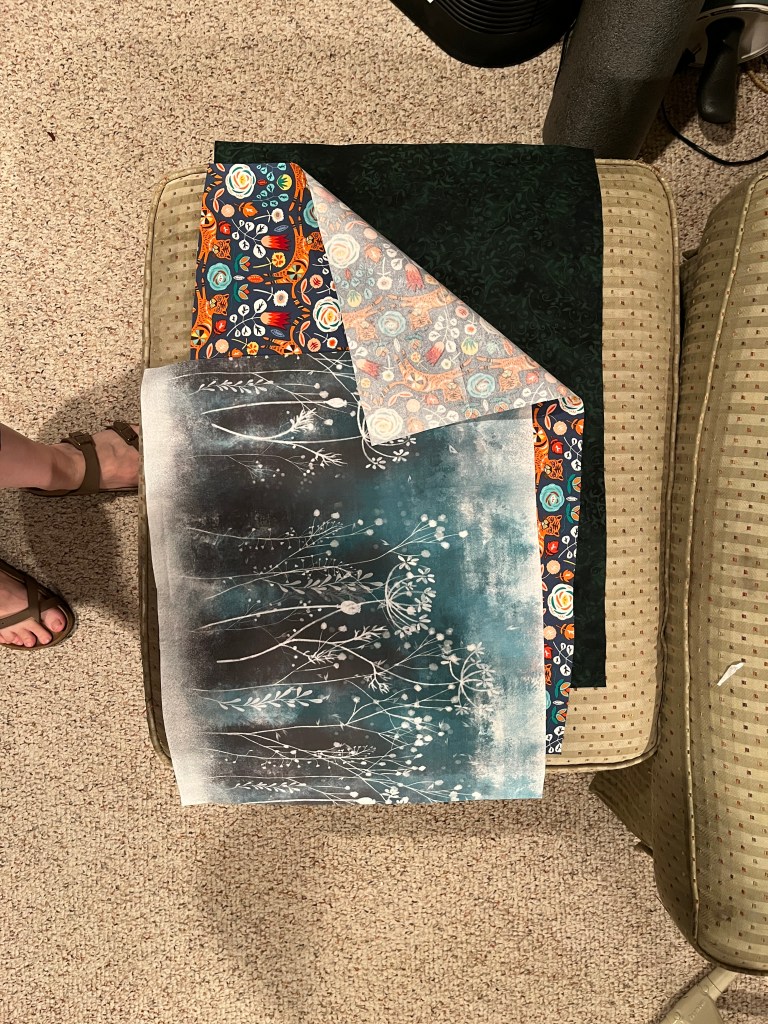
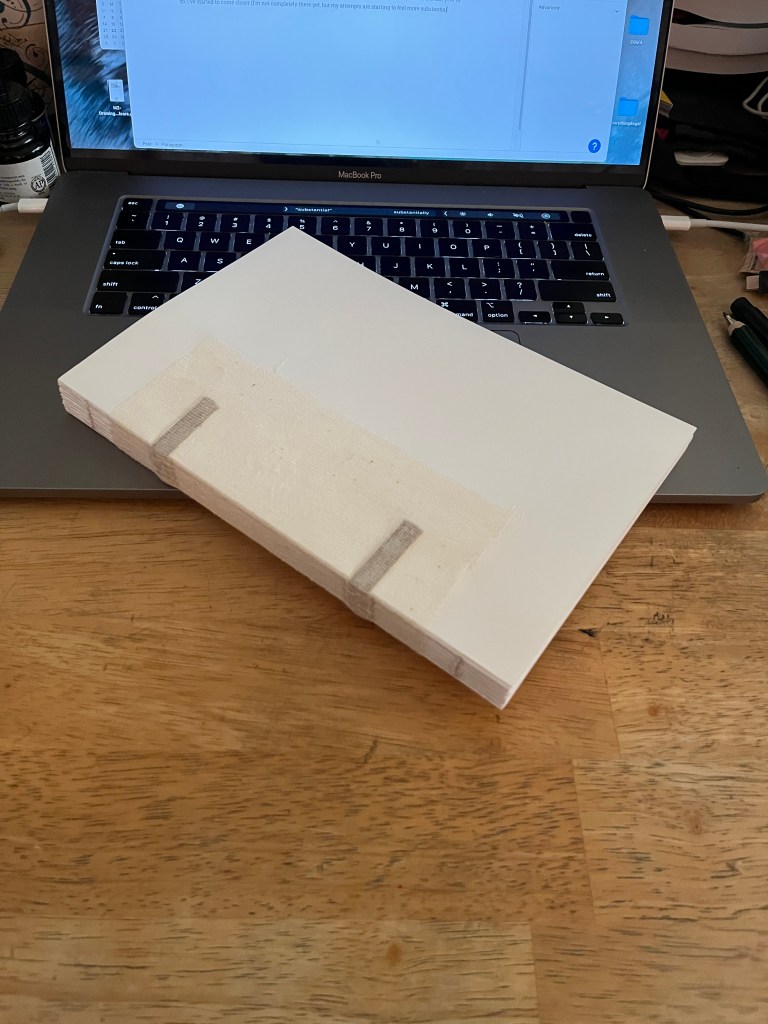
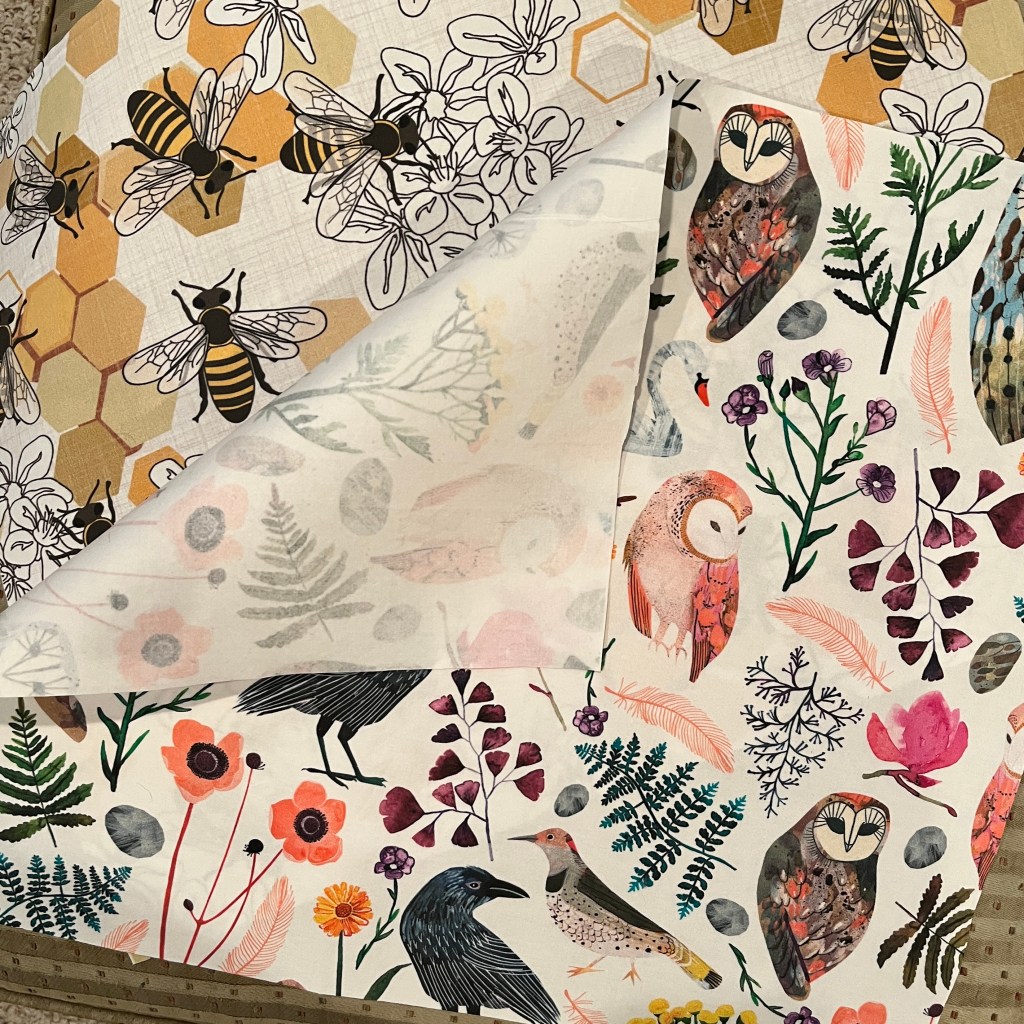
Book cloth made from fabric originally purchased to make masks.This stack of pressed signatures will become three books.First book’s text block.
I can make my own book cloth and sew text block with reasonable competency. I’m still not great with glue, but I like the stability it (along with mull) provides. I can improvise headbands when I need to. I have spent *a lot* of money at places like Talas and Hollander’s — they’re both amazing, have exactly what I’m looking for (usually), and I have been nothing but pleased with my shopping experiences.
I’ve taken a couple of bookbinding workshops through the Spokane Print and Publishing Center, which were so amazing, and learned quite a bit from YouTube (because you can learn anything on YouTube).
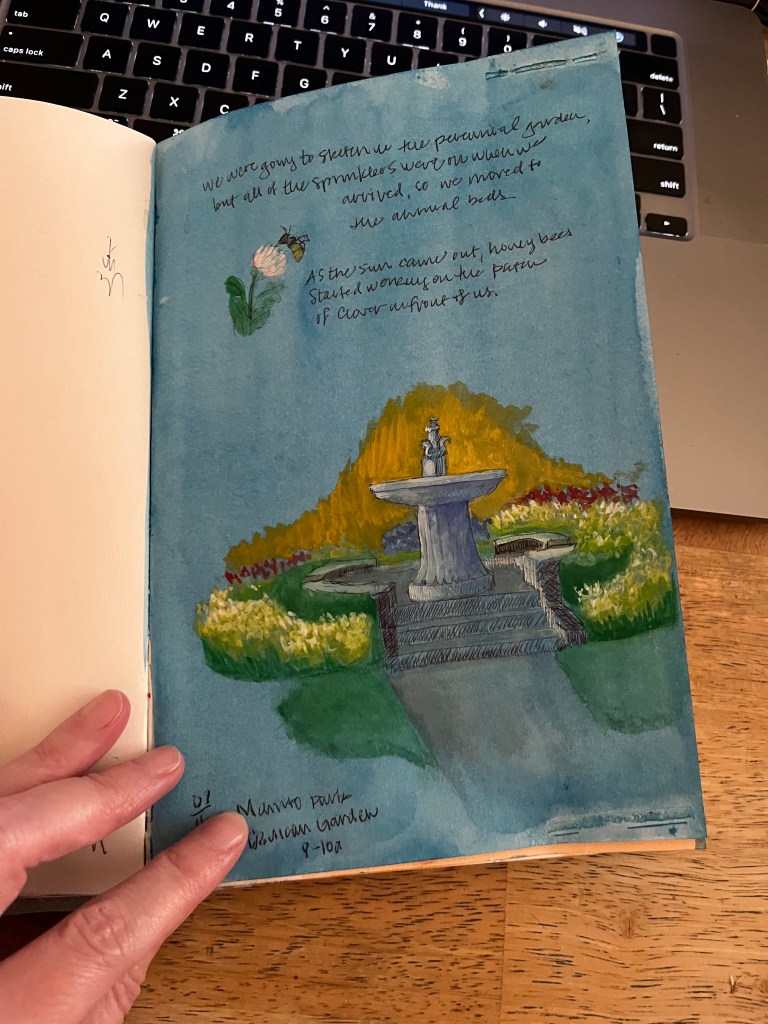
Another amazing resource: Peg and Awl, for handmade objects, ideas, and learning. During the height of the pandemic, they published a series of tutorials, “Bookbinding at Home” — I used the one at the link to cover a book I’m enjoying working in right now.
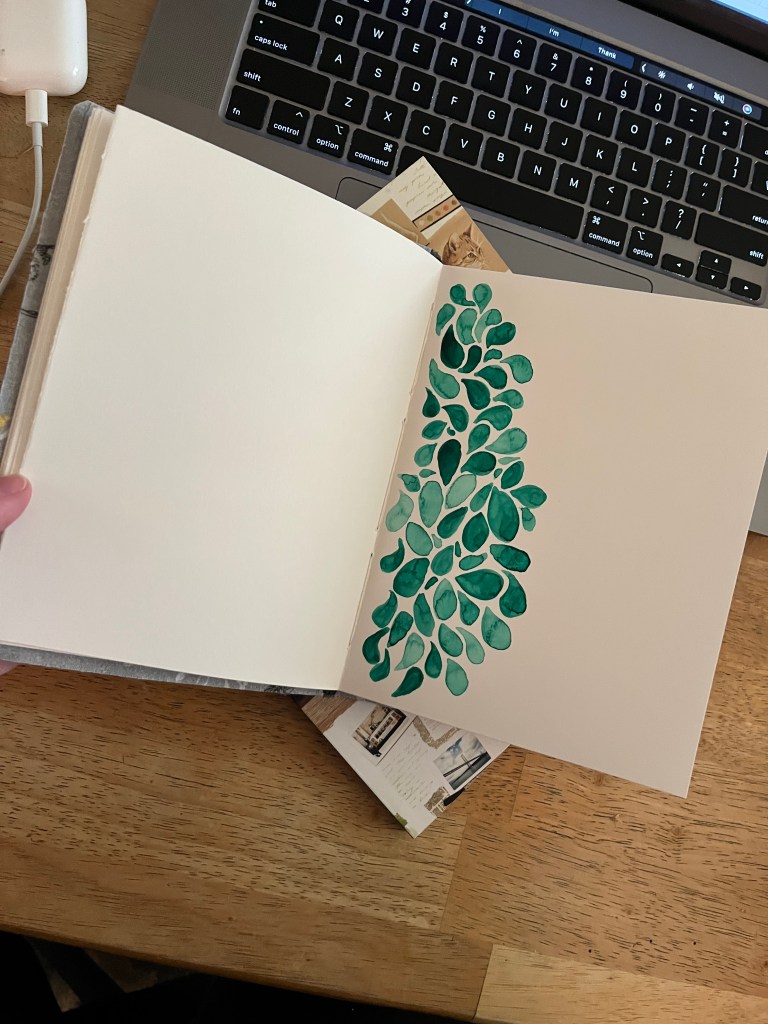
6″ x 9″, 90lb watercolor paper stitched on tapes, bound in a piece of gray leather.Starting to play around with toning pages and working in gouache.
This paper is not sturdy enough for the kind of stuff I want to do, but it was excellent practice, and it’s a lovely book.
I liked it so much that I made another book in exactly the same style, but with 140lb watercolor paper.
Want to work through “The 30-Day Sketchbook Project,” by Minnie Small. First exercise.
We’ll see if this paper does the trick. It’s heavier and sturdier than the 90-lb paper, so should hold up better to wet media.
The hard/interesting thing about bookbinding is that it’s a lot of time spent waiting for glue to cure… it’s watching grass grow or paint dry… which is why it’s a good thing to have a couple of projects in the works. Today, for instance, I can sew a notebook, make some headbands, and prep a case for the text block above.
I will likely never become an expert bookbinder. I like it, but not enough to become obsessed with it — it’s more of a means to an end for me. (People who do become obsessed with it create amazing work that I admire but will probably never be able to emulate.) But it is, so far, a grand puzzle to solve and something tangible to make, so I’m enjoying it.
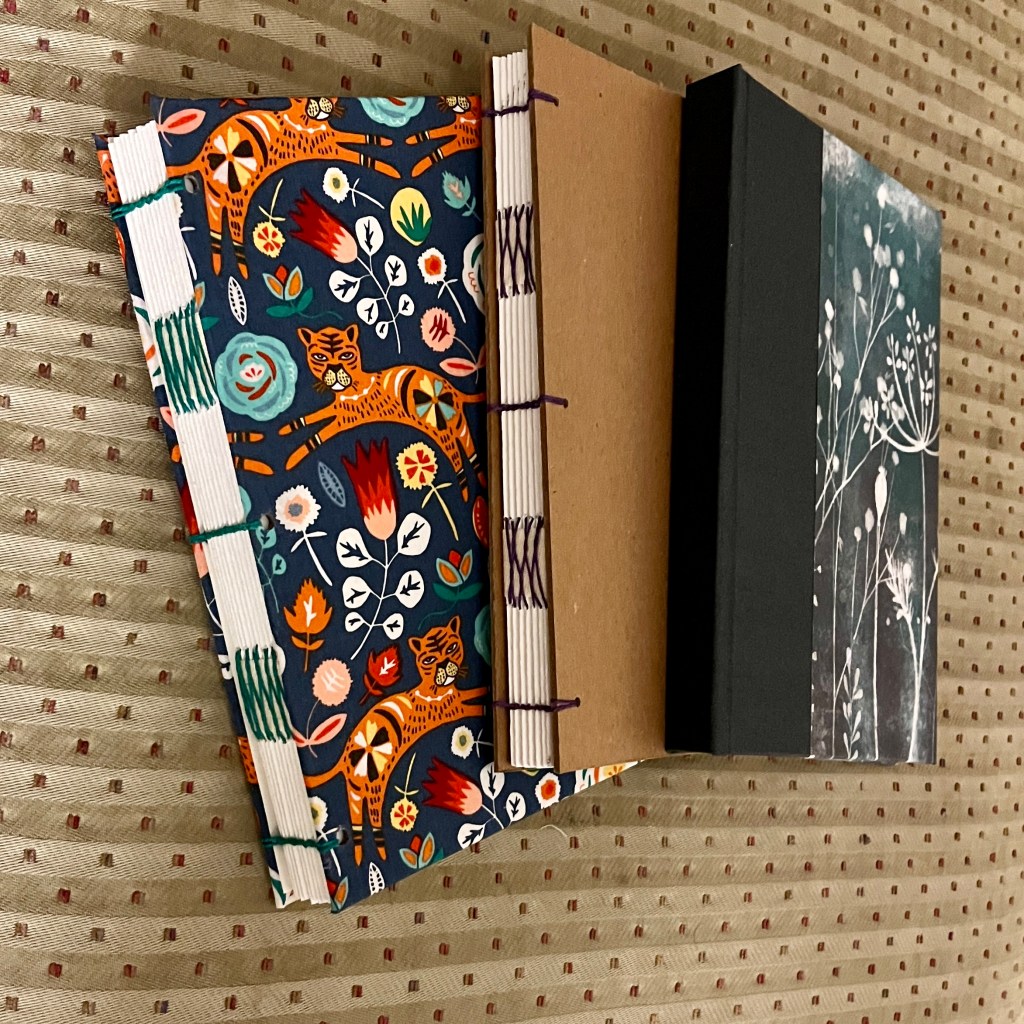
These turned out OK — they’re still practice books (not fit for gifting or sale), but each one demonstrates some improvement, and they will be useful to me. I still have one more text block to case bind (it has been sewn, but needs to be glued, and I need to make a case for it.
Actually, nothing at all to add. August has always felt like kind of a weird month to me. It’s hot (and has been for a while), and I’m clearly not built for heat… several days above 90ºF (and four or five days topping 100ºF, with more on the way next week) sucks the energy right out of me.
For the longest time, I tried to keep up in August, and failed miserably. It’s hard to push through when the universe seems to be pushing back. So in August I try to let the universe have its way; there’s nothing I can do to change the situation, and I’m not great at operating within it, so I just… don’t.
(We’re so fortunate to have central air and fans. If we didn’t, August would be hugely unpleasant instead of an ongoing minor annoyance.)
The last couple of weeks have been kind of a whirlwind though, relatively speaking. Dr. appointments, I’m working on a couple of projects (including a handmade journal as a good-bye gift), we had a houseguest for a few days last week (very fun), our old dog is really starting to feel her age and require more assistance. The calendar is starting to empty out, thankfully… and just in time.
Cooking has taken a back seat, because who wants to heat the kitchen when it’s above 90º outside? I’m making a new-to-me pasta dish tonight, but only because it requires fresh zucchini and corn, both of which we have at the moment (though not from our garden). We’re doing a lot of “snacks for dinner” these days, which I actually really like, because a) it’s heavy on fruits and vegetables, b) it’s modular, so you can have it often and it feels new each time, c) it’s so easy, and d) there’s no heat involved.
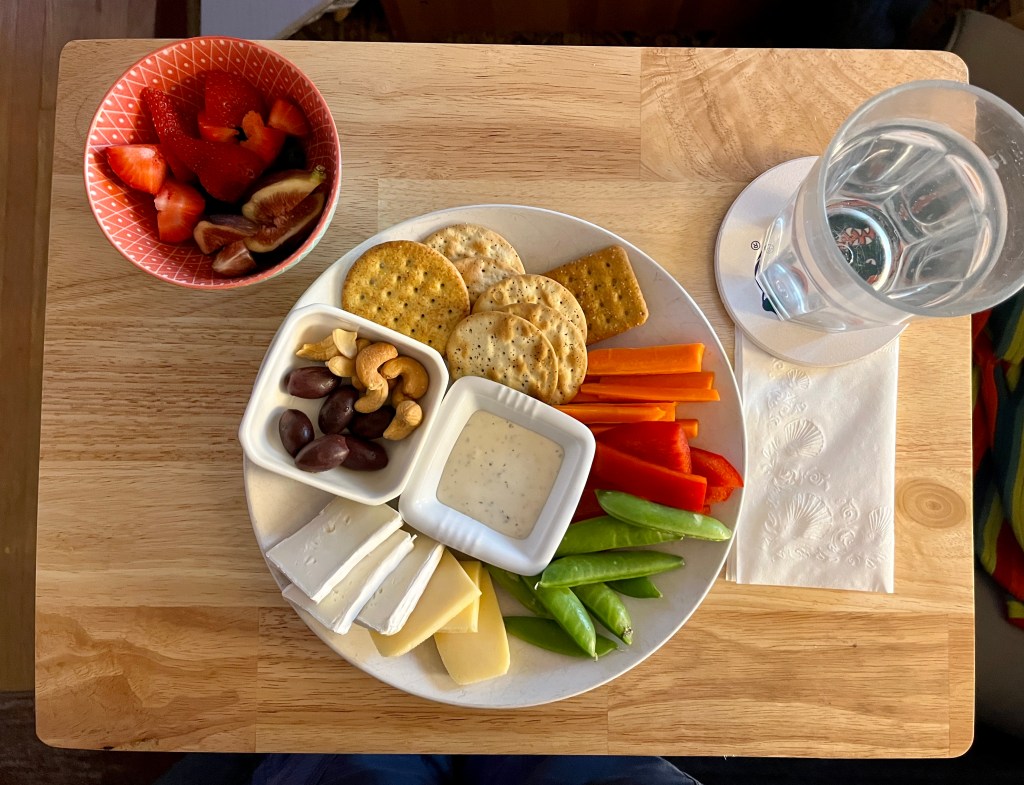
Carrots, red bell pepper, sugar snaps, cheese (smoked gouda and brie), non-dairy ranch for dipping (husband, whose plate has some meat on it, can’t have dairy), a few olives and cashews and crackers. Fruit included blueberries, a fig and a couple of strawberries. A *very nice* meal.
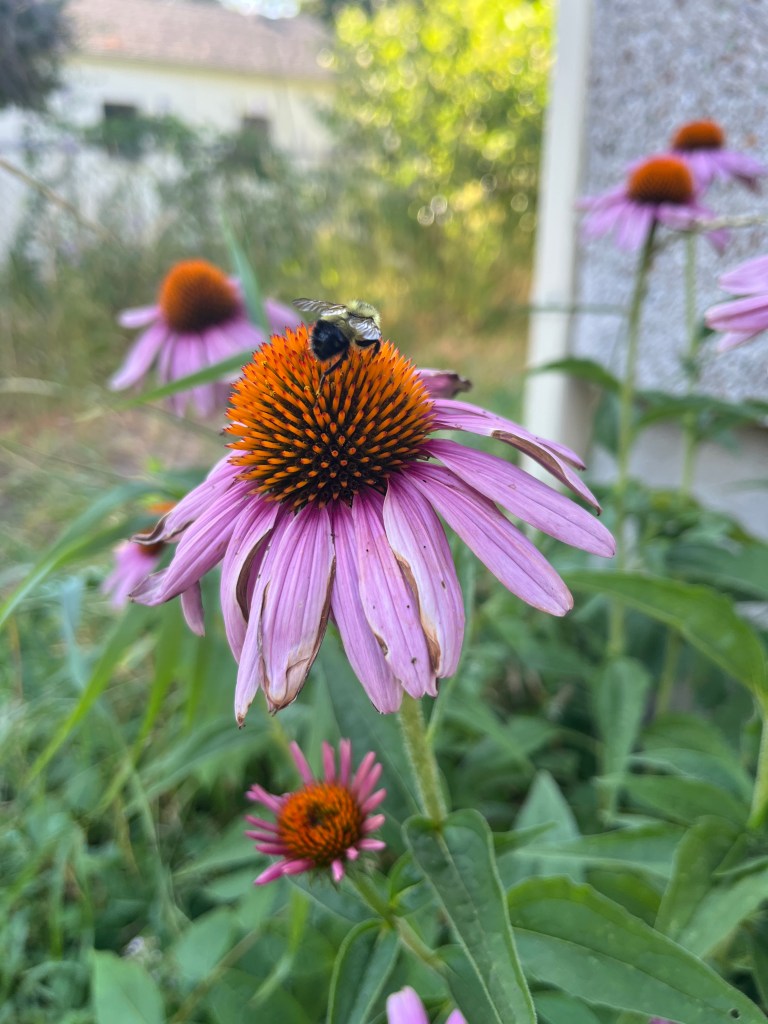
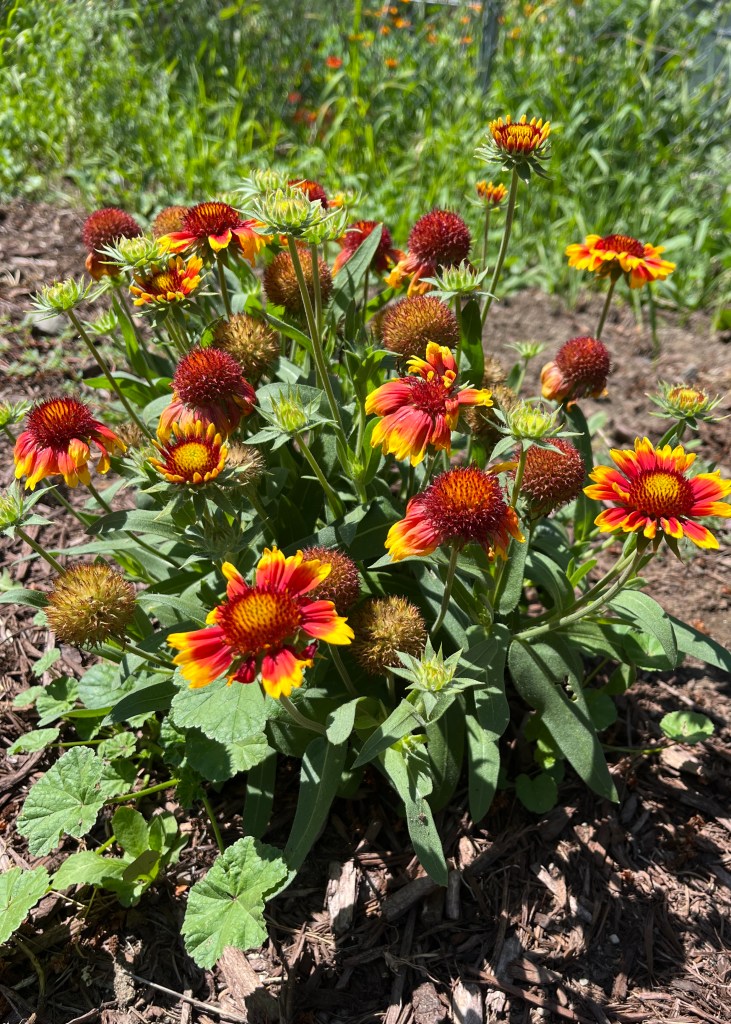
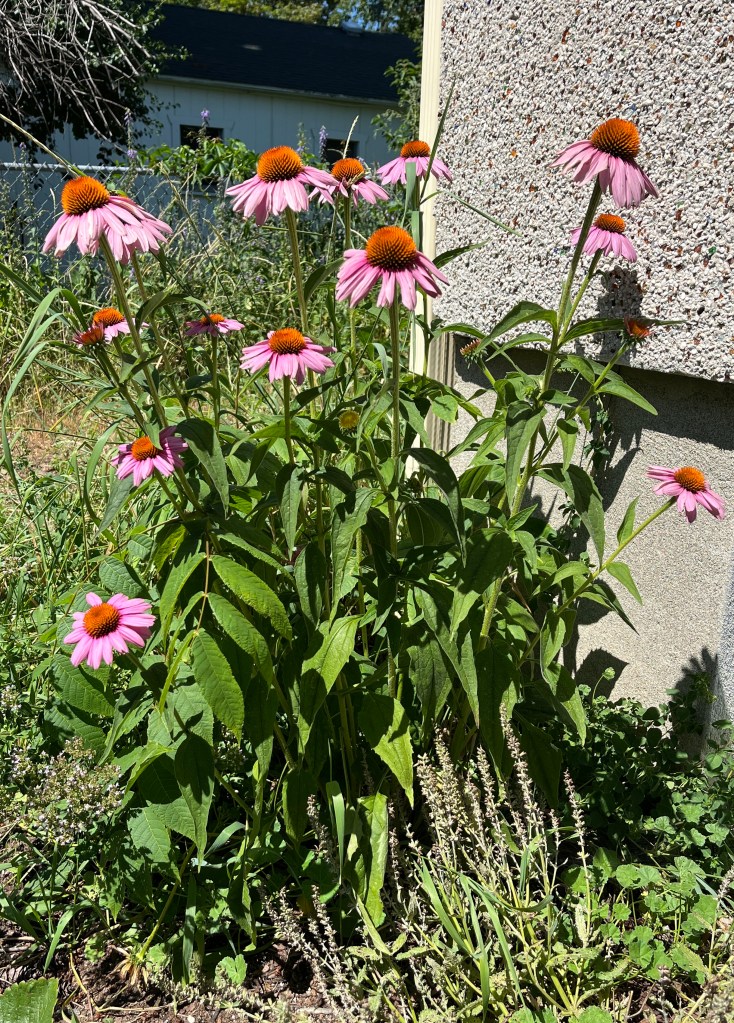
Ongoing garden maintenance has become extremely basic: removing the most annoying of the weeds, and watering. Although yesterday I deadheaded some salvia and lavender — too late for a potential second bloom, but the bees made good use of the flowers before they started senescing. I also took the old flowers off of the coneflower plants — hoping they’ll continue to send out blooms for the bees. (Note to self: blanket flowers and coneflowers are attractive to bumbles in late summer. Will definitely plant more of those this fall, along with some black-eyed Susans and a couple of larger lavender plants.)
Fuzz Butt.
After the (relative) mania of the last few weeks, slow and quiet seems… nice… and necessary. I’m still feeling pretty burned out — the ongoing concern — but I seem to slowly be recovering. Or my calendar is loosening up a little bit and I can breathe better… maybe it’s that. Whatever. I’ll take it.
Things start popping again in September, including a new adventure (one I’ve been looking forward to for a while), and hopefully (fingers crossed, knock wood) preparing for another completely new endeavor after the first of the year (at this point it’s out of my hands — I’m waiting to hear whether it will be an option).
But for now, the rest of August is for rest.
Follow up (8/26/22): Well, that (“rest of August is for rest”) was a bust. The rest of August is turning out to be for volunteering at the Outdoor Learning Center. I struggled to get down to one volunteer shift a week, and that lasted from mid-June until mid-August. For the foreseeable future, I have three volunteer shifts a week, including some classroom animal care (mostly tortoises and lizards), along with some additional raptor care (a moderate case of bumblefoot in one of the hawks — an annual thing for her (she’s an arctic bird in a hot/dry summer) — and a cracked mandible on one of the owls). My boundaries are, apparently, very porous at the moment. (And, for the record, it is ok, but not idea/.)
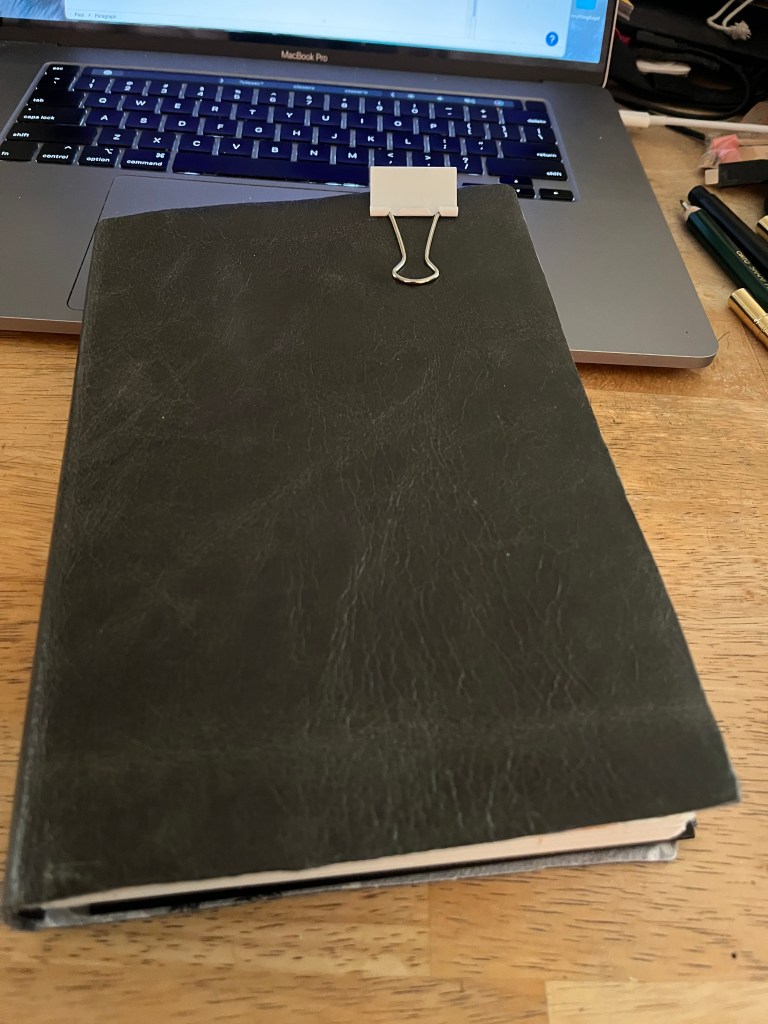
I made a new book, and I like it. It has some issues, but it was a fun experience and I learned some things, so definitely worth the effort.
I’m getting more used to sewing text blocks, both on and off tapes. Again, not perfect, but I learn more each time I do it.
The coolest part of this experiment was making my own book cloth. In 2020, when we were sewing our own masks, I bought some beautiful fabric from Spoonflower. By the time I got my hands on the fabric, better masks were becoming more readily available, so the fabric did not get used for my original intention. The great news is that with a product called Heat n Bond UltraHold, you can easily fuse light paper to fabric.
(Since I’m new at this and trying not to be too precious about anything, I used tissue paper. If you’re an aficionado, you should work with more archival products.)
Homemade book cloth, featuring fabric from independent designers from Spoonflower.
There were two primary issues with this book: I cut the spine board too wide (by a little more than 1/16″), and I’m still pretty clumsy with glue, so there are some glue stains on the black book cloth.
Those are the learning experiences. The spine thing I can fix with my next book. The glue thing will take some practice, and some consideration about how to make the process more effective.
(In other news, I’ve decided that the ability to assess, and learn from, my mistakes might be my superpower.)
This book is not ruined by those mistakes — I wouldn’t sell it or give it to anyone, but that doesn’t mean it won’t be useful to me. The too-wide spine means that it doesn’t lay completely flat, so while it’s not a good option for me for journaling or sketching, it will be a fine book to take notes in, or make quick sketches.
The finished book. I like it. It’s both visually appealing to me, and it will be a useful object. AND I learned some things from the experience. It’s a win all around.
I’m enjoying these bookbinding adventures. I enjoy the precision, even though I’m messing it up. It’s fun to learn new things while making tangible objects. Every time I complete a project, I’ve got a small list of what to do next time to improve.
It makes my brain feel good.
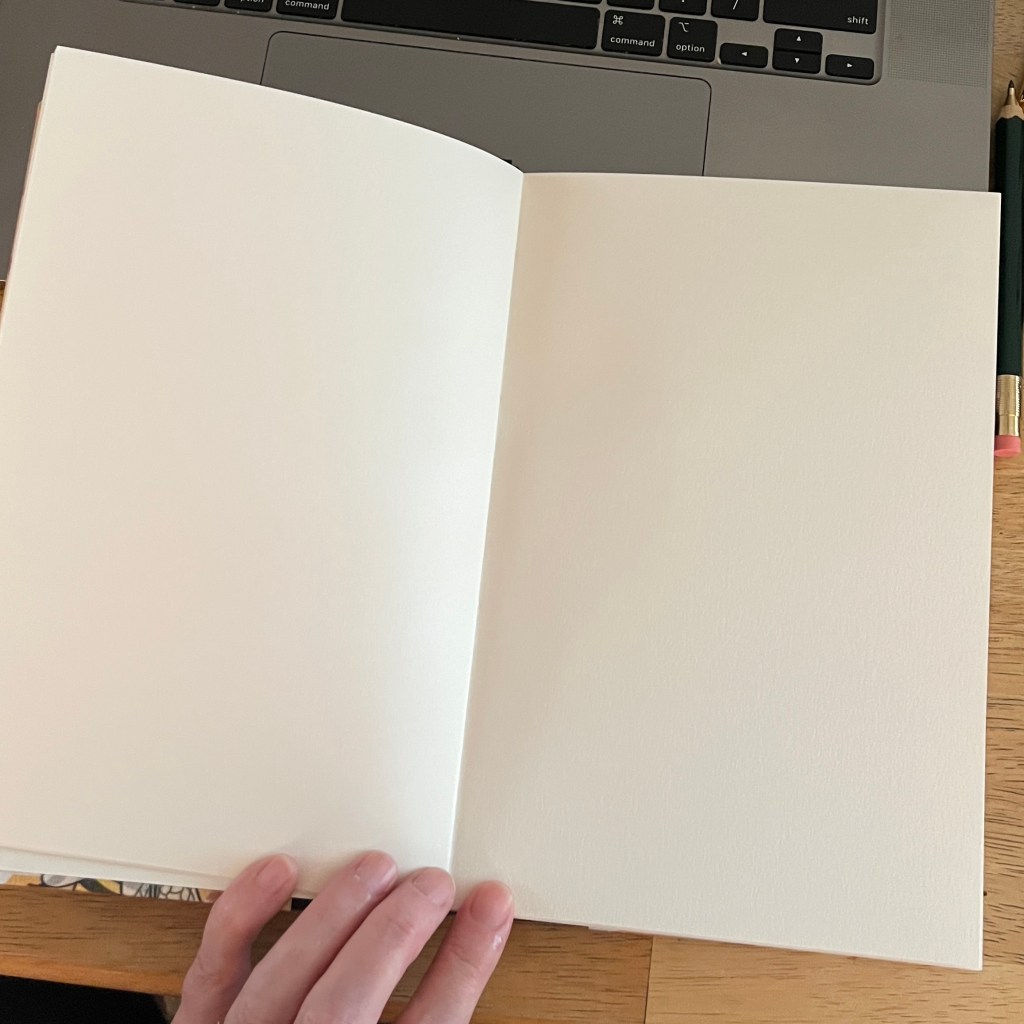
P.S. I will — always and forever — use blank pages. In the fourth grade, my teacher inexplicably had us start using unlined paper — my perfectionistic, hyper-anxious self was mortified, and I had a complete meltdown. But in the (many) intervening years, I have come to strongly prefer blank paper. You can used lined paper if you want, friend (no judgement from me), but don’t fence me in.
It took me a l-o-n-g time to figure out that summers in Eastern Washington are NOT temperate.
I grew up west of the Cascades, so I was used to being able to work in the yard year round. Not that I did, mind you, but I had the option. I lived in New York City for a decade and had no yard at all, so the hot, muggy summers were something to survive rather than enjoy… except for the farmer’s market at Union Square, which is luscious in the summer. Something about the heavy, humid air allowed scents to linger deliciously…
When we moved to Spokane and bought a house, I was under the very-much-mistaken impression that gardening here would be like gardening in Portland, Oregon.
Problem #1: it is much drier here than on the West side.
Problem #2: it is also (usually, generally) hotter (though, thanks to climate change, the differences aren’t as pronounced as they used to be).
This week in Spokane, WA. It’s a dry heat, and we’re fortunate to have central air at home.
These issues are not helped by the fact that every Barnes & Noble stocks gardening books for the “Pacific Northwest” in their garden sections.
We’re in Washington State, yes, so technically the PNW.
But in terms of our ecoregion,* we have more in common with the WEST (Montana/Wyoming/Colorado): hot, dry summers; cold, snowy winters, short growing seasons. Rainy seasons are hit or miss (in part because of climate change), and we have potentially nasty fire seasons. Our gardens benefit from plants that are hardy over winter, and tolerate hot, dry soil in the summer.
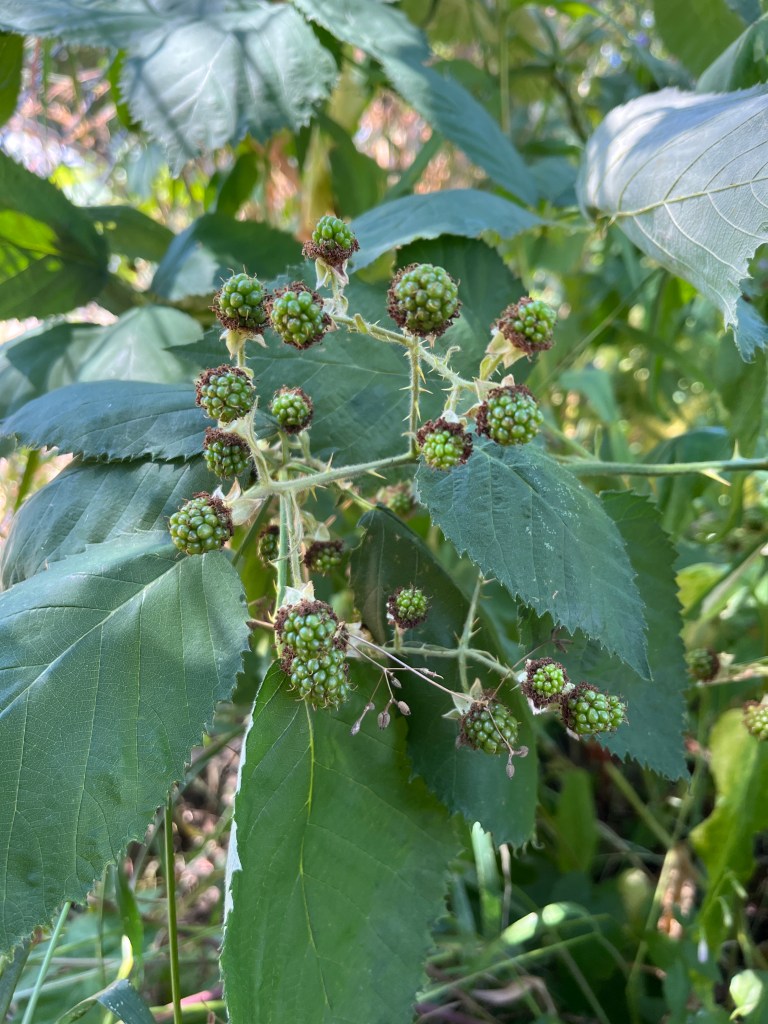
Russian sages, lavenders and blanket flowers love it here. Oregano and yarrow volunteers in the backyard, and salvia and buckwheat are delighted. We had a wet spring this year, so our volunteer blackberry (that lives in a shady spot in the yard) is pretty happy even though we don’t water it at all. I planted some catmint last fall that seems to be doing pretty well, and the bees like it quite a bit.
Our backyard is a mess, actually. It’s vastly improved from last year, and will require some more time (and plants!) to get it in shape. Grass does not like to grow out back, so we’re introducing more clover into our diminishing lawn area, and actually replacing much of the lawn with native and/or introduced plants that a) tolerate the conditions, and b) attract insects and birds. We do not spray our back yard. It’s somewhat hit or miss, but we’re getting there.
One thing I have learned over the years is that I can’t do much work outside in July, August, or the first part of September — it’s too hot and dry to do any planting (without committing to excessive water use), so I spend all of my limited time outside weeding and watering (when necessary).
Interesting work happens in the spring and fall.
Last fall I converted a bunch of lawn into a perennial bed, and that work will continue in late September of this year. I will be adding a fernbush, a couple more salvias, more coneflowers, some buckwheat, a couple of larger lavenders, some butterfly weed and bee balm. The bed will expand a bit to accommodate some black-eyed Susans and low growing lamb’s ear. I was a little too conservative with plantings last year, so I’m going to start filling in this fall.
Should be fun..
* In terms of ecoregion, Spokane is technically in the Northern Rockies — when we grow vegetables (in raised beds, in our case), we’re better off if we follow guidelines for growing in the mountains — even though we’re a little ways West from the foothills. We’re also at the edge of the Channeled Scablands. The geography here is changeable in some interesting ways.
Did you know… that you can get eczema in your ears?
Gross, I know.
But true.
Background: I have had seasonal allergies for a very long time. I’m allergic to a few different trees (spring), and really allergic to grass (summer), with milder weed allergies in the fall. (I am allergic to the most charming of weeds — in moderation — tumbleweed.)
If the allergies are well managed (thank you, Allegra, Zyrtec, Zaditor and Flonase), I’m a reasonably happy camper: both completely functional and mostly happy. Big win, thanks to modern pharmaceuticals.
(This is after five years’ worth of immunotherapy. So everything is better than it used to be, but when plants are having their sexy times, I’m still pretty miserable.)
This year, though. This year has been miserable, and long. It started in mid-March when the trees came up, and the season has proceeded with gusto until now. In addition to my usual, runny, itchy, watery eyes, and unpleasant sinus symptoms, my ears started weeping… this has never happened before. I’ve always had itchy ears, but this is the first time I’ve ever had any sort of discharge associated with it.
I’m telling you, every part of my head was leaking.
My eyes improved as we transitioned from trees to grasses. My sinuses are starting to become less reactive as grass season winds down. My ears? Still very itchy and leaky.
I mentioned it to my doctor during my check-up. I told her that I was pretty sure my ears had started doing what every other part of my head was doing in response to all the growy things, but that this was a new thing for me… so I asked if she could please check it out.
After ruling out a host of bad stuff (any dizziness or vertigo? no. blood in the discharge? no.), she let me know that allergies in ears are rare. But eczema is not, and I had a decent case of it, both in my ear canals and the pinnae (the outside parts). She prescribed antibiotic ear drops to treat the inflammation and irritation. When I’m done with that I’ll switch to something more emollient, to (hopefully) better manage irritation..
(I’m two days into my 10-day treatment, and my ears are much less itchy and weepy, thankfully. It’s a relief.)
Eczema in the ears is more common in people with allergies (check) and asthma (also check, though it seems weird to me that a respiratory issue would correlate to a skin irritation in the ears, but I am not a medical professional, so sure, whatever, I guess).
Now you know what I just learned: ears don’t normally exhibit symptoms of allergies… but the skin in and around them can be irritated in the same way as skin everywhere else on the body.
[Grain of salt warning here: it was an amazing pizza according to my skills and abilities, and the limitations of my oven. In the — waves arms enthusiastically — universe of pizza, it’s more likely a mediocre (at best) pizza. But hey, we do what we can.]
I’m struggling with burnout at the moment. Not from doing too much over a short period of time, but from doing the same thing over and over for a very long period of time. I am learning that the slow drip will get you eventually, as surely as the too much/too fast/too often pattern will. One of the things I’m trying to do to alleviate the burnout is eliminate some of the choices I find myself making every day/every week/every month. Don’t get me wrong, I’m grateful to have options, but when you’re wading through them all the time at the expense of things you want or need to be doing, they start weighing on you… it seems counterintuitive, I know.
But it’s actually pretty straightforward. I am the meal planner in my house. Over time, I’ve developed a list of about 30 meals to choose from, and I sit down every week before shopping to figure out what we’re going to have that we haven’t had in a while, that I can find ingredients for and have time to cook on any given day. And then I shop, and hopefully find what I need (or do more shopping until I do). And then, if I haven’t chosen wisely, we end up eating a rice-based meal three times in one week, or I end up cooking 90 minutes to 2 hours a day for a few days in a row to accommodate the schedule. I’m trying to streamline that situation, at least for the time being, so I don’t have to do a lot of extra shopping, and don’t have spend more than an hour a day on dinner.
If we have pizza every Tuesday, I don’t have to worry about what I’m shopping for/cooking on that night. I know that during lunch on Monday, I need to make some dough to ferment in the fridge until Tuesday night. On Tuesday I can prepare or gather the toppings and then it’s just a matter of actually making the pizza. It’s one less thing to fret over for me. And pizza is nice because you don’t have to have the same toppings every time, so it has the potential to be a little bit different each time you eat it. (That satisfies my husband’s interest in novelty.)
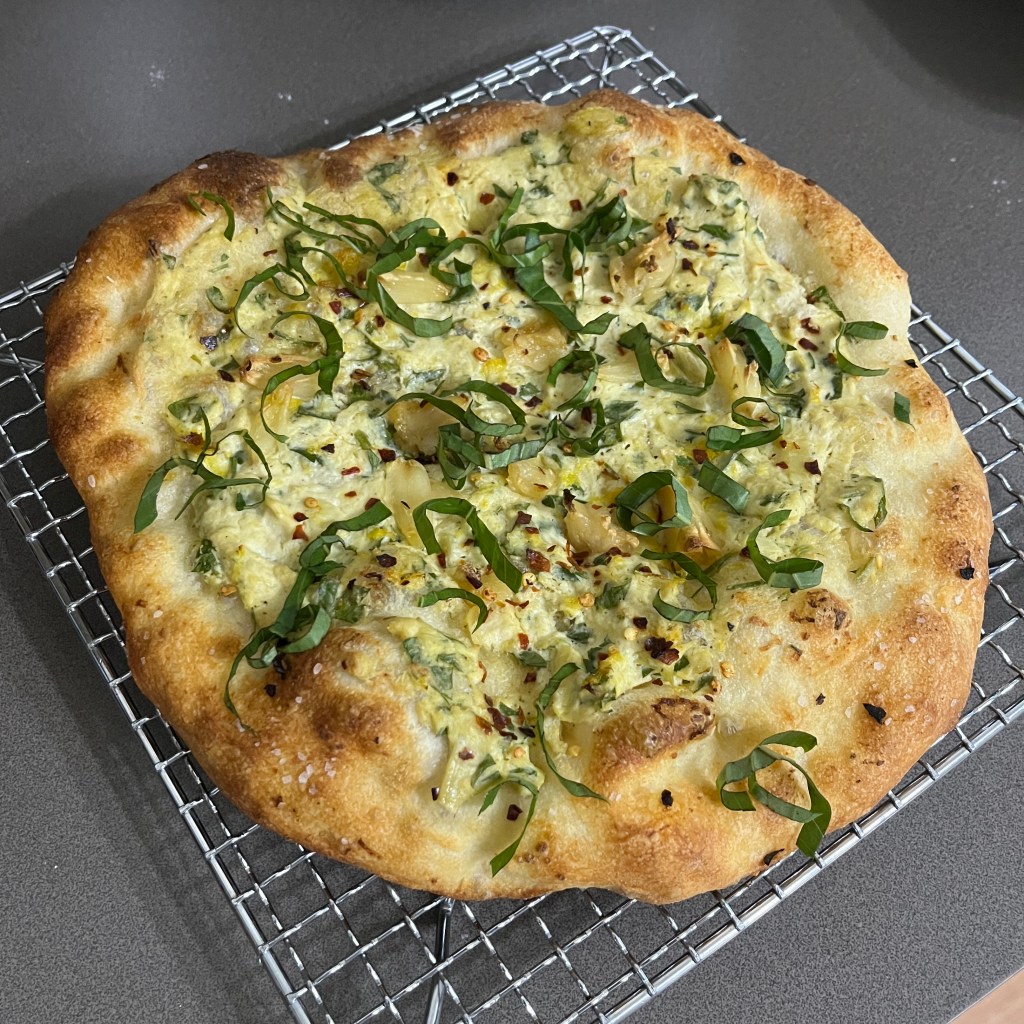
DELICIOUS. And the crust, which I have been working on for a while, turned out really well (even when baked in a home oven). The “ricotta” is mild and creamy. Other toppings include roasted garlic (YUM), lemon zest, olive oil and red pepper flakes, which give it a delightful little kick at the end.
It was also 90 degrees yesterday, and I had the oven on to 500°F, which I don’t recommend. So it’s back to the drawing board for me, because I need to find another solution for Tuesday nights for the next several weeks.
I’m thinking our theme will be “snacks for dinner” and will feature vegan nachos, an occasional charcuterie board (with meats for Dana and cheeses for me), mezze plates with hummus and olives, dumplings using pre-made wrappers… or maybe we’ll just have sandwiches… we’ll see.
Sigh. Time to start wading through the options.
[Little bit of background: I don’t eat meat. My husband can’t eat dairy — he’s lactose intolerant enough that ingesting any dairy at all acts like food poison to his system. We’re not easy to feed, admittedly, but we’ve found that between the two of us, he has the harder time, because Americans basically put milk/butter in or on everything. The plus side to all of this is that I have become reasonably good at cooking vegan food that we like. We aren’t vegan, but plant-based food checks all of our boxes.]
In addition to being a novice bookbinder, I am an experimenter with bread.
I don’t actually eat a lot of bread. Somewhere along the way I got really picky about it, or outgrew it, or something. I like a slice of toast with peanut butter for breakfast, but oatmeal is great, too… or an egg sandwich. I don’t eat more than a couple of sandwiches every week, so unless I bake, it’s pretty rare to have a loaf of bread in the house. (Lots of naan and tortillas, though, so it’s not like we’re low carb.)
This was, objectively, not a great loaf of bread. But it tasted really, really good.
I like sandwich bread, because it’s good for toast. So I generally look for bread that can at least be modified to make a sandwich loaf.
It’s good to be aware of your actual intentions.
Do I want an amazing loaf of perfect artisanal bread?
No I do not.
(I mean, yes, I would like that very much. But that’s not my goal when baking bread.)
I want a sandwich loaf for toast. It’s quotidian, I know, but this heart knows what it wants… and it’s toast. With peanut butter. And jam.
Purists and expert bakers will have… feelings about how bread should (and does!) work. There are people who are very good at this sort of thing, who have worked for a long time to perfect their craft. If that’s your cuppa, you should definitely listen to what they have to say. (My nod to this expertise, borne from experience, is that I have an easier time baking if I weigh my flour and liquid. I’m wildly inconsistent when I do anything by volume. And I use a thermometer to check internal temperatures.)
But here’s the thing about baking bread: you don’t actually have to be great at it to get to a reasonable end product. Practice makes improvement, obviously, and following directions helps a lot. Knowing what you’re after is also helpful; an expert in high-hydration artisanal loaves might not have the answers you’re looking for if you want to make a piece of toast with peanut butter.
But you do not need the fanciest stand mixer, or the fanciest flour, or all the time in the world to create a reasonable loaf of bread. If you want a homemade loaf of bread, find a recipe that fits your time requirements and the kind of equipment you have or want to use, and give it a try.
I guarantee that whatever you make will taste great… at least as good as what you can get at the grocery store.
If you’re not interested in a long ferment, here’s a riff on Peter Reinhart’s Light Wheat Sandwich Loaf (which I converted to a white loaf because whole wheat flour doesn’t sit well in my gut), from The Bread Baker’s Apprentice.
Light Wheat White Bread: a very basic, slightly enriched, recipe
18 oz bread flour
3 TBSP soy milk powder (or cow’s milk powder, if that works for you)
1.5 tsp kosher salt
1.5 tsp instant yeast
11 oz room temperature water
Mix together flour, soy milk powder, salt and yeast in a large bowl. Add water and mix until combined. Move to bread board and knead for approximately 10 minutes (if you have a stand mixer and want to use it, kneading will take less time… this dough is dense, so know your mixer).
The resulting dough ball should be smooth, smell kind of yeast-y and bounce back slowly when pressed with your finger.
Place in lightly oiled bowl, cover, and let rise for ~ 90 minutes (until doubled in size). If your kitchen is cool (mine is for most of the year), you can put the dough in an improvised “proofer” … your microwave, or oven (turning on the light will warm the oven a little bit).
Take dough out of the bowl and work it into a log shape. (If you want a visual about how to do this, check out this post from The Perfect Loaf.)
Place in a lightly oiled 9″ x 5″ loaf pan, cover with plastic wrap and let rise for 60 – 90 minutes, until the dough crests the rim of the pan. (Make sure to check it! This recipe uses quite a bit of yeast, and it gets very active, particularly if it’s warm.)
30 minutes before baking, preheat oven to 350°F. Bake risen dough for 30 – 40 minutes, rotating halfway through. Remove from pan within 5 minutes of removing from oven and let cool for at least an hour (more like two) before attempting to slice. Finished bread internal temperature should be 190°F, or should sound hollow when the bottom is tapped.
(We store our bread in the fridge — which is not great — because we occasionally have mice… which is common if, like us, you live with a parrot… or (also like us, when we lived in NYC) you live over a restaurant. If you don’t have a rodent issue, store at room temperature.)






 Carmen Yount