Nature Journal · Outdoor Learning Center · Volunteering

A Grand Experiment Gone Wrong

Or at least not entirely right…

I love nature journaling. I don’t get to do it as often as I’d like, particularly these days. My school load, volunteer work, and home life mean my schedule doesn’t have a huge amount of flex time for finding a “sit spot” and… you know, sitting.

Some animal skulls from 2022.

When I was asked to lead a nature journaling workshop at the outdoor learning center where I volunteer, I was excited, because I think it’s a perfect crossover.

Nobody signed up. (Might have been the topic — or the teacher — there also may have been some marketing issues.)

Still, I thought the idea had merit, so I suggested we do something shorter (1.5 hours instead of 3), less formal (drop-in without a prior sign up), tie it to an open house (both the timing and the theme), and see what happens. October’s open house was a Halloween theme, featuring animals that are perceived as being “creepy.” (For the OLC, that’s the resident rats and insects.)

The challenge: insect activity is low in our area right now, because it has gotten cold at night. We had a bunch of bumble- and honeybees until about 3 weeks ago, and water striders in the ponds, but everything has gone quiet. The spiders have gone into hiding (though we’re starting to see some webs in the raptor sanctuary, so maybe they’re finding food in there). We probably could have found some pill bugs, with some effort, but yesterday morning was going to be more comfortable inside. (I don’t know about anyone else, but my brain stops working when my feet get wet, and I lose too much coordination in my hands when I’m wearing gloves.)

With all that in mind, I gathered supplies:

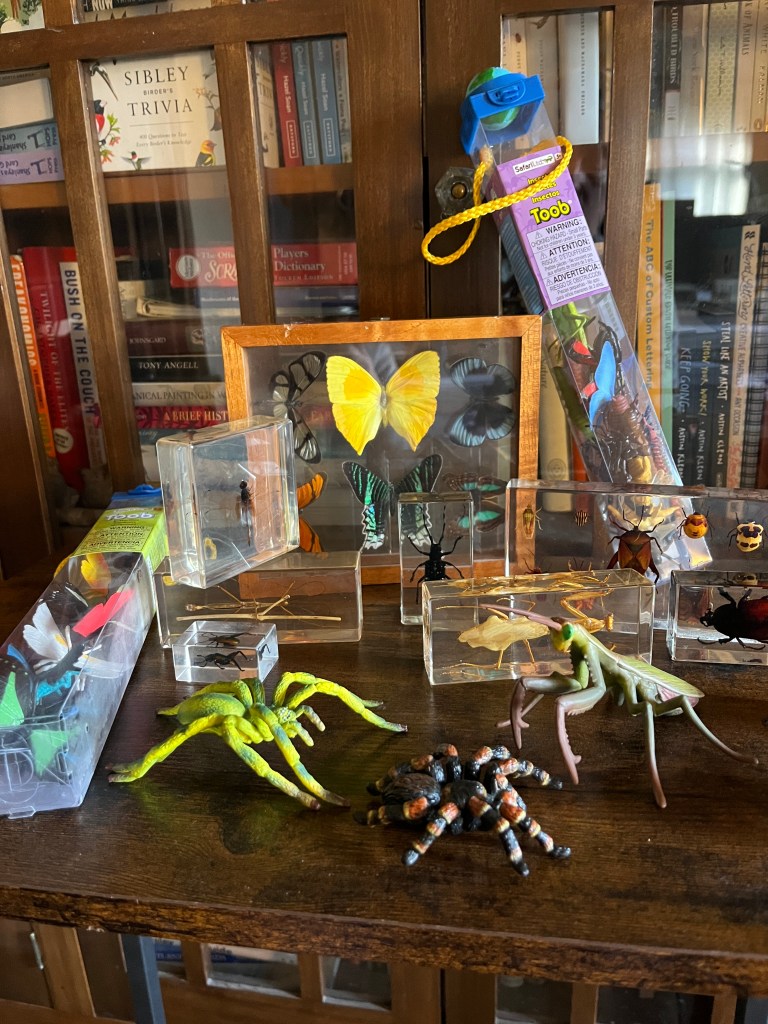
  • insects preserved in resin (difficult to draw, and not like living animals, but a good way to see some of the finer details of limb and wing structure, eye placement, and overall shape and size.)
  • plastic models (also not great representations of live insects, but a) they don’t move around, and b) it’s a good way to see the body plan, and how the masses of the body relate to each other)
  • I “borrowed” some of the live insects from the classroom: a roach, a couple of beetles, a couple of small stick bugs, and some mealworms.
  • sheets of 90lb watercolor paper (not precious, but sturdier than printer paper), and clipboards for stability
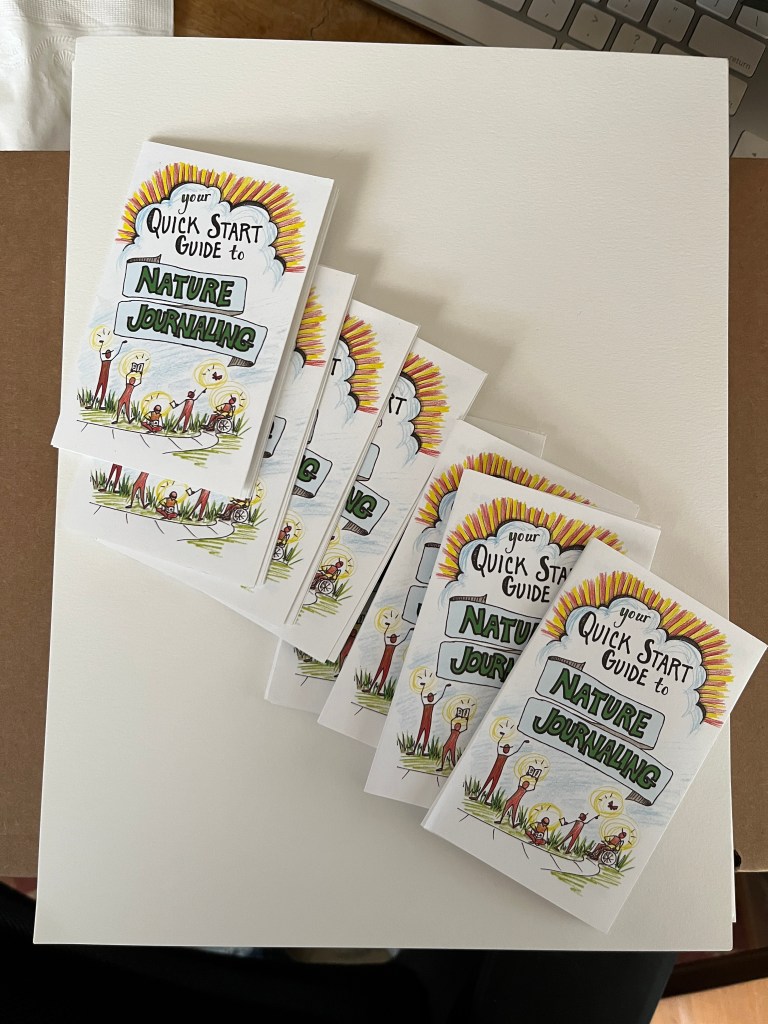
  • zines about nature journaling (available from the Wild Wonder Foundation)
  • some reference books about insects
  • colored pencils, number 2 pencils, and some watercolors
I spent some time this week making a “focus flyer” — a one-page intro with tips about how to approach nature journaling insects. (I made it with Procreate on the iPad — simple black and white so it could be photocopied.)

Everything got used, for sure, but I ended up spending most of the time chatting with small children and their parents about bugs (yes, for the record, I know that all bugs are insects, but not all insects are bugs — it’s the sucking mouth parts in bugs that make the difference — and that arachnids are their own thing, and so are the myriapods).

And hey, there is nothing better in the world than when a second grader sidles up to the table and says (something to the effect of), “let me tell you something I know.” To which I love to reply, “I’m all ears, friend.” If we’re dealing with insects or dinosaurs, it will probably be new-to-me information. In this particular case, after my education, we got to puzzle out whether a praying mantis’s forelimbs are legs, or something else (they’re counted in the leg count, even though they can be functionally different).

So yeah, it ended up being a lot of fun, even though it wasn’t nature journaling. There was no writing, very little counting, and no drawing (I think I got so far as to lay in the very first initial pencil-in of a long-horned beetle). I had planned on working with 5 – 8 (maybe?) people, ages 12 – adult, for 30 – 45 minutes. At one point, in the 90 minutes I was active, I think there were 25 people in the room (both kids and parents), and it got very loud.

I still think that nature journaling can be a great activity for kids, but unless they’re ready for it and intrigued by it, it’s going to feel more like a chore for most of them… and most kids already have plenty of obligations. The OLC’s open house wasn’t a great fit for a strictly defined nature journaling activity.

But it was still a good learning experience, and, as I am not a big bug person, a brain-stretching exercise. In the future, if the OLC is interested in a quasi-educational, quasi-artsy experience available at open houses, I think we should go a different way… perhaps a “coloring corner,” with nature-journaling-style worksheets. (I’ve been sitting with this idea overnight, and the longer I sit with it, the more I like it. Also, how fun would it be to design those worksheets?!)
Outdoor Learning Center · Studenting

Jack of All Trades

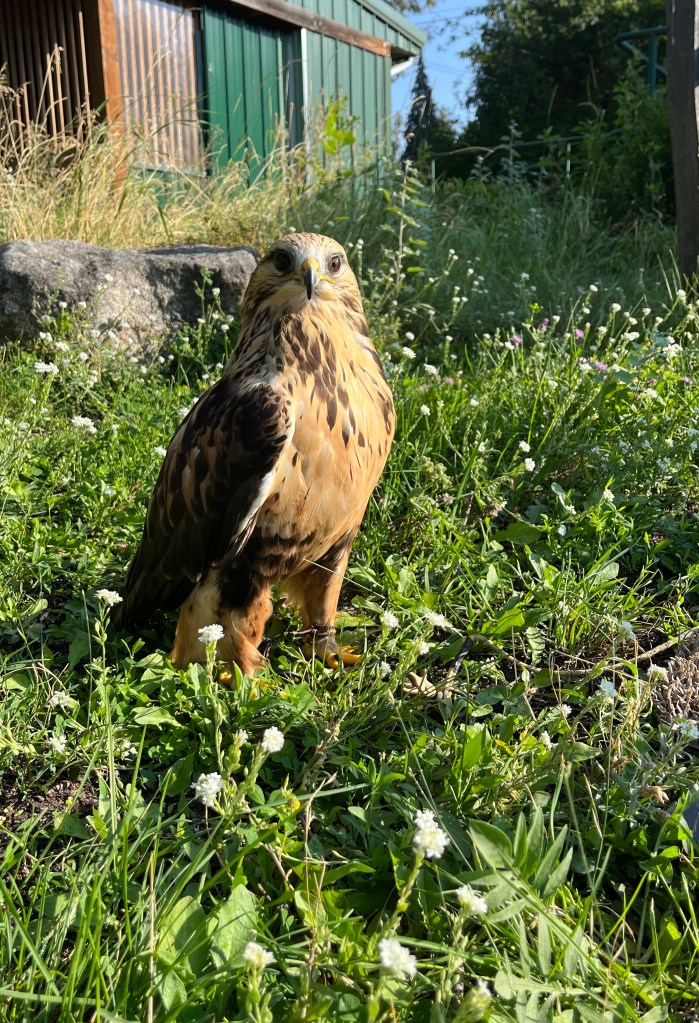
First, have a bird:

Pantalones (aka Pants), a mostly caramel-colored rough-legged hawk, standing amongst the wildflowers (aka weeds). She is a beautiful bird.
Pantalones, aka Pants, a rough-legged hawk at the
West Valley Outdoor Learning Center, enjoying some outside time.
Summer 2024

Pants has a partial wing amputation with significant tissue damage on her right wing, which, on top of the amputation, is missing both primary and secondary flight feathers. She is quite elderly, at 24+ years, and has arthritis. She has personality to spare, and in addition to being really pretty, she is quite sassy.

She had a near miss with Nelson, the OLC’s 80lb tortoise, the other day, and afterwards she seemed remarkably unbothered. She’s a champ.

Okay, down to business. I’m doing a skills inventory right now, and here are some of the skills I have listed: project management, database management, GIS, natural science illustration, graphic design, basic carpentry (power tools: *chef’s kiss*), raptor daily care and maintenance, research and writing, working at a coffee bar, community outreach.

Point is, you would not be wrong if “Jack of all trades, master of none” came to mind.

It is some comfort that one version of the “jack of all trades” quote goes something like this:

“Jack of all trades, master of none,
is oftentimes better than a master of one.”

(A Wikipedia article on the topic says that the couplet isn’t actually the original version, as many online like to claim, but I like it because it feels a bit less… awful? I’m not going to be able to solve the crises of the world, but I can make you a coffee?)

Believe it or not, even though my skills inventory looks like it’s all over the place, there are some through-lines:

  • I’ve worked on a few different newsletters, working on both writing and production — digital and print.
  • I enjoy engaging with technology: for database work, graphic design, and front-end web coding.
  • I’ve never been a teacher, but I have done a fair amount of training, teaching, and community outreach.
  • I gravitate toward environmental education and conservation.

It’s turning out to be an illuminating exercise. It will be interesting to see where it goes.

Outdoor Learning Center · Raptors

Sweet Boy: Oroville (2011 – 2024)

This is an appreciation for a barred owl who hated us with almost comical intensity. There is sadness in it, but also gratitude.

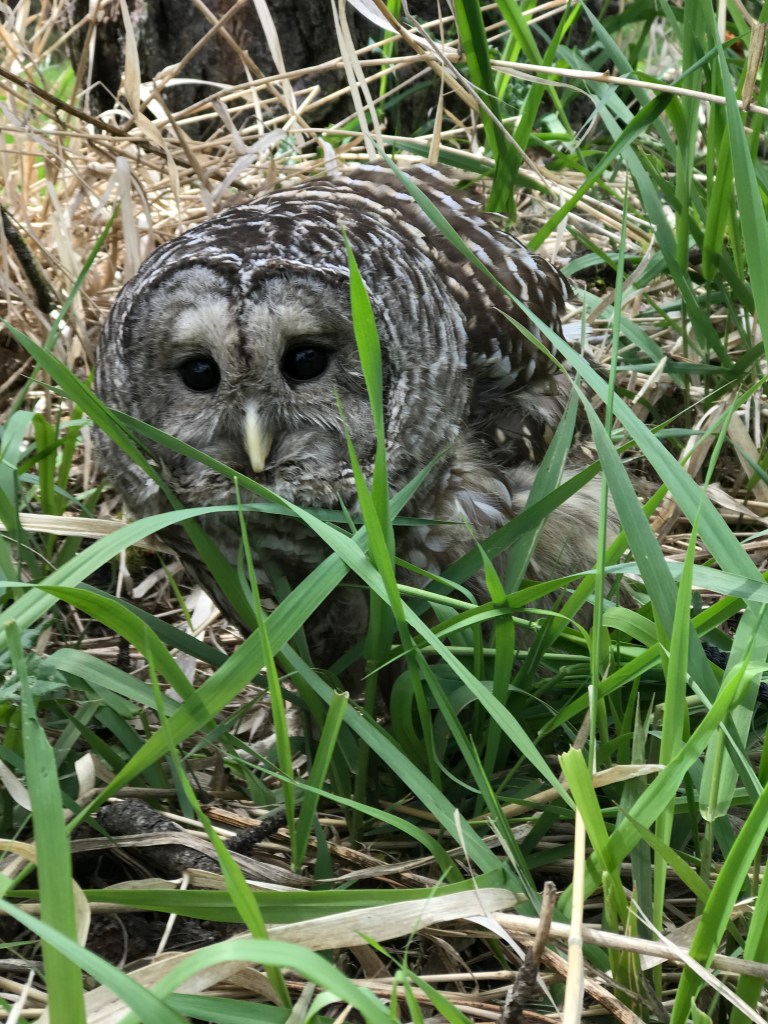
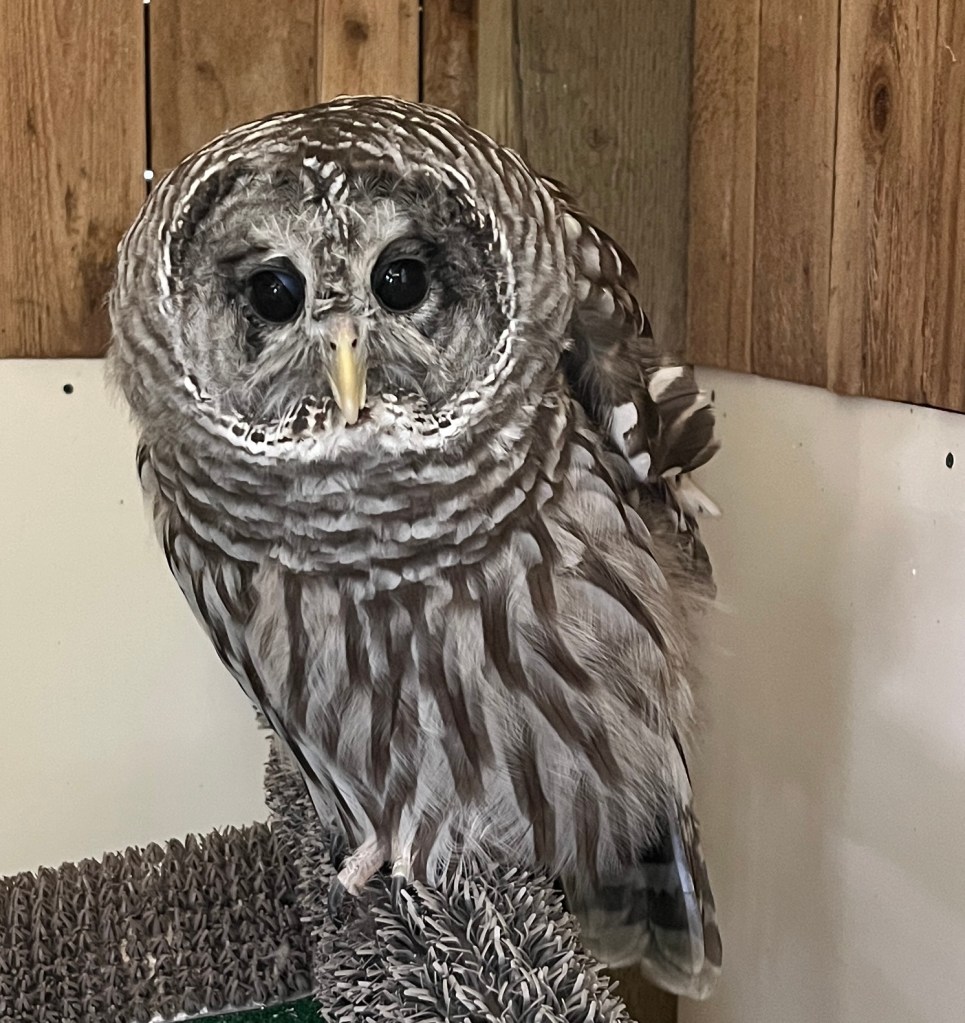
This was Oroville:

Murder muppet and professional crankypants Oroville.
(He was going through kind of a rough molt when this photo was taken.)

Oroville suffered a severe patagial injury to his left wing when he got caught up in some barbed wire as a fledgling. It rendered the wing useless for anything but balance.

He came to the West Valley Outdoor Learning Center in, I think, 2011. (I started in early 2012, and he was in a starter mew then.) He could not fly, but by every other metric, he was a classic barred owl, which is to say, he was deceptively aggressive. Got too close to him? He’d jump at your head. Stand up too quickly near him while cleaning? Jump at your head. Try to retrieve cached mice in his mew? Lunge at your hand. Collect him on the glove? Gnaw aggressively at your hand. Trimming his beak? Snap at your fingers. (The only black eye I’ve ever had came from one of Oroville’s launches.)

These were not character flaws, or lapses in training. Oroville was a wild barred owl who was being asked to live in circumstances that were completely foreign — and unnatural — to him. It wasn’t bad, but it wasn’t normal for a barred owl. He was free-lofted (as in, not tethered) in a large mew with two windows and perches at different levels. He had daily access to fresh water and food, and was weathered regularly. He was protected from the elements, but we left one of his windows partially open all winter so he could feel the wind and snow on his face. He was heat intolerant; he didn’t do events during the summer, and spent most of his time sitting under a fan.

It’s important to note for people who don’t have a lot of experience with education raptors: the alternative to this life was not freedom. It was death — because he could not fly, he would not survive in the wild. He was not a pet; keeping him required both state and federal permits. The compromises we asked him to make were extensive, but he helped to educate thousands of people about how owls fit into our ecologies, and the challenges owls face in the wild, over the course of his life.

This week Oroville developed some weakness in his right leg. And then he stopped eating. (Both of these are big red flags in raptors, but combined, they can signal a very bad situation.) Yesterday I drove him to WSU to the veterinary hospital to see our (amazing) avian vet, Dr. Marcie Logsdon, for X-rays and bloodwork.

As it turns out, his heart was enlarged, and so was his spleen. It looked like the situation had been developing for a while, but owls are both 1) stoic, and 2) good at hiding signs of illness. Until this week, Oroville’s behavior had been his feisty normal, and he had been eating/maintaining his weight, so we had no idea about this underlying condition. By the time we got to WSU, he was very ill, and had the OLC chosen to pursue treatment, his final days would have been spent receiving treatment that was best case, intrusive (worst case, invasive), but not curative. After consulting with the OLC’s director, the decision was made to euthanize him.

In addition to being an avian vet, Dr. Logsdon is a falconer, and she works with the WSU raptor center’s education birds. Working with education raptors requires walking a narrow path, ethically, and she has some good experience with it, which is really helpful to us. (Some vets know how to treat birds, but don’t have a lot of experience actually working with them.) I loved that she consistently referred to Oroville as our “friend” (even though considering the concept of friendship with Oroville would make anyone who knew him giggle).

Another thing I appreciate about Dr. Logsdon is that she is not a vet who goes to euthanasia as an early option, but if it’s important to consider, she’ll put it on the table. She did not pressure us. She told us what our options for treatment were and that she would support our decision to continue treatment, but she did not shy away from the fact that Oroville’s prognosis was very poor, and his quality of life would not improve with time or treatment.

Sometimes the worst decision is not the hardest one to make.

It’s easy to say, but it does not diminish the sadness of packing an empty crate into the car. I am sad, and I will miss him.

Oroville at an event at Turnbull National Wildlife Refuge.
Outdoor Learning Center · Raptors · Volunteering

Responding vs. Reacting

Or, learning how to manage when things don’t go according to plan…

This is Basalt.

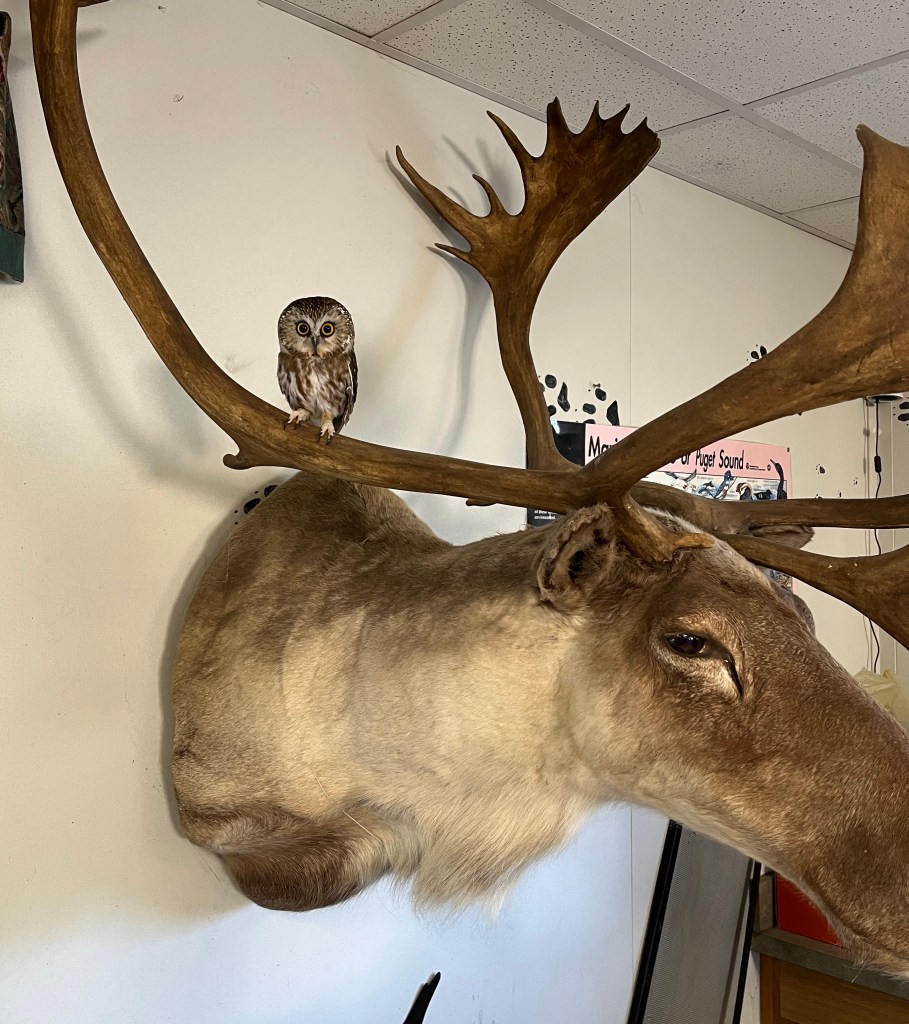
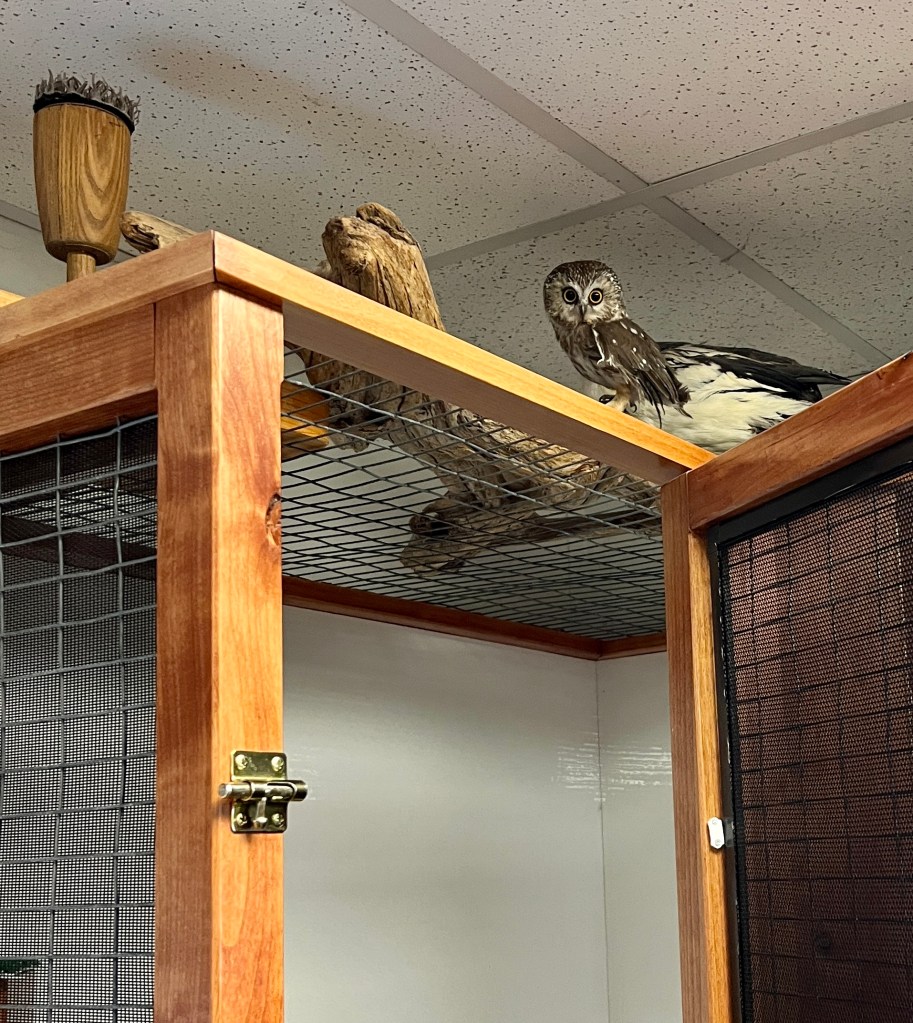
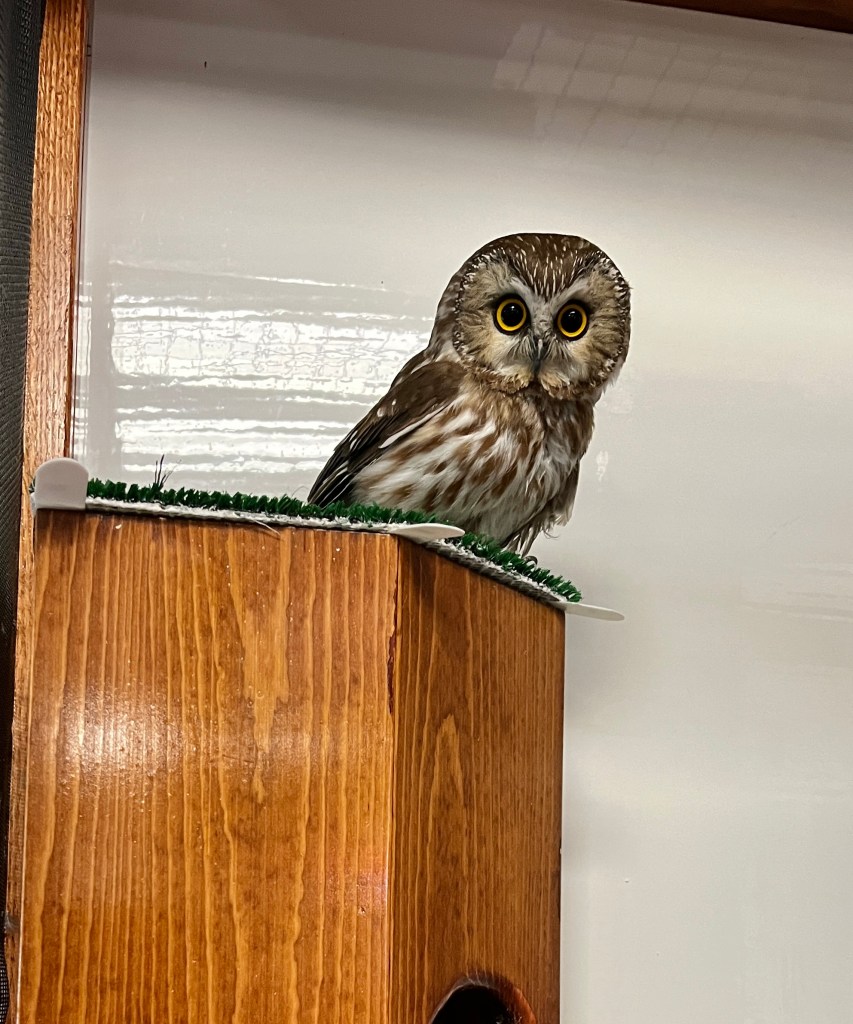
Photo of unreleasable saw-whet owl named Basalt. Saw-whets tiny, about the size of a small human fist, with large yellow eyes. Very, very cute.
Basalt, an unreleasable saw-whet owl, in his enclosure. (Those tabs are 3M Command strips — they tack down his mat without damaging the finish of the house.)

Basalt suffered a shoulder injury last winter, from a window strike. He is incapable of sustained flight, and when he came to us, we were told that he wasn’t able to get any lift…

… which, apparently, is not exactly right.

While I was in his enclosure wiping down the floor (after removing his soiled mats), he quite literally flew the coop.

I was the only one at the Outdoor Learning Center at the time — it was an early, quiet morning. The doors to the room and bathroom were closed, so he couldn’t go anywhere outside of the room we were in. He didn’t end up in any of the turtle tanks (which would have required immediate action), so I finished washing his mats and cleaning his enclosure before I started to figure out what I needed to do.

Because it was not an urgent situation, and he didn’t appear to be in any danger, I decided to follow him for a few minutes. In part to assess the situation, but also, it was an opportunity for me to see how he moves (way better and more efficiently than I thought!).

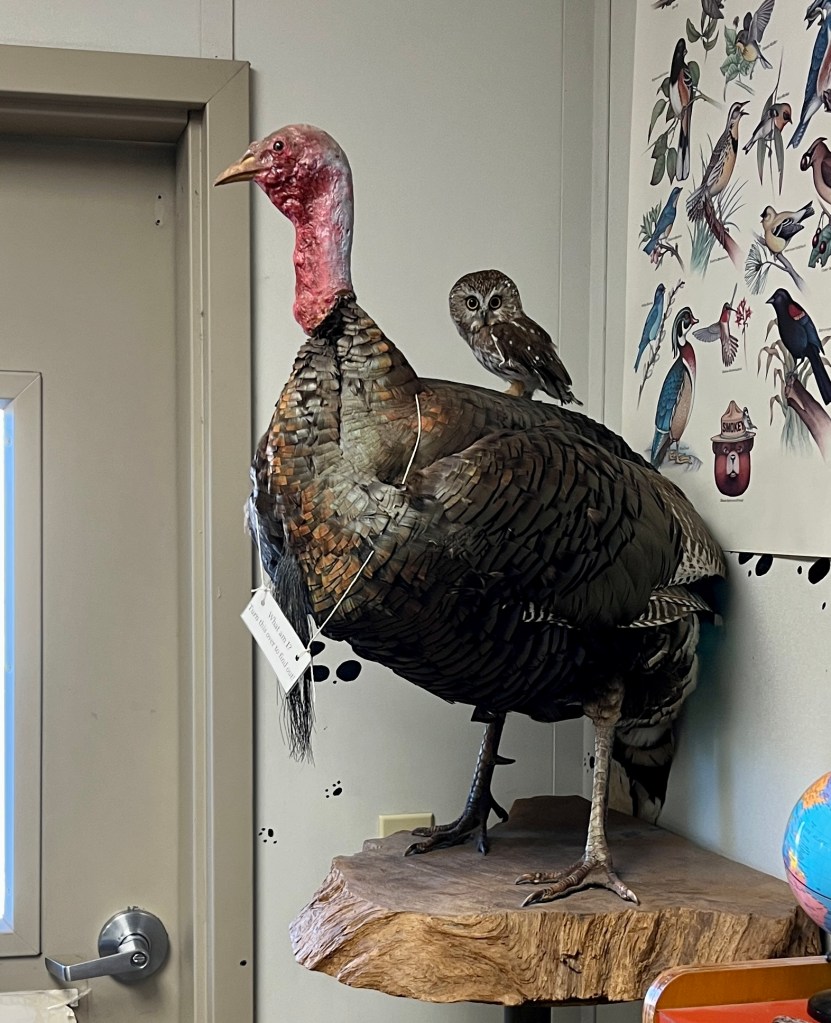
Going up is a known behavior in wild birds, but I was surprised to see him moving around the room to tall perches because I thought he couldn’t. My guess? He had to molt some damaged wing feathers while in care with the vet, and that’s why he couldn’t generate lift. Now that he has those wing feathers, he can really get somewhere. (This wasn’t sustained flight, more like big arc-ing wing-assisted hops.)

I did not chase him. He moved and settled, and then I followed. I did not try to towel him while he was moving, or when he was out of reach. Had he ended up in a turtle tank or a tortoise enclosure, I would have been there immediately to help him before he had to interact with another animal.

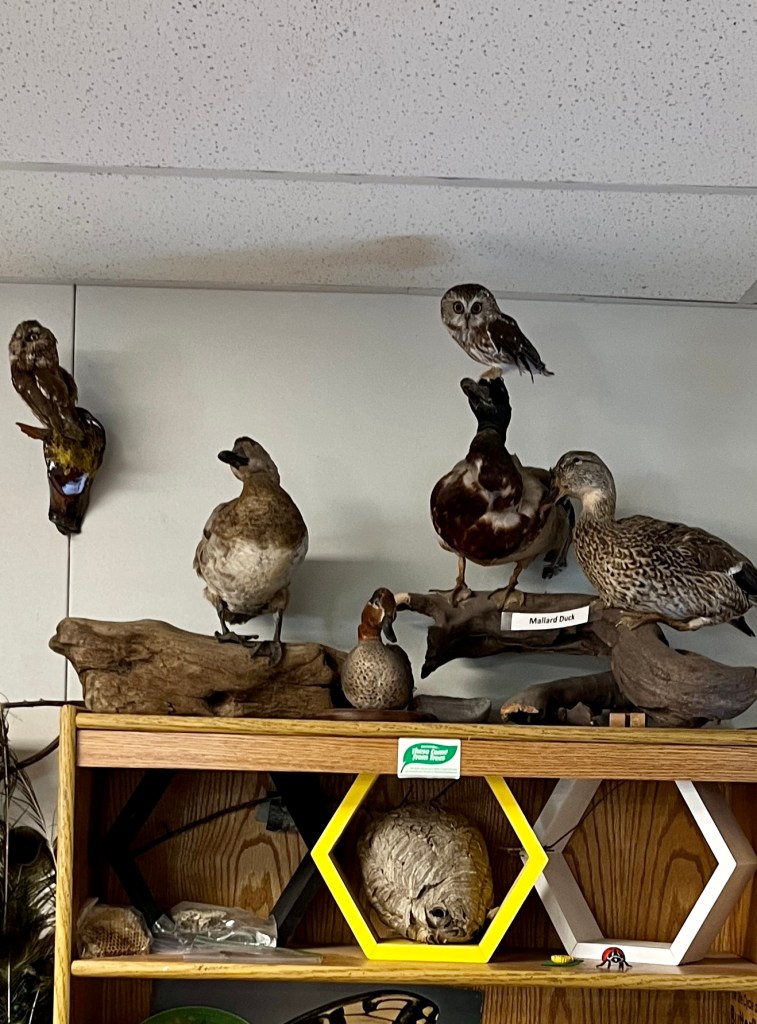
(He yarked up a pellet while sitting on the Mallard’s head, so while I’m sure this wasn’t a relaxing situation for him, he wasn’t so stressed out that he couldn’t take care of his own needs.)

Eventually, after a round robin of the taxidermied mounts and window valances, he got tired and ended up on the floor. At that point, I was able to gently gather him in a towel and move him back to his enclosure.

So yeah, things were a little bit exciting today, in an unexpected way. I don’t want to encourage this behavior — I will have to alter my approach to make sure this doesn’t happen again. But I’m impressed by his ability, and I think it’s time to see about adding a couple of other, higher, perches in his enclosure…

Outdoor Learning Center · Raptors

Basalt… ‘Bee’ for short

One of the most joyous things for a raptor volunteer at the Outdoor Learning Center is to get to meet a new bird. It’s somewhat bittersweet, because we all understand that this is not the natural order of things, and it would be better for everyone if the bird were able to be released.

But by the time the birds get to us, the option to be released has been taken off the table by people who are in a position to know what’s possible: the bird’s rehabilitator and the bird’s veterinarian. When release is no longer an option, places like the Outdoor Learning Center become an option (if space is available).

Saw-whet owl Basalt (recovered from Basalt Rd. in Spokane, WA) injured one of his shoulders in a window strike. His flight is compromised (he cannot gain altitude), and there is some speculation that he may have some mild neurological damage (though it does not manifest in his appearance or movement). He has been in care with his vet for the last several months while we waited for our federal permits and transfers to go through. We welcomed him to the OLC two weeks ago.

We’re in the process of getting used to each other. This morning, for the first time since he arrived, I was able to get into the enclosure to clean his house and add a piece of outdoor carpet to the top of it (he spends a lot of time perching there, so it needs to be cleaned often). He watched me quietly from another platform — no panic, just a desire to not be where I was.

And when I was done working on his house, he headed right back up there.

Basalt, no doubt wishing I would put the phone away and leave.

Lack of panic at my presence, and a quick return to a perch that has been altered — those are good signs with new birds. He recognizes that the enclosure is his space, and even though he was wary of my presence, he seemed to be reasonably sure that I was only there to clean. When I removed myself, he immediately went back to the place where’s he’s comfortable, even though something about it had changed.

Saw-whet Owls are tiny — Basalt weighed 74g when he was transferred to us. For the sake of comparison, Arden (female red-tail) weighed 1,310g this morning.

We haven’t had a long-term resident “pocket owl” since Tilt (screech owl) died a few years ago, so we’re excited to get to know, and work with, Basalt.

Lucy the Pup · Outdoor Learning Center

I’m whipped.

This was my “office” on Friday:

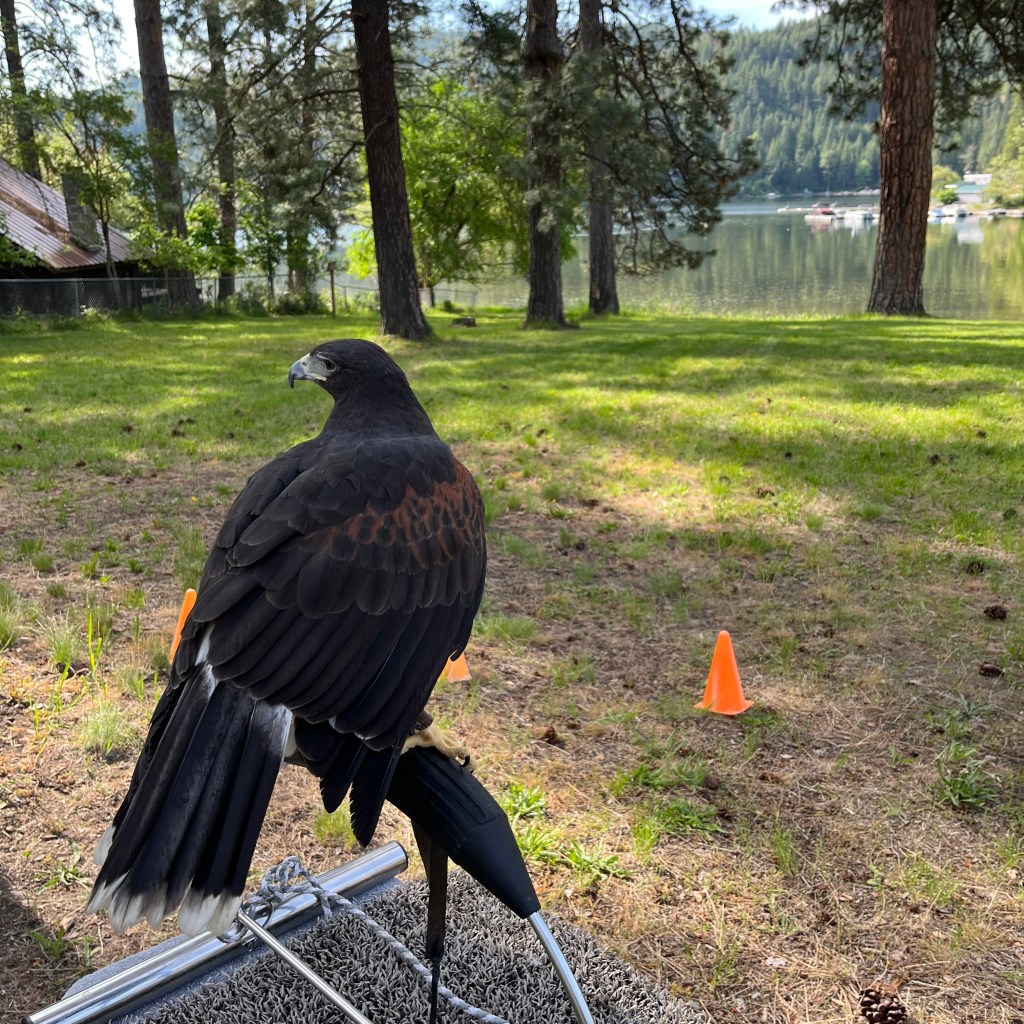
Stan (the Harris’s Hawk) waiting for the kids to show up.

Stan and I went to Deer Lake with six other OLC folks (teachers and interns) to spend the day with the Deer Park School District’s fifth graders. They spent the day rotating through seven stations of science-based activities.

I’m just a volunteer, and I have to say, I do not know how “real” teachers do this every day. Give these folks a raise. For real. Between the teaching and the driving (~100 miles, round trip from my house), it was an exhausting day.

Fifth graders are, on the whole, amazing people. They’re smart, curious, and observant, and they ask great questions. (I suspect fifth grade is just before most of the massive social pressure kicks in.) I have a prepared presentation, but if I’m with a group on a field trip (in other words, no curriculum requirements have to be met), and they want to talk about something else related to the bird I’m using, I’m all in for that. Those are some great conversations. Yeah, ok, sure, the kids can be all over the place, but geez, if they’re out at a lake on a beautiful Friday around the end of the school year? Entirely understandable.

Stan was, as always, completely charming. Harris’s Hawks are more social than other birds of prey, and Stan (a retired falconer’s bird with a significant (healed) wing injury) seems to like being the center of attention… so long as everybody keeps their distance. He spent the day preening, and rousing, and jumping onto the ground to foot something, sometimes stopping to watch the kids watch him.

Being outdoors means there are lots of distractions, but there’s also some really great stuff going on! In the morning, there were crows looking (and sounding) like they were getting set to mob Stan (and me), so it was a relief when the kids got there. There was a bumblebee wandering around the space we were in — I suspect we were near the bee’s nest, so the kids and I got to talk about bumblebee life cycles, and how to respect a bumble when they look like they’re wandering around near the ground. A pair of local bald eagles made an appearance around lunchtime. I got there a little bit early, and saw a great blue heron hunting at the lake’s edge (and later some red-winged blackbirds mobbing the heron as they flew across the lake).

It was a great — and exhausting day. And then yesterday, Lucy (the menace like Dennis) “graduated” from puppy kindergarten, part 2. We’re laying a foundation for recall, and waiting/staying (yesterday I learned that those are two very different ideas), and learning how to greet people without knocking them over (work in progress, but improving!). She loves training — the interaction, and the treats — and I’m starting to be able to use a short session of whatever we’re working on to redirect her when her short-circuiting puppy brain gets all wound up.

Lu was so wary when she came to us almost four months ago, I was concerned that she was going to be afraid of other people or dogs. So far it does not look like that’s the case, although she needs a minute to warm up to new people or situations. I’m not sure she’ll be a dog who will tolerate random strangers walking up to her for pets — she has to observe and assess the situation in a way and place she feels safe in — so we’ll have to advocate for her in those instances.* Once she’s determined that everything is OK, she’s all in. (She starts wiggling and whining if she just hears Allie, one of our puppy-K teachers.)

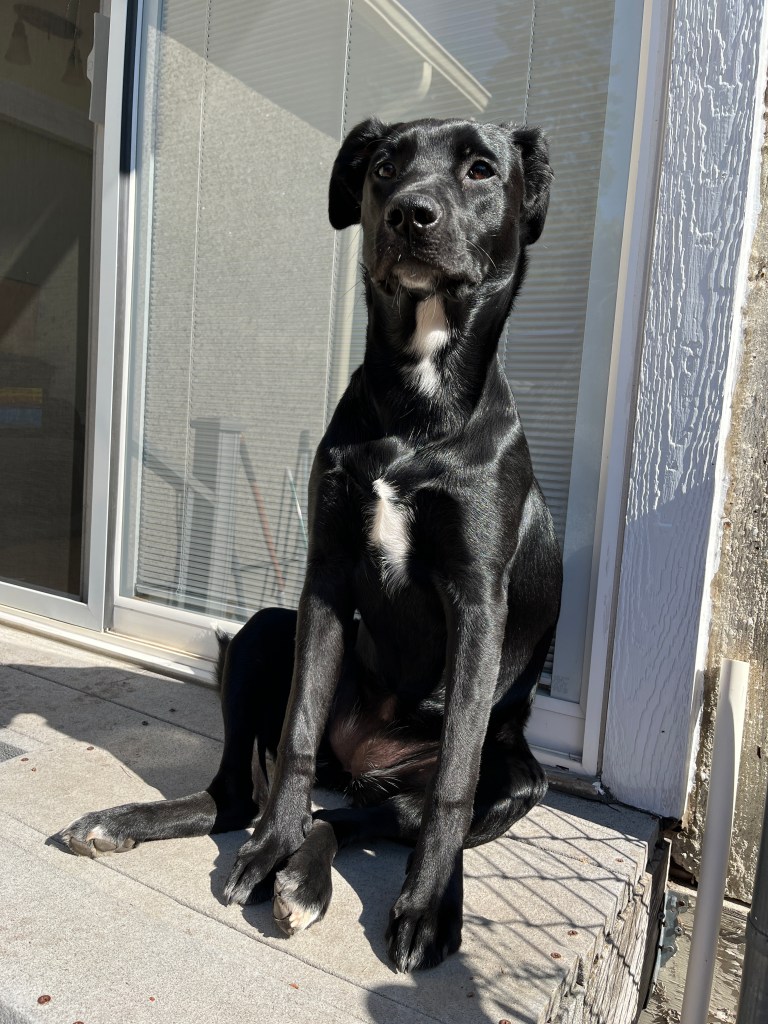
Lucy this morning, just before she came inside, counter-surfed my journal, and chewed up the back cover… sigh. (I’m bummed, but it was my fault. I had to go to the bathroom and I left my journal within reach on the dining room table.)

The thing about puppy school is that it’s work for everybody. Lucy is almost seven months old. Her attention span is short. Trying to pay attention to the wonderful, can’t recommend them enough trainers and keep track of Lucy for an hour and a half is… something. So a session of puppy school, after a long teaching day… I’m going to need a minute.

(One of the things I’m excited to work on is teaching Lucy how to give hugs, so she can have the experience of an intimate greeting in a gentle and orderly way. That’s going to take some work, but it will be worth it.)

* On IG, MyBoyRudder’s person Maddie said something I’ve been thinking about a lot: everyone would be better off if we assume that no one wants anything to do with our dogs. We’re working with Lucy so that she will be attentive to us when we’re out in the world — we want her to notice, and be aware of, other people and other dogs, but to turn her attention back to us. Our goal is to work with her so we can act calmly in tandem, even when other people or dogs can’t. If someone wants Lucy’s attention, they can proactively ask for it and we can mediate the interaction in a way that’s safe for them and for her. We have a long way to go to get there (we’re starting by asking her to sit and look at us when she hears the phrase “can I pet your dog?”)… we will work on it.

Outdoor Learning Center · Volunteering

Coffee with Raptors

In February of 2020, the West Valley Outdoor Learning Center raised a bunch of money to replace the windows in our raptor sanctuary.

You know what happened next.

Spring and summer of 2020 were… affected… by the pandemic.

In 2021, the school district replaced the parking lot of the school next door (and the OLC), and it was really, really hot that summer, so working in the heat would not have been easy.

Not sure what the hold up was in 2022, but whatever happened, we couldn’t schedule the window replacement.

Doing this kind of work over winter isn’t feasible. It’s cold, there’s not a lot of daylight, and everything freezes.

So here we are in spring of 2023. The windows are being put in as I write this. I got here to move the birds at 6:45a. The workers from the district got here at about 7:45a, and, as I write this at 10:40a, they’re going strong… yay!

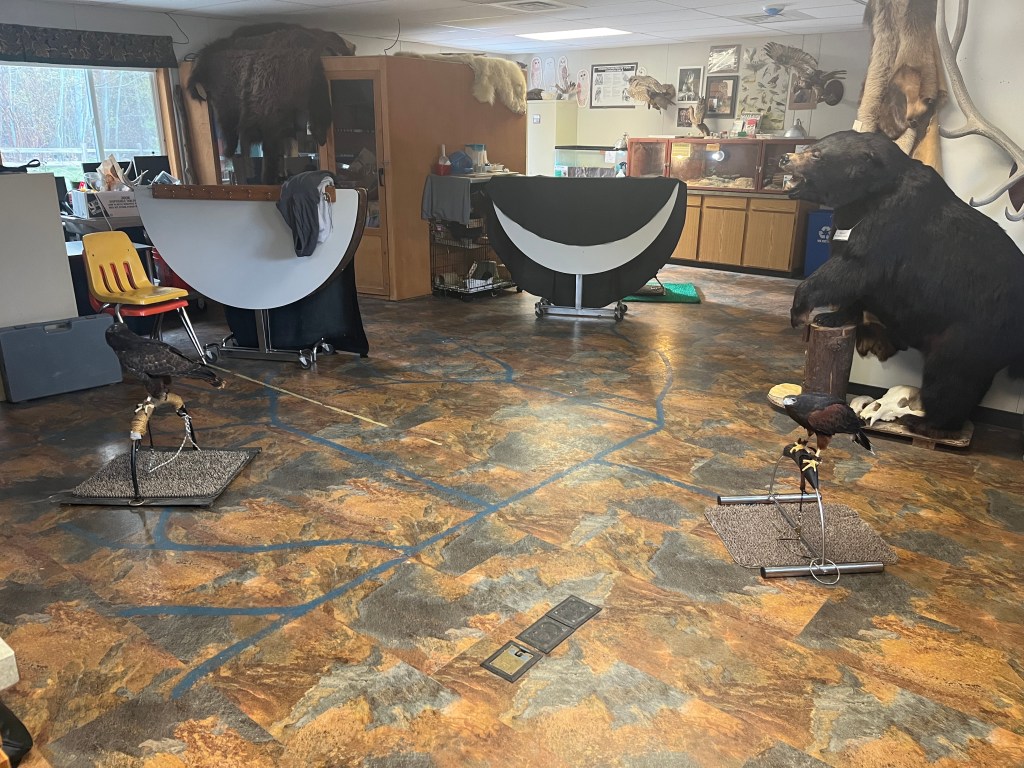
When that kind of construction happens on the building, we move all of the birds out and away from the structure. (Marcus, the Great Horned Owl, lives in an outdoor mew and is staying put.) When it’s warm enough, the birds hang out in the small meadow outside of the director’s office. Right now, because I’m here and I have work to do, they’re in one of the classrooms with me.

The set up this morning. Stan (right), and Arden in front, Oroville and Pants behind screens (the tables), and Ruby in her crate in the bathroom (where it’s dark and quiet).

There are no kids here today, and the teachers are leading a field trip, so it’s just me and three hawks and two owls.

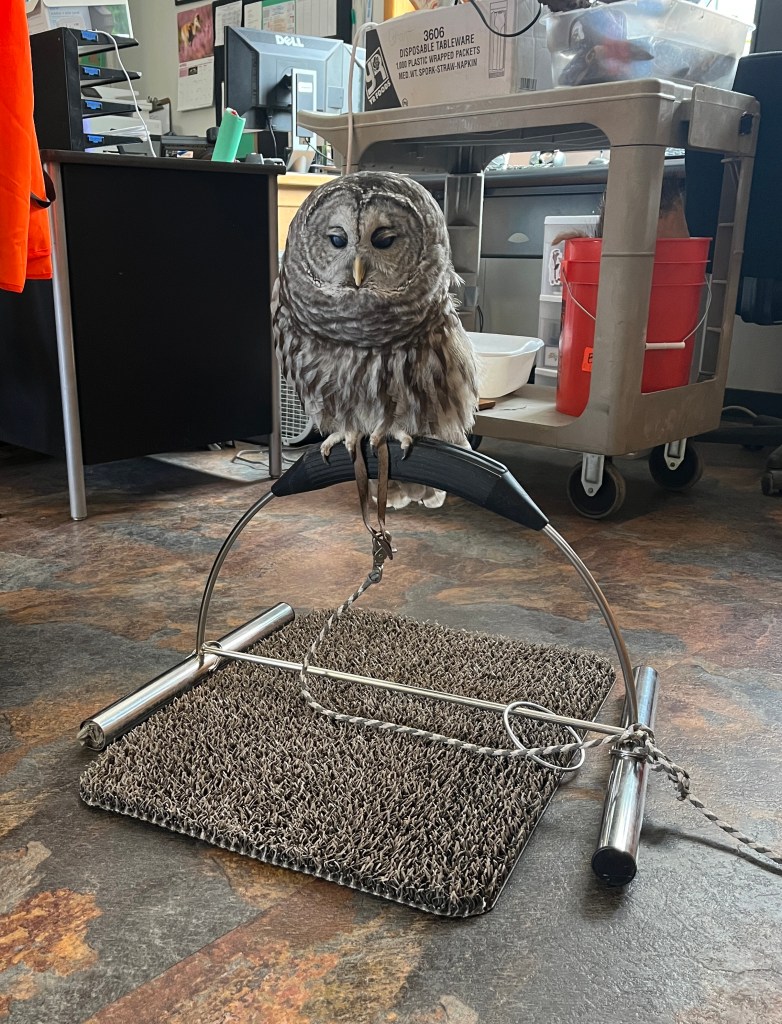
Oroville, in his little “room.” He feels most secure when nobody can sneak up on him.
Arden, who is afraid of nothing, but annoyed by everything, looking non-plussed about being in the classroom and having to stare at Stan all day.
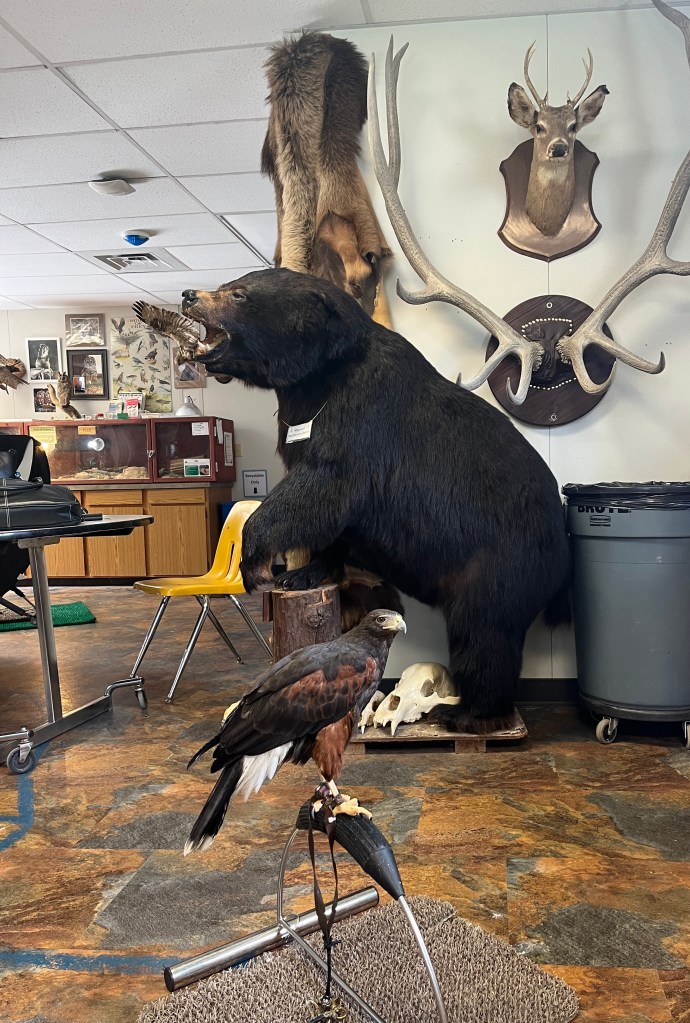
Stan, who would like to be the center of attention all the time, thank you very much, not bothered at all hanging out in the shadow of a black bear.

There are two classrooms, but the OLC’s 75-lb tortoise is roaming in the other one. It’s not fair to him to make him stay in his small enclosure (where he would kick up a fuss and make a lot of noise anyway), or to the birds (who can’t get away from him if he’s wandering, because they’re tethered), to try to make them occupy the same space for the day. (It’s warm enough that we could let the tortoise outside, but he likes to wander where the district folks are working with their power tools, so…)

The new windows (and framed bars that allow us to open them up to clean the windows) are amazing, and I’m glad this is finally happening.

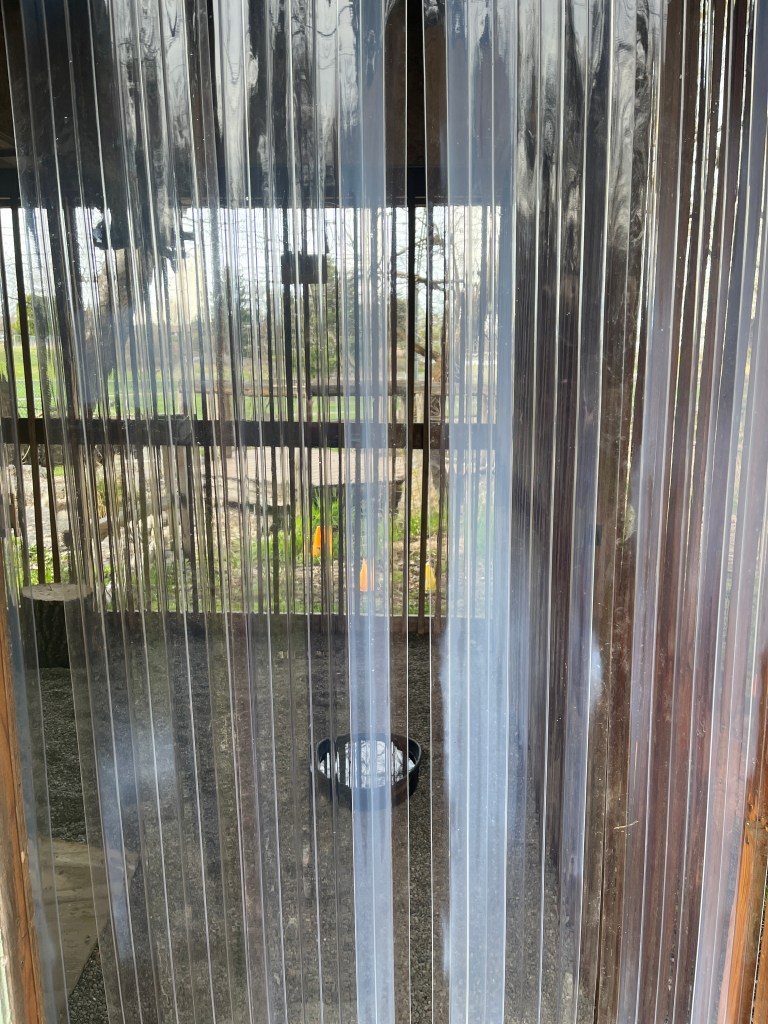
Also today: hanging plastic strips inside Marcus’s mew so that he can’t get a wild hare and fly out when we open the door!

That should slow him down a little bit!

He hasn’t shown any interest in sharing space with any of us for any length of time, and that’s what would be required for him to get out of the mew. But now we have an actual physical barrier, and I think that makes all of us feel a little more comfortable with the situation.

Right after we finished putting it up, he settled back on his perch across from the door, so he apparently isn’t too bothered by the new accessory. Let’s just hope he doesn’t chew on the strips…

Outdoor Learning Center

Craft Project

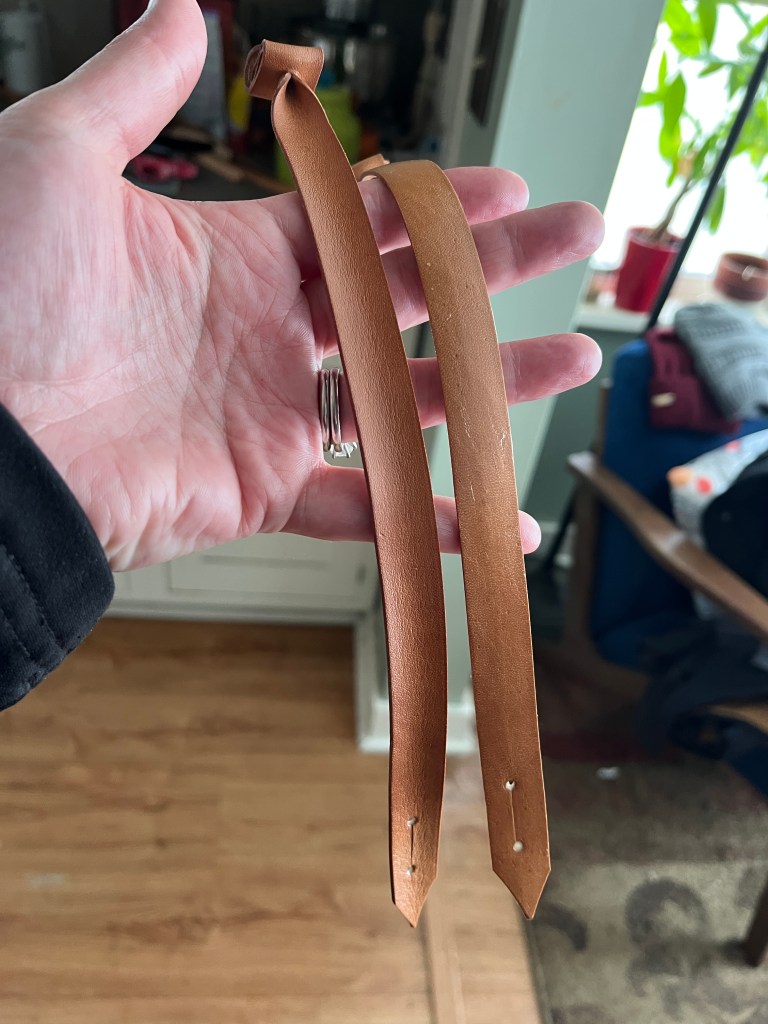
And sometimes, I spend part of the afternoon making jesses…

Stan broke one of his jesses this morning (they’re leather, so they eventually get brittle, and he’s been wearing his current pair for more than a year), so I made these this afternoon and will install them tomorrow.

We use kangaroo leather. These might be a little bit too heavy duty, but it’s the leather I had, so…