Outdoor Learning Center · Raptors

Sweet Boy: Oroville (2011 – 2024)

This is an appreciation for a barred owl who hated us with almost comical intensity. There is sadness in it, but also gratitude.

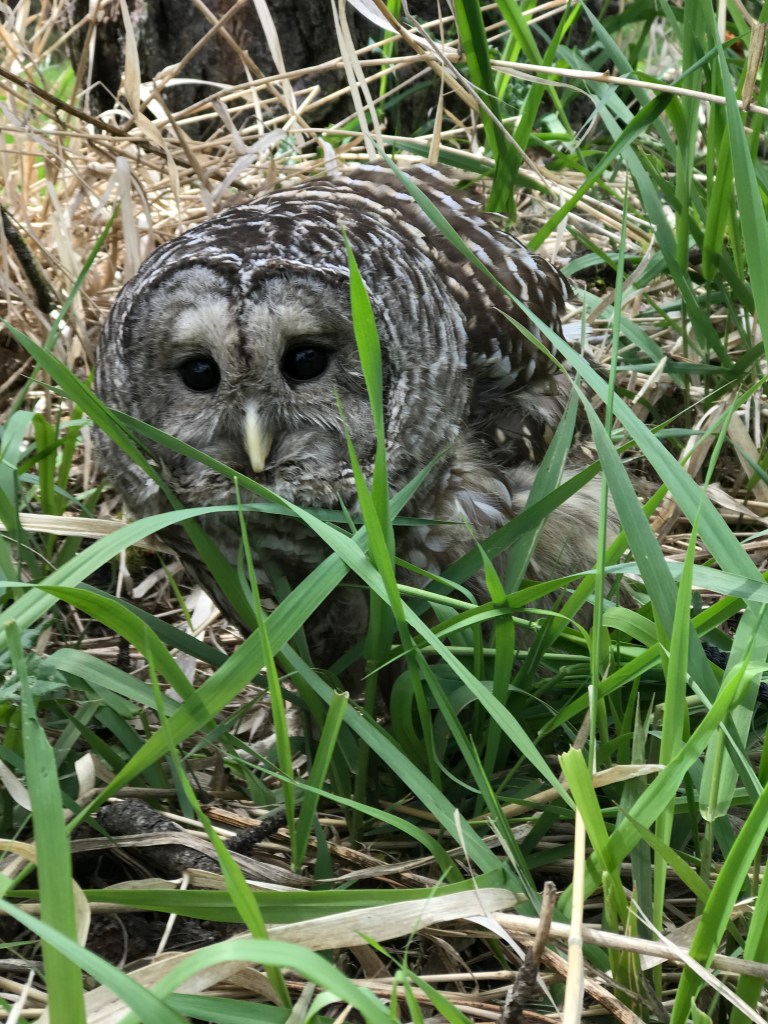
This was Oroville:
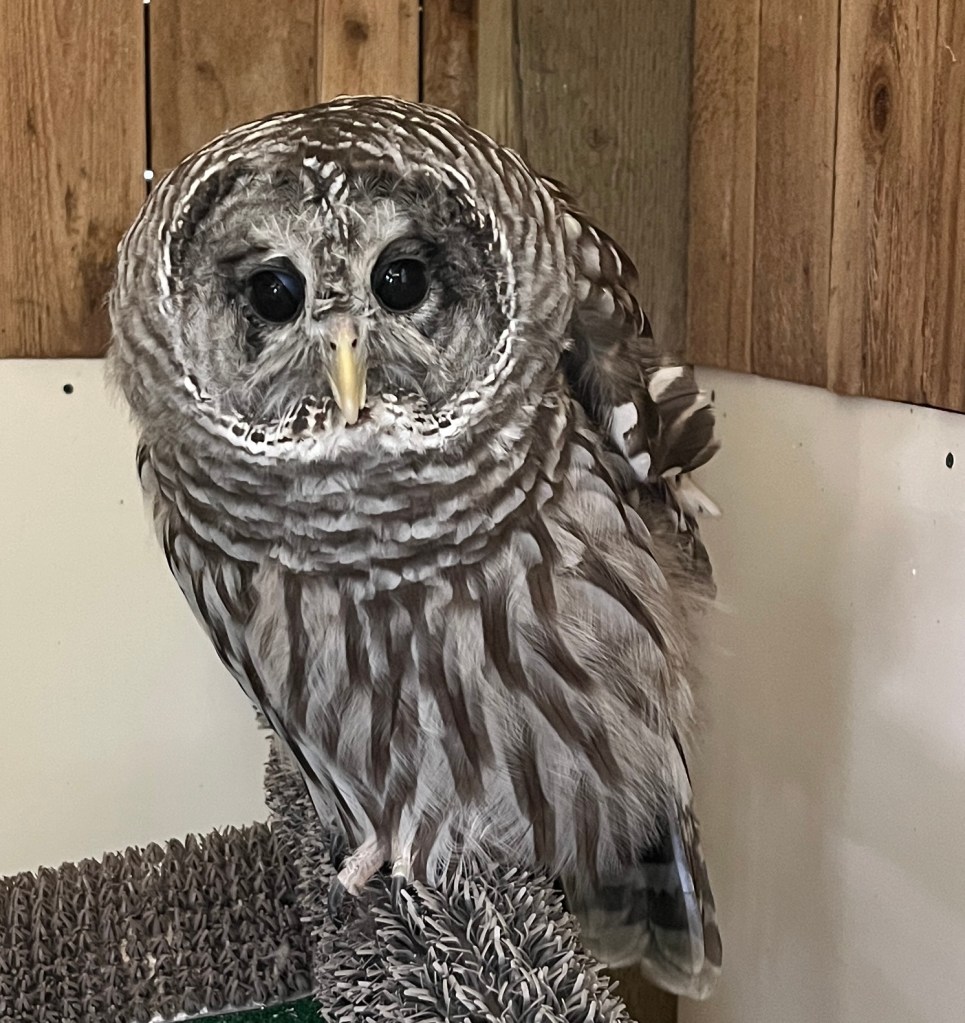
Murder muppet and professional crankypants Oroville.
(He was going through kind of a rough molt when this photo was taken.)

Oroville suffered a severe patagial injury to his left wing when he got caught up in some barbed wire as a fledgling. It rendered the wing useless for anything but balance.

He came to the West Valley Outdoor Learning Center in, I think, 2011. (I started in early 2012, and he was in a starter mew then.) He could not fly, but by every other metric, he was a classic barred owl, which is to say, he was deceptively aggressive. Got too close to him? He’d jump at your head. Stand up too quickly near him while cleaning? Jump at your head. Try to retrieve cached mice in his mew? Lunge at your hand. Collect him on the glove? Gnaw aggressively at your hand. Trimming his beak? Snap at your fingers. (The only black eye I’ve ever had came from one of Oroville’s launches.)

These were not character flaws, or lapses in training. Oroville was a wild barred owl who was being asked to live in circumstances that were completely foreign — and unnatural — to him. It wasn’t bad, but it wasn’t normal for a barred owl. He was free-lofted (as in, not tethered) in a large mew with two windows and perches at different levels. He had daily access to fresh water and food, and was weathered regularly. He was protected from the elements, but we left one of his windows partially open all winter so he could feel the wind and snow on his face. He was heat intolerant; he didn’t do events during the summer, and spent most of his time sitting under a fan.

It’s important to note for people who don’t have a lot of experience with education raptors: the alternative to this life was not freedom. It was death — because he could not fly, he would not survive in the wild. He was not a pet; keeping him required both state and federal permits. The compromises we asked him to make were extensive, but he helped to educate thousands of people about how owls fit into our ecologies, and the challenges owls face in the wild, over the course of his life.

This week Oroville developed some weakness in his right leg. And then he stopped eating. (Both of these are big red flags in raptors, but combined, they can signal a very bad situation.) Yesterday I drove him to WSU to the veterinary hospital to see our (amazing) avian vet, Dr. Marcie Logsdon, for X-rays and bloodwork.

As it turns out, his heart was enlarged, and so was his spleen. It looked like the situation had been developing for a while, but owls are both 1) stoic, and 2) good at hiding signs of illness. Until this week, Oroville’s behavior had been his feisty normal, and he had been eating/maintaining his weight, so we had no idea about this underlying condition. By the time we got to WSU, he was very ill, and had the OLC chosen to pursue treatment, his final days would have been spent receiving treatment that was best case, intrusive (worst case, invasive), but not curative. After consulting with the OLC’s director, the decision was made to euthanize him.

In addition to being an avian vet, Dr. Logsdon is a falconer, and she works with the WSU raptor center’s education birds. Working with education raptors requires walking a narrow path, ethically, and she has some good experience with it, which is really helpful to us. (Some vets know how to treat birds, but don’t have a lot of experience actually working with them.) I loved that she consistently referred to Oroville as our “friend” (even though considering the concept of friendship with Oroville would make anyone who knew him giggle).

Another thing I appreciate about Dr. Logsdon is that she is not a vet who goes to euthanasia as an early option, but if it’s important to consider, she’ll put it on the table. She did not pressure us. She told us what our options for treatment were and that she would support our decision to continue treatment, but she did not shy away from the fact that Oroville’s prognosis was very poor, and his quality of life would not improve with time or treatment.

Sometimes the worst decision is not the hardest one to make.

It’s easy to say, but it does not diminish the sadness of packing an empty crate into the car. I am sad, and I will miss him.
Oroville at an event at Turnbull National Wildlife Refuge.
AI · Raptors · Studenting

Being a “Mature” Student

I am what they call a “mature” student. I’ve been around the block a few times. I’ve done a lot of formal education-related activities. I’ve got a bachelor’s degree, a post-baccalaureate certificate and a graduate certificate… and I was something like six units away from an associate’s degree in the middle of all of that (I had to abandon it for a cross-country move).

And now I’m at the point where, as a graduate student, I still want to learn, but I’m not a fan of the trappings of school. I’m working on a project at the moment that I’m kind of excited about… and while I’m paying close attention to all of the rubrics, readings, and feedback, I don’t really care what my professor thinks about it. That’s not to say that I won’t make changes to it in accordance with feedback. I will, for sure, especially if that feedback helps to move the project in a direction I want to go. But I’m intrigued enough by the subject matter that I don’t feel the need to alter the trajectory of it, if that makes sense.

I guess what I’m saying is that I’m not really looking for my instructor’s approval. I’m interested in their opinions about how I can sharpen my argument, or strengthen my sourcing, but I’m not all that concerned about whether they think it’s an amazing piece of work. I think the subject is very, very cool, and that’s what matters to me in this moment, I think.

Hint: falconry, but not in the context of falconry. Falconry is what it’s about, sort of, but folded into an information science topic. (Image source: https://en.wikipedia.org/wiki/Hunting_with_eagles#/media/File:Kazakh-Mongolian_Eagle_Hunter.JPG)

This is kind of a new way of thinking for me, and likely comes from being exhausted from a lifetime of people-pleasing. The thing is, like most people, I generally perform better doing work I’m excited about, or at least interested in. Again, like most people, I *can* do things that don’t really interest me, but I generally don’t excel at them, and that’s fine.

So yeah, this week it was a 1700-word blog post, with photos, a video, and lots of references. Next week, a 1000-word essay about an information seeking-model that pertains to my topic. As I move forward, I’ll fill out my research with more peer-reviewed, academic work (newsflash: I’m currently working with 10-12 sources from the perspectives of archaeology, anthropology, ecology, and, of course, information science).

I’ve been thinking a lot about AI over the last several months, and I’ve concluded that there’s synthesis that happens when I’m researching and writing that AI can’t really help with. Maybe it’s because I’m a deliberate thinker (not all that quick on the uptake), and I need to puzzle ideas out for myself. Maybe it’s because I’m old(er), and I still like to read papers on paper, so I can make notes and mark them up. Also on the “mature,” front, I still draft longhand, occasionally, though I’ve been moving away from that (now I draft mostly in MS Word, so that I can save versions — once a graphic designer…). I’m sure at some point I’ll have to figure out how to work with AI, but at this point, I haven’t found a way for it to be useful for my process.

One thing I am not enjoying? Formatting references (resources… whatever). I’ve always been kind of bad at it, but now I’ve had to switch from MLA to APA, and it’s a little bit different, so… that’s going to take a minute.

But you know what? If I knew how to do any of this I wouldn’t need to be here. So I’m just going to continue to nerd out on my topic, and figure out the rest of it as I go along.

Outdoor Learning Center · Raptors · Volunteering

Responding vs. Reacting

Or, learning how to manage when things don’t go according to plan…

This is Basalt.

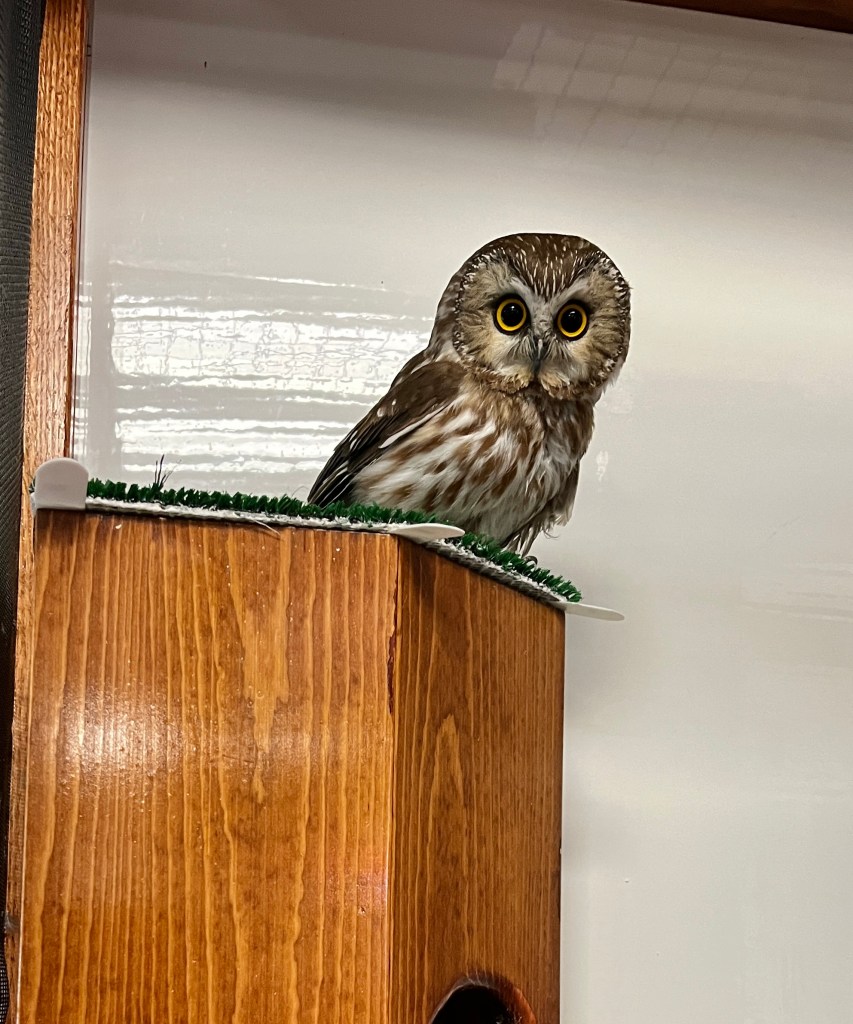
Photo of unreleasable saw-whet owl named Basalt. Saw-whets tiny, about the size of a small human fist, with large yellow eyes. Very, very cute.
Basalt, an unreleasable saw-whet owl, in his enclosure. (Those tabs are 3M Command strips — they tack down his mat without damaging the finish of the house.)

Basalt suffered a shoulder injury last winter, from a window strike. He is incapable of sustained flight, and when he came to us, we were told that he wasn’t able to get any lift…

… which, apparently, is not exactly right.

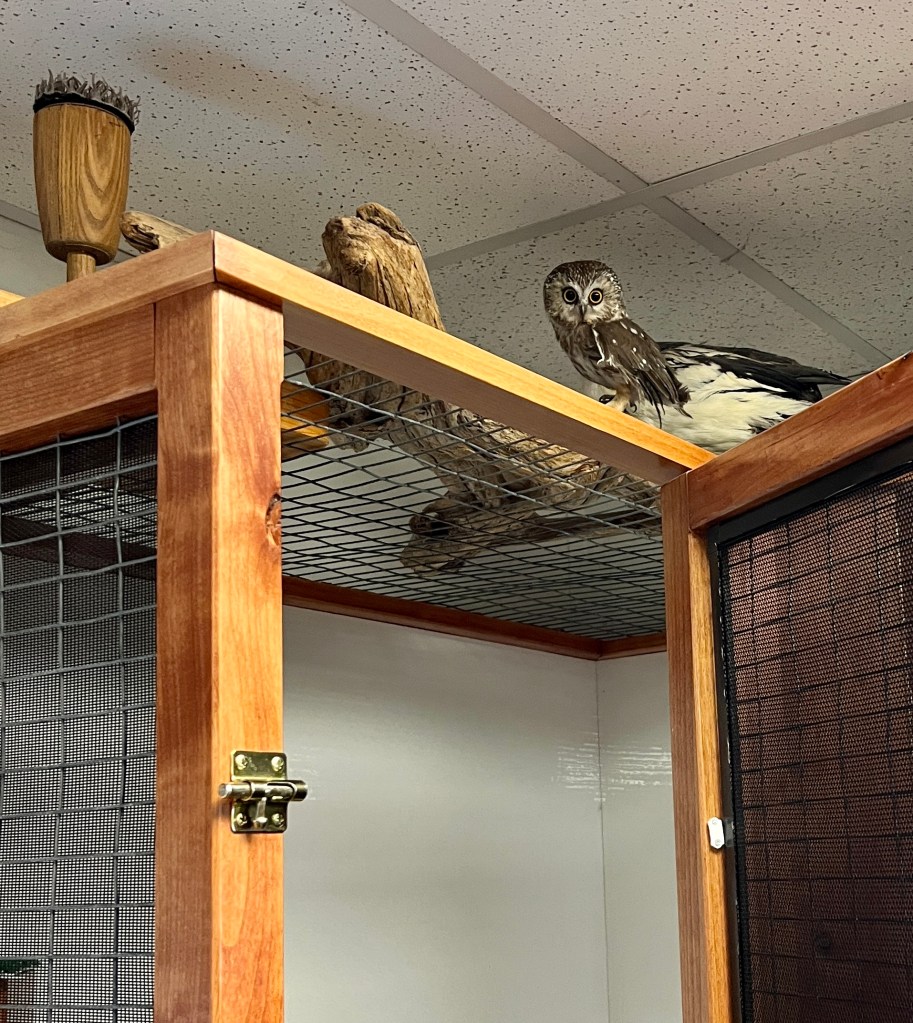
While I was in his enclosure wiping down the floor (after removing his soiled mats), he quite literally flew the coop.

I was the only one at the Outdoor Learning Center at the time — it was an early, quiet morning. The doors to the room and bathroom were closed, so he couldn’t go anywhere outside of the room we were in. He didn’t end up in any of the turtle tanks (which would have required immediate action), so I finished washing his mats and cleaning his enclosure before I started to figure out what I needed to do.

Because it was not an urgent situation, and he didn’t appear to be in any danger, I decided to follow him for a few minutes. In part to assess the situation, but also, it was an opportunity for me to see how he moves (way better and more efficiently than I thought!).

Going up is a known behavior in wild birds, but I was surprised to see him moving around the room to tall perches because I thought he couldn’t. My guess? He had to molt some damaged wing feathers while in care with the vet, and that’s why he couldn’t generate lift. Now that he has those wing feathers, he can really get somewhere. (This wasn’t sustained flight, more like big arc-ing wing-assisted hops.)

I did not chase him. He moved and settled, and then I followed. I did not try to towel him while he was moving, or when he was out of reach. Had he ended up in a turtle tank or a tortoise enclosure, I would have been there immediately to help him before he had to interact with another animal.

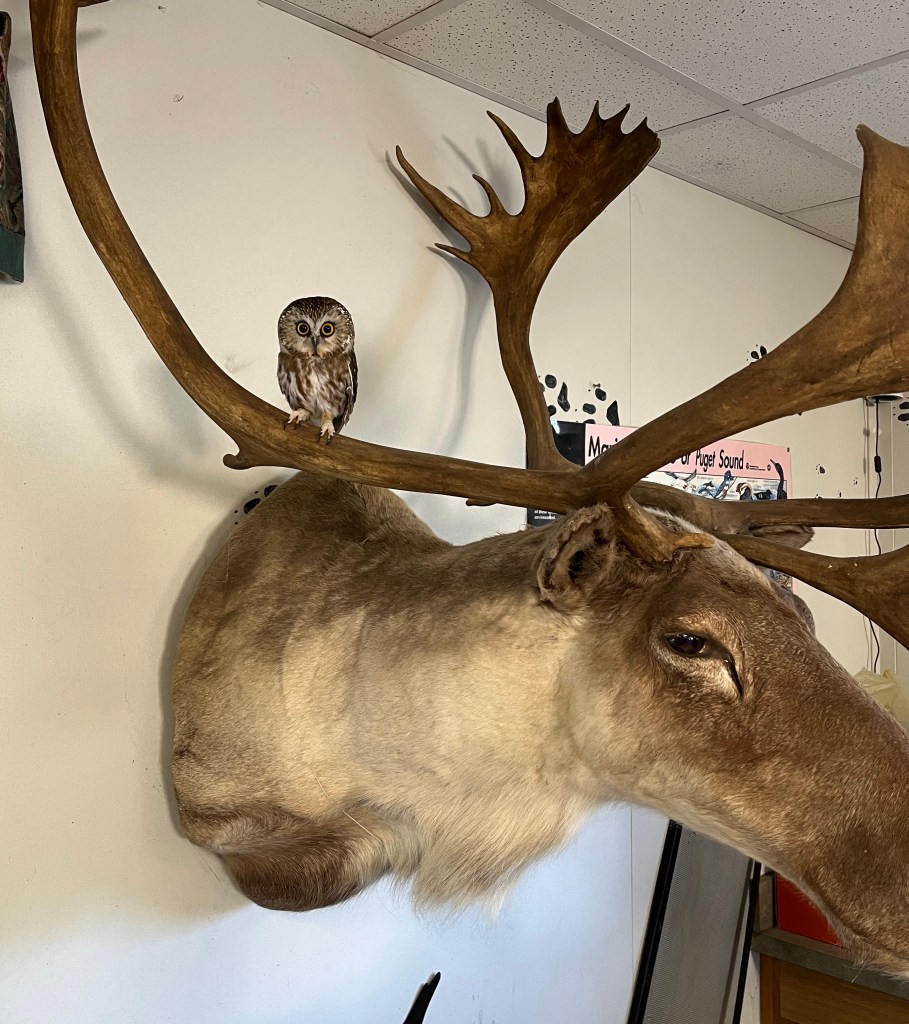
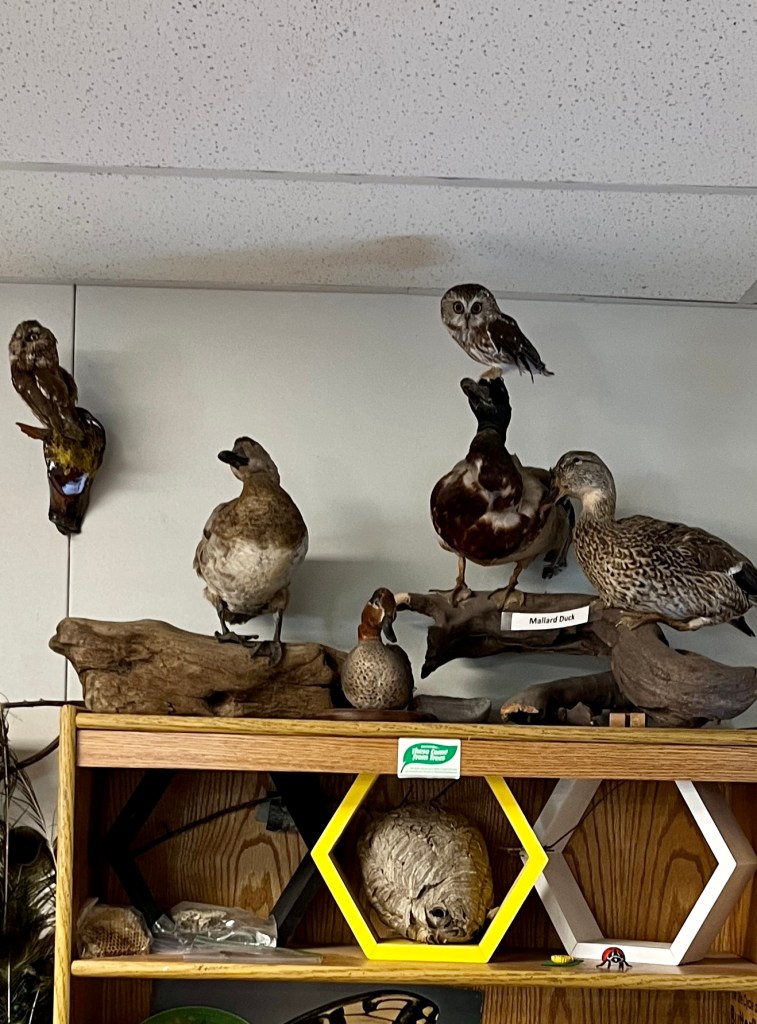
(He yarked up a pellet while sitting on the Mallard’s head, so while I’m sure this wasn’t a relaxing situation for him, he wasn’t so stressed out that he couldn’t take care of his own needs.)

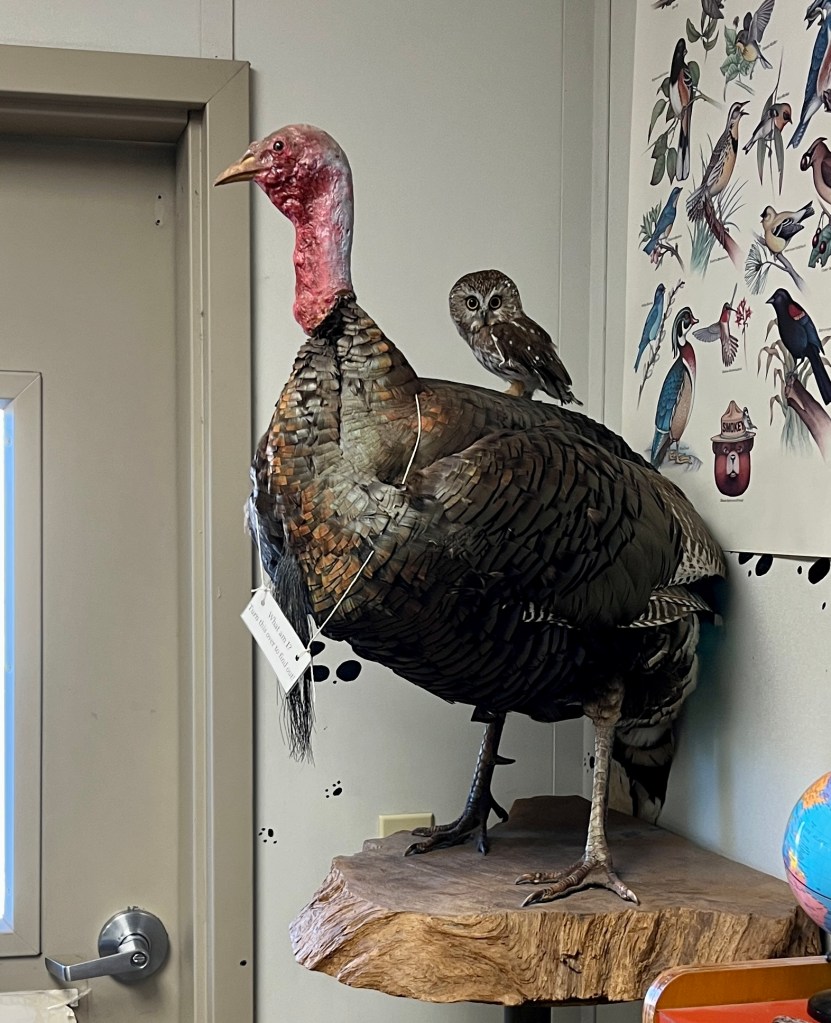
Eventually, after a round robin of the taxidermied mounts and window valances, he got tired and ended up on the floor. At that point, I was able to gently gather him in a towel and move him back to his enclosure.

So yeah, things were a little bit exciting today, in an unexpected way. I don’t want to encourage this behavior — I will have to alter my approach to make sure this doesn’t happen again. But I’m impressed by his ability, and I think it’s time to see about adding a couple of other, higher, perches in his enclosure…

Outdoor Learning Center · Raptors

Basalt… ‘Bee’ for short

One of the most joyous things for a raptor volunteer at the Outdoor Learning Center is to get to meet a new bird. It’s somewhat bittersweet, because we all understand that this is not the natural order of things, and it would be better for everyone if the bird were able to be released.

But by the time the birds get to us, the option to be released has been taken off the table by people who are in a position to know what’s possible: the bird’s rehabilitator and the bird’s veterinarian. When release is no longer an option, places like the Outdoor Learning Center become an option (if space is available).

Saw-whet owl Basalt (recovered from Basalt Rd. in Spokane, WA) injured one of his shoulders in a window strike. His flight is compromised (he cannot gain altitude), and there is some speculation that he may have some mild neurological damage (though it does not manifest in his appearance or movement). He has been in care with his vet for the last several months while we waited for our federal permits and transfers to go through. We welcomed him to the OLC two weeks ago.

We’re in the process of getting used to each other. This morning, for the first time since he arrived, I was able to get into the enclosure to clean his house and add a piece of outdoor carpet to the top of it (he spends a lot of time perching there, so it needs to be cleaned often). He watched me quietly from another platform — no panic, just a desire to not be where I was.

And when I was done working on his house, he headed right back up there.

Basalt, no doubt wishing I would put the phone away and leave.

Lack of panic at my presence, and a quick return to a perch that has been altered — those are good signs with new birds. He recognizes that the enclosure is his space, and even though he was wary of my presence, he seemed to be reasonably sure that I was only there to clean. When I removed myself, he immediately went back to the place where’s he’s comfortable, even though something about it had changed.

Saw-whet Owls are tiny — Basalt weighed 74g when he was transferred to us. For the sake of comparison, Arden (female red-tail) weighed 1,310g this morning.

We haven’t had a long-term resident “pocket owl” since Tilt (screech owl) died a few years ago, so we’re excited to get to know, and work with, Basalt.

Raptors · Thoughts about Stuff

Maxime’s Minion

A couple of days ago, The Raptor Center at the University of Minnesota announced that one of their bald eagles, Maxime, had passed away. She had been at The Raptor Center for more than 20 years. In her later years, she developed severe arthritis that interfered with her quality of life. On May 19, she was humanely euthanized.

In 2016, I had the opportunity to visit The Raptor Center to take a week-long workshop on the care and maintenance of captive raptors. Some of Minnesota’s birds are like ours at the Outdoor Learning Center. That is to say, at least a few of them came into care from the wild, and have ongoing concerns resulting from injuries sustained in the world.

I’ve only ever worked with one bald eagle, and only for a few minutes, and it was at The Raptor Center. It was Maxime.

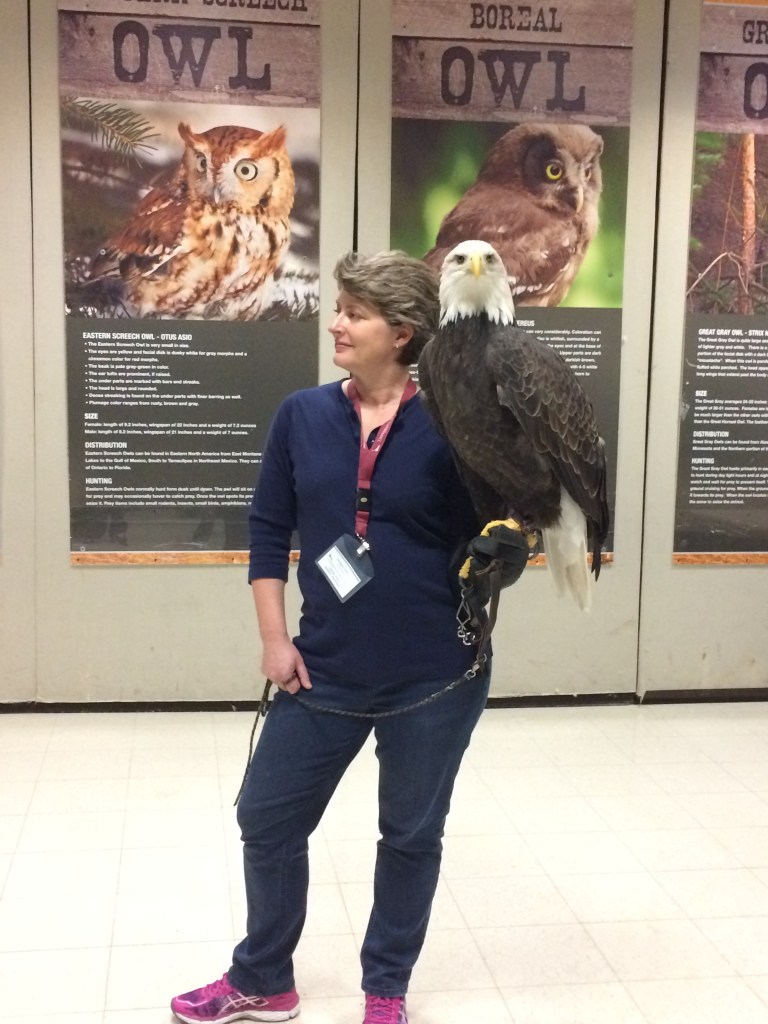
Maxime and Me, 2016

First thing, bald eagles get heavy in that position. I had her on my hip for stability for almost the entire time I worked with her. I was closely supervised by two of her handlers. They were very patient with me, and so was she.

By the time I went to that workshop, I had worked with the OLC’s birds for about 3.5 years, so I had experience working with great horned owls, a barn owl, a barred owl, a screech owl, and American kestrel, a Harris’s hawk, a rough-legged hawk, and a red-tailed hawk. I knew how to keep myself, and the birds, safe during our handling and husbandry sessions.

I knew that raptors aren’t props, pets, or toys. I knew that most raptors aren’t social (unless they’re migrating or nesting), and that “friendship” between our species just isn’t a thing. I knew how to tie a falconer’s knot. The OLC’s facilities are much smaller and less sophisticated than The Raptor Center’s, but we had checked in with other rehabbers and vets, and Fish & Wildlife, to make sure they’re good for the birds. I understood that our goals at the OLC were (and are) habituation, and tolerance.

The most profound thing I learned at The Raptor Center was how to incorporate cooperation into the relationship. The birds are sentient individuals who have preferences, and personalities, and it’s important for those of us who get to work with them to honor those preferences when we can. It’s not always possible, but to the extent that it is possible, it’s our responsibility to try.

These thoughts are still front-of-mind today:

Do not lie to the bird.

Do not try to conceal what’s going on, especially in situations where you know that bird isn’t going to enjoy it (like restraint for medical procedures).

Project what’s going to happen.

Be safe.

Be efficient.

Let the bird recover quietly, without interference from you.

If you’re going to be involved in activities the bird doesn’t enjoy, and you want to be a regular handler of the bird, you have to put in extra time, so time spent trimming beaks and talons isn’t the only time you’re handling the bird.

It’s 2023, and I’m still working on this stuff, with our birds (many of them new since 2016) and other volunteers. It’s aspirational, particularly if a bird came into care as an adult. But I think about it often, and I’m grateful to have had the opportunity to learn it from The Raptor Center, with Maxime.

At the workshop, we broke into groups for some games, and my group was named Maxime’s Minions.