
Confession: I was a Duolingo junkie. Until January 1, 2025 (January 2?)…
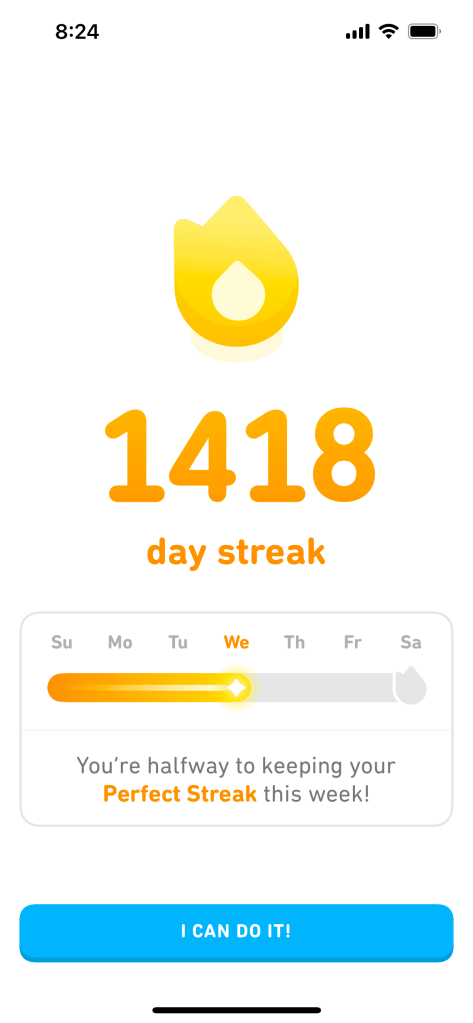
Yeah, so 1,418 days is… almost four years. We’re not talking hours a day or anything, but I’m not sure I’ve ever done anything (optional) on a daily basis for that long.
I’ve seen some criticism re: using Duolingo for language learning. I suppose at least some of it is valid. It’s a fun thing to do, but I think it would be a mistake to rely on it as a sole source for language learning. Am I fluent in Italian? Of course not. That said, I know a lot more Italian than I would if I hadn’t used Duolingo.
My issue(s) with Duolingo involve individual traits that made using it challenging. For example, I do not want to be in competition with anyone else when I’m trying to learn something new; for me that’s a recipe for spiraling into perfectionism. It’s not a good place to be mentally, and frankly, it’s not a good look. (I turned off the competitive aspect of it last year, and my experience improved.)
Being aggressively prompted makes me anxious, so that part of it wasn’t great either. As I was disentangling from the app, I saw that I could have turned that stuff off, so… lesson learned.
Last, when I have any kind of streak going, it can (and did) become more of an obsession than was helpful, particularly when the streak itself becomes the goal. I suspect that if I had had some solid language-learning goals in mind (including conversation and reading comprehension), it would have been a reasonable way to support those goals. But I didn’t, and it was starting to feel… not great.
So, at the beginning of this year, I decided to end it. I cancelled my subscription, turned everything off, and just… stopped.
I’d love to say that it was liberating, but that’s not it. Nobody cared about this streak but me, and I didn’t even care about it all that much. But it had become more of a distraction than I was comfortable with, so it did feel good to end that distraction.
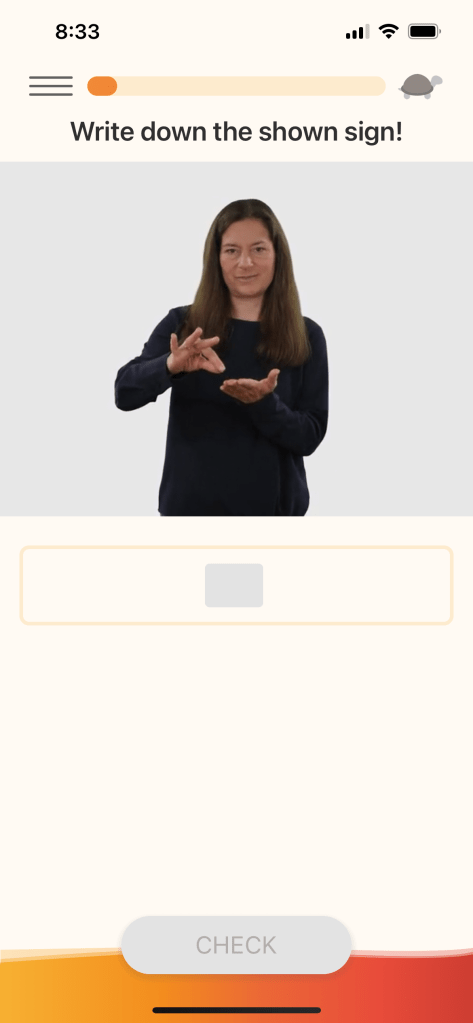
One of the main reasons I stopped using Duolingo was that I want to work on learning American Sign Language (ASL). It’s been on my list of things I want to do for the last couple of years, and last year, I found an app that would allow me to learn some of the basics (fingerspelling, some vocabulary, a bit of receptivity practice), in preparation for finding a class taught by a deaf teacher.
The app: Lingvano


Why ASL? Yes, it’s amazing (watch The Barbie Movie with ASL!), of course, but I have a personal reason: I have no evidence that my hearing will remain intact as I age. Both of my maternal grandparents were profoundly deaf when they died in their late 90s, and I suspect that their hearing loss made their later years more difficult. Granted, it was a very different time — there was a great deal of stigma attached to aging, and the hearing loss that comes with it, so denial was significant for both of them. (One of the harder things about denial is that you have to consistently remind everyone that they’re not speaking clearly, or that they’re speaking too softly.) Hearing aid technology wasn’t great, and hearing aids were both very expensive and very technical. (It’s my understanding that hearing aid technology has gotten a lot better over the last couple of decades, but they’re still both expensive and very technical.) I suspect that neither of them started using assistive technology until their hearing loss was severe, and for a lot of reasons, they were both reluctant users.
I think my hearing is probably fine for a person my age, though I have developed tinnitus in both of my ears (chalk that up to aging, and living with a parrot doesn’t help), and I have a difficult time filtering conversation in crowded spaces. I want to stay on top of those changes, to use assistive technology as I need it, and to become conversant in ASL, so that as I continue to age, I don’t lose access to language and communication. (It’s a generational shift, I think, to consider the loss of language/communication a bigger issue than hearing loss.)
As for the apps, am I replacing one compulsion (Duolingo) with another (Lingvano)? Maybe. (I wouldn’t argue with you if you accused me of it.) Will Lingvano make me fluent in ASL (or even conversant)? No, but that’s not my expectation. My goal is to get through the Lingvano “course” to build a very basic foundation — to be able to introduce myself, to fingerspell with some competency, and to be able to ask (politely!) if the person signing to me can slow down a little bit — and then start looking for an ASL class, so I can work with other learners and qualified teachers.
In other words, I’m using Lingvano in support of broader language acquisition goals.
So far, 400+ days in, it seems like a good investment of time (and money). We’ll see how it goes.
 Carmen Yount